Showing posts with label Church. Show all posts

Why I Became an SGRho...and Why it Matters

I went to college with zero interest in Greek life. Having attended predominately white schools my whole life, I decided I didn't want to join a traditionally white sorority, but my perception of black sororities—the Divine 9, NPHC, BGLOs (why do we have so many names y'all?)—wasn't much better. Without offense to my sister greeks, I just didn't see the hype; I didn't see sisterhood and quite honestly didn't see any "works" that I thought were worth joining one of their organizations. So, I walked on campus without any inclination of joining a sorority.

The shift in this perception happened when both a friend of mine and a cousin of mine crossed Sigma Gamma Rho Sorority, Inc. in Spring 2007. I had never heard of the organization before then. My cousin had grown up surrounded by women of Delta Sigma Theta, so I was shocked (as I'm sure they were too) when I logged on to Facebook to see she had chosen differently. For those not familiar with Greek life, specifically black Greek life, most people become what we call legacies. A legacy is someone who joins the same organization as their parent (or family members). For instance, my grandfather is a member of Alpha Phi Alpha, so are two of his sons (my uncles); they are legacies. Many times you will see a clustering where mom, daughter, sister, granddaughter, cousins, etc. all join the same organization. So I expected my cousin to become a Delta if she became greek. This reveal was the first to make me wonder what Sigma Gamma Rho (SGRho) was about. It is what prompted me to attend the SGRho neophyte (new member) presentation at my own school.

My freshman year of college there were no SGRhos on campus. The neophyte presentation or probate (at Clemson we weren't allowed to use the word probate officially) was the resurrection of the chapter. I didn't know what to expect. At that point I had only been to a Delta and a Kappa show; both of which had a large (for a predominately white campus) number of new members. I was shocked to see that only one person had joined SGRho and was doing a show by herself—I was further shocked that this one person was a friend of mine, one of the first people I met all the way back at orientation, who lived down the hall from me. When you watch 20 people spit information and perform complicated steps it's entertaining, but when you see one person command an audience and do the same thing alone it's mind-blowing. My first thoughts were along the lines of "that takes guts" and "I want to be able to do that."

Now, as I researched the organization and fell in love with the motto "Greater Service, Greater Progress," I didn't think I would actually be doing a show by myself. There were actually a couple mutual friends I thought might also join. However, I agreed with the focus on service and education; I trusted they didn't do anything too crazy because both my cousin and my friend were Christian women I trusted; and I wanted the strength, boldness, and leadership skills that my friend exhibited in her show. So, even though I was the only one who showed up at the interest meeting that next Spring, I pressed forward and I found myself learning just what it took to earn those skills as I, too, stepped out to do a solo performance.

So why on my Christ-centered blog am I telling you about my experience joining a sorority? There are at least two posts on this blog relating the things I learned from joining the sorority and what I thought should be learned in Church communities (you can check them out here and here.) Today, however, I want to focus on that first step. Christians are often asking the question of how to convert a non-believer, and 9 out of 10 times the methods used backfire only to create more non-believers. What "converted" me from not interested in Greek life to being a member of sorority is the same thing that converted countless non-believers during the early church: action.

Anyone can talk the talk. Take a look at the missions of the four sororities that comprise NPHC[1]:
Sigma Gamma Rho Sorority's aim is to enhance the quality of life within the community. Public service, leadership development and education of youth are the hallmarks of the organization's programs and activities. Sigma Gamma Rho addresses concerns that impact society educationally, civically, and economically. Sigma Gamma Rho Sorority, Inc.
Alpha Kappa Alpha’s mission is to cultivate and encourage high scholastic and ethical standards, to promote unity and friendship among college women, to study and help alleviate problems concerning girls and women in order to improve their social stature, to maintain a progressive interest in college life, and to be of "Service to All Mankind". Alpha Kappa Alpha Sorority, Inc.
Delta Sigma Theta Sorority, Incorporated is an organization of college educated women committed to the constructive development of its members and to public service with a primary focus on the Black community. Delta Sigma Theta Sorority, Inc.
Zeta‘s national and local programs include the endowment of its National Educational Foundation community outreach services and support of multiple affiliate organizations. Zeta chapters and auxiliaries have given untotaled hours of voluntary service to educate the public, assist youth, provide scholarships, support organized charities, and promote legislation for social and civic change. Zeta Phi Beta Sorority, Inc.

Did you notice anything? Despite having very distinictive cultures and images in the black community, the mission statements are not that different. Every organization is essentially about service, scholarship, and sisterhood. What makes them different is not the words written on their websites; it's the everyday action of the members in the organization. While I would hope every member read the mission statement of their organization before joining, no one comes to an interest meeting and says they want to join because the mission statment really got to them. It's always something they witnessed. As I mentioned, for me it was the rock solid solo performance that exhibited traits I wanted to have. One of the girls who came after me said she was drawn to us because she saw us recieving academic excellence awards (our chapter maintained a ~3.8GPA average giving us the highest chapter GPA in Greek life for both black and white organizations). Some people talk about interactions with a favorite teacher. Others are impressed with the person who mentored them their freshman year...

SGRho isn't associated with education simply because our founders were educators or because our mission statement says we care about it. We're associated with education because the members of the organization are scholars! I have to scratch my head to start naming sorority sisters (sorors, as we call them in NPHC) who stopped pursuing education after undergrad and I can't think of any that didn't graduate. Most of my sorors have higher degrees and even those who did not become teachers/professors, some form of mentoring or teaching is involved in what they do. We didn't just write it on a piece of paper and then keep repeating it until people believed it, we are out doing it.

This is precisely why the church fails to convert non-believers. Galatians 5:22-23 says "But the fruit of the Spirit is love, joy, peace, longsuffering, kindness, goodness, faithfulness, gentleness, self-control." How often do we show these traits? How many people can say they experienced peace when around a group of "Christians?" How many people can say they truly felt loved (see 1 Corinthians 13 for God's definition of love)? How many people can say they see joy in life of "Christians" or experienced joy from being around these "Christians?" Are we patient? Do we exhibit self-control? Are we kind? Are we gentle? Do we panic with the rest of the world or are we seen to have faith fueled by hope in times of need?

Can you imagine standing in the crowd in Babylon to see these three men refuse to obey the king even though the punishment was death (Daniel 3)? Can you imagine witnessing Daniel praying even though he was told not to and being thrown in the lion's den (Daniel 6)? What about Esther, approaching the king without being summoned and facing the possibility of death? Or Ruth following her mother in law to a strange land not knowing how they would survive? The Bible is full of people demonstrating their faith. They did not knock on people's door and say "Can I tell you about our Lord and Savior today;" they simply lived according to the faith.

6“And these words which I command you today shall be in your heart. 7You shall teach them diligently to your children, and shall talk of them when you sit in your house, when you walk by the way, when you lie down, and when you rise up. 8You shall bind them as a sign on your hand, and they shall be as frontlets between your eyes. Deuteronomy 6:6-8 NKJV
When the your actions (hands) match the words (thoughts from your forehead), you are truely sealed and it is then that others will endeavor to follow the path you've chosen.

As Sigma Gamma Rho turns 100 years old, I reflect on how I became a member 12 years ago and how I influenced others to join. I also reflect on those same questions as it pertains to my faith in the Most High God. Do the things I claim to believe match my actions? Do I live life such that people interact with me and think "wow, I want to be like that, I want to learn how to do that?" I hope so.

References and Footnotes

  1. The mission statements of the other three organizations were taken from their national websites. I couldn't find a mission statement for Zeta Phi Beta on their national website, so I substituted a paragraph from their page on the history of the organization which clearly demonstrates what the purpose of the organization.


The Problem With Church Folk: Presumption Over Relationship

#QTNA: Does presumptuous unsolicited advice ever go over well?
Not too long ago, I received a message (via a social media platform) from a woman who attended the church I used to attend in Florida. The message didn't contain any text—not even a greeting—just a link to a video clip of a sermon.

For context, I've had a total of maybe two conversations with this woman, all very brief and to the point. Nonetheless, I thought perhaps it was a profound word that she just had to share, so I clicked it... It was a man preaching about singleness. He started out saying that God "doesn't give companions, He gives helpers," and then went into a spiel about people wanting a significant other but not working. His example being that Adam was busy naming the animals when God decided to create Eve. I didn't get past that part.

Aside from thinking "wtf" (yes I thought that, see footnote below), the following are a few thoughts that popped into my head:
  • Did you send this because you think that I need to hear this?
  • If so, are you implying I am a person that wants a spouse but isn't working?"
  • How would you know if I want a spouse?
  • Actually, how do you know I don't have a spouse[2]
  • Why would you send me this?
  • Did you send this to other people?
As I mentioned, this woman and I have never had a real conversation. For all she knows, I could have a boyfriend. I could be engaged. Throw in the fact that we haven't spoken since before COVID started and I have been in a totally different state for 8 months: I could be married for all she knows. It is very presumptuous of her to assume not only that I am single, but that I also need help with my singleness (as though it is a disease in need of curing).

After simmering down a bit, I cut her a little slack on the presumption of singleness as I've probably mentioned it on my YouTube channel/podcast before, though I don't know if she follows either. I decided to give her the benefit of the doubt and assume she does. However, that didn't suddnely make the message less bizarre.

There are three types of "work" the man in the clip could have been referencing: physical, spirtual,or emotional. We have physical jobs we do in this world to earn money to pay pills; this is one form of work. There is spiritual work we do both on ourselves and for the Kingdom; this is another form of work. Lastly, there is emotional work that many require to heal from childhood traumas... What type of work was he referencing?

It doens't matter what type of work the man was referencing because this is where my lack of relationship with this woman shines clearest. Literally, the hardest thing about dating is making time for it. I work full time as a software engineer and prior to relocating, also volunteered as a mentor for college women in STEM. I worked with an organization called BOLD Justice to hold elected polictions accountable and fight for a better community.[3] I was in leadership for our young adult ministry and a Sabbath school teacher for the youth class. I have this blog, a podcast, and a YouTube channel dedicated to the Most High God. I have also seen a therapist about past traumas concerning racism in my childhood (as well as for anxiety in grad school). If that's not working, I'm just going to have to be single and lazy cause I can't add much more to my plate.

The thing is, she wouldn't know any of this because we've literally never had a meaningful conversation! (And contrary to the fact that I'm pretty open on the blog, podcast, and YouTube channel, I don't use social media as a diary).

Perhaps she meant well, but I'll never know because she didn't communicate (and I refuse to ask, because I'm too blunt and liable to say something I shouldn't say). A simple message with the link would have done wonders. For all, I know she could have been sharing it with me because she thinks I'm still a youth leader; she could have been hoping that I would pass the information on and it may have had nothing to do with me personally. It's possible that if I'd listened further, the person said something I echoed in one of my posts and maybe she sent it because she thought I'd agree. However, I'll never know because she didn't articualte her thouhgts.

The problem with most Christians—specfically church folk—is that instead of developing and cultivating relationships that lead to organic conversations, they pass out unsolicited advice based on assumptions they've made. Even as a follower of Christ who has done much work on my temper and controlling my tongue, I had quite a few choice words in response. I imagine a younger, less mature version of myself and I see exactly why young people don't want anything to do with the church. Unfortunately, when people behave like this, they're claiming to represent The Most High God (which is both bearing false witness and using God's name in vain) and it doesn't just turn people away from the church but away from God Himself. Let's not continue this.

Footnotes

  1. Many Christians subscribe to the belief that "cursing" is wrong. While I would agree that you should watch your mouth on the basis that you may offend ofters (Romans 14), I would like to point out that there is a difference between a "curse" word and a cursing a person. Simply speaking negatively about a person is cursing a person. Shouting an expletive when you drop something on your foot is not cursing a person; there really isn't any difference in screaming the f-word vs. ow in this situation. So while I strive to keep my vocabulary clean and am mindful of how I use my words toward (and about) others, I often think "wtf" and see nothing wrong with it.
  2. There are several people at that church that I had known for a year or two (I mean I had actually had conversations with!) that ended up having spouses and I didn't even know. While I disagree with the belief, many in that church believe jewelry to be a sin and therefore a large portion of them don't wear wedding rings. Thus, it's equally plausible that while I was attending the church, I could have had a whole husband she wasn't aware of. Throw in the fact that I haven't seen this woman in person (nor had a conversation with her) in over two years and I could have met someone and gotten married in that time.
  3. BOLD Justice (Broward Organized Leaders Doing Justice) is a coalition of religious communities that research problems in the community—such as treatment of homeless people, care for mental health and the elderly, uneccessary arrests, and more), then work with elected official to implement solutions to said problems. While I was there, the main issues worked on were providing stable housing for those struggling with mental health, creating civil citations to reduce the number of arrests for minor infractions (particularly for youth), and ensuring all nursing homes have generators and are inspected so that the elderly are provided with safe living spaces.

Out of Touch: Issues with White Christianity

"If a man say, I love God, and hateth his brother, he is a liar: for he that loveth not his brother whom he hath seen, how can he love God whom he hath not seen?" 1 John 4:20 KJV The Church does this often, and that's a problem.
There's a particular ministry that I started listening to back in 2011 that really helped me in my spiritual journey. They have a plethora of sermons and articles about Biblical truth that answered many of the questions I had as a young believer. I am greatful for their ministry, but that doesn't mean I haven't noticed a fatal flaw in it as well.

Last night, they kicked off a series that I thought might be interesting so I set my alarm and made sure to tune in to YouTube in time to catch the broadcast. The pastor was only moments in when he mentioned dressing up like pilgrims and "Indians" as a kid, associating it with the quintessential American experience. He followed that up with the backstory of why the pilgrims came to America, and doubled down on the heroism of the pilgrims by asserting their bravery for traveling to the undeveloped "New World." In the midst of this narrative he casually repeated what people would have been saying about America: "there are cannibals and savages there; you could be eaten!" As though that weren't cringey enough, he continued down this theme of glorifying the pilgrims with a phrase similar to "we are pilgrims passing through the Earth."

It was at that point that I had to stop listening. I want to try to provide some balance and discussion about this issue, because I see it often, and it does more harm to the Kingdom of God than I believe those who perpuate it realize.

Meeting Halfway

Let's start with the fact that none of what this pastor was saying was untrue. At 33 years old, it is true that if you dig through my mother's photo albums you will in fact find a photo of 3 or 4 year old me at my preschool dressed up as a Native American. He was not wrong in the assumption that most people his age had that experience as a child or that many would relate to that sentiment. What is wrong with the statement is that there is no acknowledgement of growth.

First, the pastor refers to indigenous tribes as "Indians" without any indication that this is an incorrect term. This would be like him refering to black people as "Coloreds" or "Negros"—can you image a pastor standing before the people saying "We all gathered around to watch the Negros play sports when we were kids"? Yes, I know, pilgrims and Native Americans sounds weird to the ears because we're used to the phrase "pilgrims and Indians," but that brings me to the second gaffe in his sermon.

Each of us starts life in ignorance. As I said, I too grew up in the era where it was normal to dress up as a Native American (particularly once Disney release Pocohantas and people were dressing up specifically as her for Halloween[2]). However, 33 year old me is aware that this is disrespectful and could be likened to black face in terms of how someone from an indigenous tribe might feel. If I were to show a picture of myself from childhood partaking in the activity, I would acknowledge my growth from that point in my life until now; I would point out that even though it was common practice then it's not acceptable now. This is the major issue with the sermon in general, lack of awareness or acknowledgement.

The pastor is probably right that people in England viewed America as a place were there were "savages" and "cannibals"—it is factually correct in stating that is how Europeans felt about the native population. Again, what he said isn't wrong, but the way he said it was so casual and the reason he was able to say it so casually is because he is removed from the situation. The words are not offensive or hurtful to him because they were not aimed at his people. To him this is simply a piece of history that everyone already knows. In fact, he may have mentally assumed people knew it was wrong, but he didn't verbalize that the way Europeans saw Native Americans was both inhumane and un-Christianly.

Out of Touch

How is it that I, as a black person, can listen to the sermon and instantly feel uncomfortable for my Native American brothers and sisters, but this white pastor remained oblivious? How is it that I, as a "lay person," can see how this would turn people away from the gospel, but an ordained pastor cannot?

In many cases, pastors deliver sermons that probably have a profound meaning hidden in there somewhere, but it is lost by the insenstivty surrounding it. This particular sermon was on the fulfillment of prophecy in the arrival of the pilgrims to America, which is actually a profound topic. Knowing the symbolism of Revelation, I saw exactly where he was trying to go with the sermon and that message is what made me interested enough to tune in. If I didn't already know that symbolism, I'm not sure I would have saw where he was going and the whole point would be missed.

Minorities, and people who are able to understand the minority point of view, are leaving the body of Christ because the gospel is buried under this type of rhetoric. We fail at representing Him when we behave this way and we fail to introduce Him to others when we behave this way. There will be a lot of people explaining to the Most High that their disbelief in Him was caused by our ignorance and mishandling of the gospel and He's going to hold us accountable for that.

The Fantasy of it All

I could stop right there, but there's one more thing that pastor said that is mixed up in this. We spend a lot of time distancing ourselves from this world and focusing on the Kingdom to come (I was actually reading about just that before the sermon![3]). In truth, we are Biblically commanded to do so. We can find evidence of this Biblically. While both Paul and Yeshua/Jesus instruct us to be respecful of government (Matthew 22:21; Romans 13), we see both men (along with Daniel), disrupt the govenment when it conflicts with God's kingdom (Matthe 6:24; Acts 26; Daniel 6). The Bible clearly instructs us to store our treasures in Heaven, not on earth (Matthew 6:19-21). In truth, the Bible supports the statement that this is not our home; we are just passing through (as the pastor said). I even have a podcast episode where I echo a similar sentiment about us merely being ambassadors for the Kingdom as opposed to citizens of the U.S. (or whatever country your citizenship is with).

However, there's a tiny flaw with the way we opperate after internalizing this belief: we leave the world to crash and burn. Yes, we know that it will eventually crash and burn literally, but has God called us watch the world plummet into darkness, or has He called us to be lights in the darkness (Matthew 5:14)? Often, though, we let our focus on the spiritual to allow us to forget that there are people in need physically amongst us.

In my podcast episode Christianity and Climate Change, I touched on the fact that despite the fact that Adam's given role at creation was to take care of the earth, the Church has nothing to say about the topic. We aren't promoting lifestyles that produce less waste, concious purchasing (re: buying from companies that are not harming the planet in the production of their products), or conservation of resources (e.g., not wasting water, fuel efficent/electric cars). Yes, I know that this earth will be destroyed, and a new purified earth will take its place (though increasingly, I wonder if this verse is meant literally or spiritually--that's another blog post though). I know that this earth is doomed, but does that mean it's ok to help sabotage it? If we aren't cultivating and exemplifying behaviors that protect and care for our home now, how are we suddenly going to be able to do so in the Kingdom?

The same conundrum exists with issues of diveresty and socio-economic disparity. If we are unable to make all feel welcome in our midsts on this earth, how will we learn how to foster an inclusive society in Heaven?

References & Footnotes

  1. 2CDBN Tv. "America's 11th Hour with Scott Ritsemal". YouTube. November 26, 2021
  2. This is not an endorsement of Halloween either. Please see my post Halloween for more on that topic
  3. Jeremy Myers. "Meeting Physical Needs to Get at the Spiritual". Redeeming God"; visited November 26, 2021

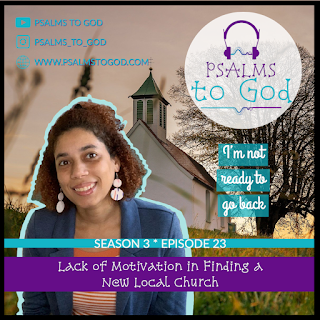
Lack of Motivation in Finding a New Local Church

Are you ready to go back to Church? I'm not.
He has told you, mortal one, what is good;
And what does the Lord require of you
But to do justice, to love kindness,
And to walk humbly with your God?
Micah 6:8 NASB

Truth is, I'm not super motivated to find a local church. In this video I'm talking about 4 (and sort of 5) reasons why I haven't been particularly motivated to find a church here in TX.

Important Verses to Remember

  • James 1:27 - Defining pure and undefiled religion
  • Micah 6:8 - Our responsibilities as believers
  • Exodus 12:38 - The Mixed Multitude joining Israel
  • Leviticus 19:34 - The treatment of strangers in Israel
  • Galatians 3:8 - Race, gender, etc. should not effect how a person is treated within the Body of Christ
  • Galatians 2 - Peter and Paul disagree (there will always be disagreements)
  • How Real Church Should Look

    Church is not a building. It's the people of God and the community they build. I've been blessed to experience what real Church looks like and from this environment I was able to truly able to grow in Christ.
    They were continually devoting themselves to the apostles’ teaching and to fellowship, to the breaking of bread and to prayer. Acts 2:42 NASB

    The first Century church, as described in Acts, did life together. They didn't just see each other on Sabbath for a few hours; they ate meals together, laughed together, cried together, sold their belongs to support each other, and most importantly, worshiped together. Luckily, I've had friends like this my whole life, which I credit as part of the reason I've been able to develop such a strong relationship with God.

    In my teenage years, the spiritual aspect of these friendships was spearheaded by adults. So while my friends and I maintained a relationship similar to the first century church, we weren't actively cultivating our relationship with God. It wasn't until recently that I met a group of people I could truly live this experience with. It was life changing, and I wish every Christian could have that opportunity.

    References

    1. Adorned by Adanna Website
    2. Styled by Jah Instagram

    Why I Miss the Segregated Church

    Sometimes God has a message for the 1 and we're the 99 that's left behind.
    As children we are taught to be tolerant and inclusive. It is in our very nature (well, for most of us at least) to reject the idea of being exclusionary. Yet, not quite a year ago, I found myself deeply missing the segregated churches I grew up in. I missed Negro Spirituals and Black History programs. I missed how black pastors related the trials of the Israelites to the trials of black people today. I missed the fact that the people at city hall fighting for justice where the same people sitting in the congregation. I missed the unity that comes from shedding some aspects of diversity.
    There is neither Jew nor Greek, there is neither slave nor free, there is neither male nor female; for you are all one in Christ Jesus. Galatians 3:28

    The Straw That Broke The Camel's Back

    Last May, after the death of Ahmaud Arbery, Breona Taylor, and George Floyd, mayhem insued. I don't mean the riots. I mean the conversations between members of "the church." We were 2 months in to COVID, and where the church was already struggling to maintain meaningful communication, the fracture of race and culture became truly apparent. It felt like every day some non-black church member was saying something insensitive. Leadership was quiet and when those of us with a short fuse (like myself) chose to speak, we were repremainded. The ire I felt culminated with me blurting out that I no longer wanted to attend a multicultural church and removing myself from all church communication.

    I thought I was reacting in the moment. I thought a month would pass, and the feeling along with it. I thought I didn't really mean it...

    Months passed, and to my surprise, I ended up in a few more heated conversations. I didn't feel any different, and realized I actually do miss attending an all African-American church.

    The History of Racism and the Church

    The western church (re: Catholicism and it's offspring, known as Protestantism) is responsible for racism. Europeans twisted the curse of Canaan into a non-existant curse on Ham and attempted to legitimize the mistreatment of Africans based on this fradulent interpretation. From there, we saw "devout" Christians torture, maime, brand, rape, and otherwise dehumanize black people. From Europeans whitewashing the people discussed in the Bible during the renissance, to white Americans refusing to let blacks worship in the same spaces, to the KKK, racism and Christianity in America are almost synonymous. I did a three part series going over some of this history along with my personal experiences last year. I'm linking them below instead of repeating myself.

    Previous Blogs on Racism in the Church

    The Colorblind Church

    Instead of admitting to the role white America has played in racism, there is a push to leave it in the past. Instead of white pastors openly admitting that the white man pictured in churches and homes accross the world is not Christ, they defend those who don't want to part with the tradition of breaking the second commandment to honor some random European man. Instead of addressing white flight, pastors ask minority congregants to make sure they invite their white friends. Instead of uttering a truth that might offend one group, we stick to sugar coated messages that don't challenge anyone. And while churches are fighting desperately to create these diverse congregations to show they are colorblind, black youth are leaving God becuase the message they need to hear is too much for the white people who put us in this position in the first place.

    A Lesson In Colorblindness

    I've known for a long time that homes owned by black people appraise for less than similar homes owned by whites. We're not going to derail the post by getting too deep into that (I'm sure you're already confused as to why I brought it up, just go with me for a minute). If you're curious about the validity of my statement, read up on some of the recent incidents involving the appraisal of black homes.[1][2]

    I'm currently in the process of selling my house to move and for the first time, had to assess the "blackness" of my home.

    There was a portrait of an African woman I painted with my friends that needed to come down, as well as a professional painting of a black Southern Belle. Of course any and all personal photographs of me or my family. Just as I'd tucked away all the photos, a book on my bookshelf caught my eye: How Long Til Black Future Month Scanning the shelves, I saw enough black literature to open a library. So I started removing the obvious ones: Is Christianity the White Man's Religion, Roll of Thunder, Hear My Cry, The Autobiography of Malcom X, a collection of African folk tales, everything by Toni Morrison, Zora Neale Hurston, Nikki Giovanni...

    As I struggled to move the heavy box to the garage, I passed my DVD collection. I stopped to remove the obviously black DVDs from the shelf: The Boondocks (season 1-3), The Babershop, First Sunday, Eve's Bayou, For Colored Girls..., Drumline, Stomp the Yard... It was too many to fit in a box. So I loaded the self back up, and stacked Disney movies in front of them. Then placed a decorative candle on the now empty Disney shelf.

    I thought I could finally relax, so I went to my bathroom to take a relaxing bath. There I was greeted by my bonnet, the various oils and moisturizers for my afro-textured curly hair, the wide tooth comb and wooden-handled brush... This was obviously the bathroom of a black woman.

    Every where I looked my house testified to the fact that I am black. Even after removing as much as I could, there are still things that made it into the staging (e.g., the poodles that decorate my house which are actually a reference to my sorority, which has non-black members but is a historically black sorority). In the end, I could not completely separate who I am from the space I live in without getting rid of everything.

    As I stared at the house that only represented a fraction of me, I felt empty and unsettled. It no longer feels like home and wash day means I have to trek all the way to the garage to dig out my deep conditioner. As I reflected on the inconvience, I realized my life is like this house.

    One of the posts above talks about my experience with racisim in the church, but it doesn't detail all my experiences with racism—we might need a book for all of that. Nonetheless, these traumas, hurts, lessons, and conversations have shaped who I am. It is from these experiences that I have the boundaries I have. It is from these experiences that I react the way I do. It is from these experiences that I value this or that. It is from these experiences that this passage hits differently than when you hear it...

    When I approach the throne of YHWH, the Most High God, those expereinces come with me. YHWH was there when I watched my grandmother panic over the possibility of white men taking our family's land. YHWH was there with me when little white kids were calling me a n*****. YHWH was there with me when my Asian aunt told me she was glad her half-black daughter didn't have hair like me. YHWH was there when my white teacher said I'd end up pregnant or in jail because that's what happens to black youth. YHWH was there the Asian department chair told me I didn't have what it took to earn a PhD (and YHWH walked across the stage with me when I earned that PhD). YHWH was there when I learned to love my hair. YHWH was there when I learned not to shrink myself into a corner trying to blend into the whiteness around me. YHWH understands my blackness, my womanness, my Americanness, my singlness...

    And sometimes YHWH has a message just for me.
    “What do you think? If any man has a hundred sheep, and one of them goes astray, will he not leave the ninety-nine on the mountains, and go and search for the one that is lost? Matthew 18:12

    Leaving the 99

    A few weeks ago, I watched a sermon that spoke straight to my heart.[3][4] Seven men and women of God spoke on the last seven things Christ said before He died on the cross. Each message was tied into justice and the black experience here in America. The speakers were black, the audience was black, and the message was specifically for black people. It ranged from a reminder about forgiveness, to a warning about protecting our spirit. There were messages and nuggets of truth that anyone could (and should) appreciate, but the core of the message was a message of hope for the down troddened souls of black America. It was a reminder that YHWH is our YHWH too.

    As I listened to the sermon, I realized that was what I was longing for. I wanted to hear that message that God had for me in my time of need. Contemporary churches love to sing "Reckless Love" and belt out the line about Him leaving the 99 to search for the one, but we often forget we're not always the one. In a society where certain groups of people are being mistreated, abused, and belittled, those groups are the people God is going after. He's going after the black person longing for justice. He's going after the people in the LGBT community with questions. He's going after the Asain person scared to step out of their house. He's going after the women who have been abused. He's going after the immigrants who were locked in cages. He's going after the refugees that survived brutal wars. He's going after the poor/homeless, the drug addict, the orphan, etc. And that message may hurt your feelings—it may hurt my feelings—because maybe we didn't do enough for that group, maybe we are part of the reason that group is hurt... But it's not about us, it's about the message for the one.

    Finding Love in Diversity

    Most of my friend circles have been characterized by diversity. Even here, in South Florida where 90% of my friend group is black, there is diversity—some are Jamacian, some Hatian, some Bahamian, and some Canadian. It is amazing to learn about different cultures and to experience the world through someone else's eyes. It is equally heartbreaking to expreince trauma in the midst of people who refuse to acknowledge the trauma (or the history of that trauma). You cannot obstruct the message for the one because the 99 aren't ready to admit the church has played a role in the suffering of the one. A year later, and I understand where that longing is coming from. I can't say what type of church I'll seek out when I move in 3 weeks, but I can say I want to belong to a body that isn't afraid to leave the 99 to go after the one.

    References & Footnotes

    1. Julian Glover. "Black California couple lowballed by $500K in home appraisal, believe race was a factor". ABC 7 News. February 12, 2021
    2. Debra Kamin. "Black Homeowners Face Discrimination in Appraisals". The New York Times. August 25, 2020
    3. Mount Sinai Church. "The Seven Words of Justice". YouTube. April 2, 2021
    4. No one is perfect; we're all human. If I gave a sermon, my human-ness would creep in as well. The only reason I'm pointing out this particular nitpick is because it's about doctrinal truth and since I'm "promoting" the sermon, I need to point out what I disagree with doctrinally. Good Friday is tied to the pagan Easter. Passover was last week (March 28). Even if the Bible asked us to celebrate "Good Friday," based on Biblical doctrine, it should occur before Passover and would have been last week.

    Come Out Of Her My People

    The final episode of the season is here! In this episode we talk about participation in the Church body and leaving apostate churches (Revelation 18:4)
    1After this I saw another angel with great authority coming down from heaven, and the earth was illuminated by his splendor. 2He called out in a mighty voice:

    It has fallen,
    Babylon the Great has fallen!
    She has become a home for demons,
    a haunt for every unclean spirit,
    a haunt for every unclean bird,
    and a haunt for every unclean and despicable beast. 3For all the nations have drunk
    the wine of her sexual immorality,
    which brings wrath.
    The kings of the earth
    have committed sexual immorality with her,
    and the merchants of the earth
    have grown wealthy from her sensuality and excess.
    4Then I heard another voice from heaven:

    Come out of her, my people,
    so that you will not share in her sins
    or receive any of her plagues.
    5For her sins are piled up[e] to heaven,
    and God has remembered her crimes.
    6Pay her back the way she also paid,
    and double it according to her works.
    In the cup in which she mixed,
    mix a double portion for her.
    7As much as she glorified herself and indulged her sensual and excessive ways,
    give her that much torment and grief.
    For she says in her heart,
    “I sit as a queen;
    I am not a widow,
    and I will never see grief.”
    8For this reason her plagues will come in just one day—
    death and grief and famine.
    She will be burned up with fire,
    because the Lord God who judges her is mighty. Revelation 18:1-8 CSB

    Episode on defining "Church"
    • I think of the Church as the body of Christ
    • This doesn't have borders, but generally we look for people within a certain distance
    • I still consider people I am able to call and pray with or talk to about spiritual matters part of my Church family
    Personally I prefer smaller Churches where you can get to know people and develop ginuine relationships
    Christianity is about doing life together!

    If majority of the Church is in apostasy, it's time to leave
    Matthew 10:14 says to move on if people don't want to hear the truth
    Now is the time to leave behind the god of the world and start following the God of the Bible; it's time to focus on truth and turn away from man made traditions.
    Then I heard another voice from heaven:

    Come out of her, my people,
    so that you will not share in her sins
    or receive any of her plagues.
    Revelation 18:4 CSB

    Subscribe on YouTube

    I recently started a YouTube channel![2]
    Season 3 will be visual in addition to the usual format!
    Currently I am doing a Bible Study series that includes my note taking

    References & Footnotes

    1. This is the last episode of the season, but God willing, I will be back in January 2021

    Church Hurt

    Church hurt turns a lot of people away from God when it's actually us that are the problem. In this episode, I want to talk about how "Christians" have turned people away from Christ because we don't follow the words of Christ.
    1Then He said to the disciples, “It is impossible that no offenses should come, but woe to him through whom they do come! 2It would be better for him if a millstone were hung around his neck, and he were thrown into the sea, than that he should offend one of these little ones. 3Take heed to yourselves. If your brother sins against you, rebuke him; and if he repents, forgive him. 4And if he sins against you seven times in a day, and seven times in a day returns to you, saying, ‘I repent,’ you shall forgive him.” Luke 17:1-4 NKJV

    What is the difference between corporate church hurt and personal church hurt?
    In this episode I talk about "corporate" and "personal" church hurt. When I say corporate church hurt I'm referring to things that apply to the institution of organized religion. These offsenses may not affect a person personally, but are issues with the religion as a whole. Personal church hurt occurs at a specific church between specific people.

    Corporate Church Hurt Examples
    • Racism -- Protestant "Christians" behaved outside of the word of God in their practices of slavery and murder of the indigenous population in America.[1]
    • Sexism
    • Sexual Assault/Pedophila
    The issue is that people are claiming to be followers of God, but not living according to His Word and lying about His Word (re: all the images of Biblical figures as white people)

    Admitting that you have angered someone is part of the process. Some times you have to pray to be compassionate and let God do the resolving of the situation.

    Here are a few verses to meditate on:
    • James 1:19-20
    • Ephesians 4:2-3
    • Romans 12:17-21
    • John 13:34-35
    • Proverbs 27:5-6
    • Matthew 5:38-42
    • Proverbs 19:11
    "I like your Christ, I do not like your Christians. Your Christians are so unlike your Christ." -Gandhi[2]
    The I Feel Statement—I feel _____ when you _____ and I would like you to _______.

    References & Footnotes

    1. In the episode, I called out Protestants because that's who shaped most of the US's history, but Catholicism has played a a role in spreading white supremacy as well.
    2. Soutik Biswas. "Was Mahatma Gandhi a racist?". BBC News. September 17, 2015

    Councils & Creeds

    Pure and undefiled religion before God the Father is this: to look after orphans and widows in their distress and to keep oneself unstained from the world. James 1:27 CSB

    After the first century, the Church continued to have disagreements. When the Constantine declared he was a Christian, the Church became mainstream. With that change, there was an influx of people into the Church that may or may not have been truly converted—Christianity was now "hip." It was during this time that modern Christianity took form.

    The Roman religion I mentioned and failed to pronounce is Mithraism. It was the dominate religion until the legalization of Christianity.[1] Much of the sun worship that has crept into the modern church comes from Mithraism.

    The first 7 ecumenical councils
    1. The First Council of Nicea (325ad)
    2. The First Council of Constantinople (381ad)
    3. The Council of Ephesus (431ad)
    4. The Council of Chalcedon (451ad)
    5. The Second Council of Constantinople (553ad)
    6. The Third Council of Constantinople (680–681ad)
    7. The Second Council of Nicaea (787ad)
    Important decisions from the First Council of Nicea include a stance against Arianism (the belief that Jesus is a created being) and officially abandoning Passover for the pagan holiday of Easter.[2]

    The Council of Laodicea was held in 364ad. Although it is considered a minor council by scholars, the major decision to "move" the Sabbath to Sunday was made.[3][4] (Note: only God can transfer holiness, we will dive deeper into this in the next episode)
    Christians must not judaize by resting on the Sabbath, but must work on that day, rather honouring the Lord's Day; and, if they can, resting then as Christians. But if any shall be found to be judaizers, let them be anathema from Christ. Canon 29 of the Council of Laodicea[4]

    References

    1. Reinhold Merkelbach. "Mithraism". Encycolpædia Britannica. February 5, 2020
    2. "First Council of Nicaea". Encycolpædia Britannica. November 29, 2019
    3. What happened at the Council of Laodicea?". GotQuestions.org; visited July 8, 2020
    4. "Synod of Laodicea (4th Century)" New Advent; visited July 8, 2020
    5. "First Seven Ecumenical Councils". Wikipedia; visited July 8, 2020

    The Jerusalem Council

    After Paul and Barnabas had engaged them in serious argument and debate, Paul and Barnabas and some others were appointed to go up to the apostles and elders in Jerusalem about this issue. Acts 15:2 CSB

    A more in depth study of Acts 5 can be found in the post "Acts 15: Disagreements."

    Conflict #1: Paul vs. Barnabas
    Barnabas and Paul get into an argument about the company they keep. In determining who they should bring with them to minister to the churches they'd planted in Acts 13-14, Paul had serious doubts about Barnabas' choice. The issue was so important to the two that they chose to go separate ways! We're often told to mend things with our Christian brethern and the ideal outcome is reconciliation. When we say reconciliation, we thing that means that we agree and move forward in the same direction, but clearly does not. Both men were confident in their decision and neither was willing to compromise. Note that this doesn't mean they walked away from the disagreement hating eaching other! This is a prime example of agreeing to disagree. Remember, who each took with them on the journey was a spiritual matter—hence their refusal to back down—but it wasn't a salvation matter.

    Do Paul and Barnabas remain friends?
    After the pair disagree, what happened? The Bible isn't explicit on how they left each other, and we don't see them travel together afterward. This has lead some to believe that they were never reconciled. However, there is Biblical evidence that they were at least neutral toward each other afterward. For one, Paul affirms John Mark (the person they disputed) in his letters (Colossians 4:10 and 2 Timothy 4:11). Paul also speaks of Barnabas in 1 Corinthians 9:6, lumping themsleves together among the apostles and without any negative commentary.

    Conflict #2: How Are Gentiles Saved?
    In chapter 15, the Church has to answer the question "what is required of a Gentile to be saved." Some said they had to be circumcised and keep the law of Moses, others disagreed. The apostles discussed the matter and determined that they would ask of 4 things for converts: abstain from meat offered to idols, abstain from things strangled, abstain from sexual immorality, and abstain from blood. There is still a lot of confusion about was is and isn't required of believers (please see my post on Acts 15 for more detail), but the important thing to remember is that the leaders were discussing what it meant to be considered saved.
    9Know ye not that the unrighteous shall not inherit the kingdom of God? Be not deceived: neither fornicators, nor idolaters, nor adulterers, nor effeminate, nor abusers of themselves with mankind, 10Nor thieves, nor covetous, nor drunkards, nor revilers, nor extortioners, shall inherit the kingdom of God. 11And such were some of you: but ye are washed, but ye are sanctified, but ye are justified in the name of the Lord Jesus, and by the Spirit of our God. 1 Corithians 6:9-11 CSB
    To bring it in to a more modern context, think about participating in a Church ministry. The church I grew up in does not allow non-members to do certain things. As such, you must be a baptized member of the church ("saved") to be eligible to participate. The Jews considered Gentiles unclean, so they felt the Gentiles needed to "do" something to be worthy of their company. Later in the chapter James mentions that the law of Moses is taught in every city, but when you put things in context, you have to realize that "unclean people" could not go listen. Further, the act of being saved is the act in which we allow the Holy Spirit to cleanse us (see 1 Corinthians 6:9-11). It doesn't mean we won't struggle or commit sin after that point, but that we have surrendered to the Spirit, allowing God to determine what is right or wrong. The council's decision simply removed the tempation of false gods from the Gentile's equation because you cannot serve two masters. Once they were able to fully surrendered to God, they could be receive the Word with "clean" ears, from there the Holy Spirit would do the convicting.

    The Council
    In light of the disagreement, leaders of the Church gathered together to discuss a solution. The Church is supposed to be on one accord, and as such needed to talk out the issue and come to a consensus. In this council, each side presented their arguements and eventually a decision was made. This method of deciding doctrine was one of the few authentic practices kept by the Catholic Church. Throughout history, many church councils have been held, each shaping modern Christianity for better or worse—we will discuss this in greater detail in future episodes.

    Acts 15: Disagreements in the Church

    Let's agree to disagree is easy when it comes to trivial matters, less easy when it comes to matter of the heart/morality, and even less easy when it comes to salvation. Today, there are over 30,000 Christian denominations,[4] mainly due to doctrinal disagreements. This issue existed all the way back to the very beginning of the Church. This chapter gives us two examples of disagreements within the church—one of which doesn't seem to get resolved.

    Circumcision & the Law

    After the church agreed to allow Gentile converts, they quickly ran into the problem of what was required to be a true convert. Descendents of Abraham were required to be circumcised. Israelites by birth were circumcised on the 8th day, but converts were circumcised at conversion. We see in Genesis 34 that this process in adult males rendered them incapcitated. Can you imagine hearing the gospel, believing it, and then someone telling you to be saved you have to get circumcised? The Pharisees—presumably those who had converted to Christianity—were suggesting exactly that. Many of the early Church leaders disagreed with this stance, including Paul, Barnabas, Peter, and James.[1] Which poses a theological question: are you still saved if you don't circumcise yourself.

    To resolve the matter, the leaders met to form a consensus. Peter argues that when God gave the Gentiles the Holy Spirit, He purified their hearts through faith. Peter also asserts that the Pharisees were asking the Gentiles to do something they couldn't even do (keep the law of Moses). After Peter's argument, Paul and Barnabas support his points by revealing the miracles God has worked for the Gentiles, proving His presence is there without circumcision. James concludes the discussion by outlining 4 things they should require of the new converts: abstain from meat sacrificed to idols, sexually immorality, meat from strangled animales, and blood.

    So the Law is Gone?

    There are two (and a half) interpretations of the council's decision. Some believe that this completely abolishes the laws of the Old Testament, leaving only the four requirements outlined by the council. More commonly, people divide the laws of Moses[2] and claim only a subsection of the laws were abolished. The remaining state that this isn't about abolishing laws but emphasizing what was important for salvation, particularly to the Gentiles.

    It's one of the more confusing matters. Remember scripture has to work in harmony, and it needs context, so lets work through some of that.

    After this council, when Paul writes to the Church in Corinth,[3] he says this:
    9Know ye not that the unrighteous shall not inherit the kingdom of God? Be not deceived: neither fornicators, nor idolaters, nor adulterers, nor effeminate, nor abusers of themselves with mankind, 10Nor thieves, nor covetous, nor drunkards, nor revilers, nor extortioners, shall inherit the kingdom of God. 11And such were some of you: but ye are washed, but ye are sanctified, but ye are justified in the name of the Lord Jesus, and by the Spirit of our God. 1 Corinthians 6:9-11 KJV
    Paul's statement lists traits that we are not to revel in. We'll save the specifics of the verse for when we talk about Corinthians but the basic concept is that these traits are seen as unrighteous. Many of them fit within the four things spoken against by the council, but some of them (thieves, covetous, drunkards, revilers, extortioners, etc.) do not. Theft and coveting are covered by the 10 Commandments, for those who argue the 10 Commandments was not part of the Law of Moses but is the Law of God. However, guidlines about drunkenness and extortion are given in other parts of the law, parts that can't be distinguished from the Law of Moses.

    In Acts 15:21, we can find clarity. James argues that each of the cities has someone who preaches the law of Moses (re: they have access to that information). There was a stark difference between the Gentile converts and the Jewish converts: one was converting religions and learning a new diety, while the other was simply relearning how to interpret old scriptures. The Jews who joined the Church were already well versed in the law and circumcised, there wasn't much that needed to change as they assimilated into the body. Gentiles, however, still needed to learn the laws. Those who were pro-circumcision, didn't want to include the Gentiles in the synagouge or the church without them being both circumcised and fully aware of the law. The opposing side proved that circumcision wasn't nessecary as God was already showing His Spirit to the uncircumcised Gentiles. Learning the law is something the Holy Spirit could handle once they surrendered their life to God. When the Holy Spirit filled them, they could go listen to the law read in thier respective city and gain that knowledge. However, it was not neceassary for them to keep that law in order for the Holy Spirit to enter their life, this is why we see Peter and Paul arguing that the Gentiles have felt the Spirit even though they are uncircumcised.

    The Importance of these 4 Things

    The Law of Moses references the entire Torah (Genesis - Deuteronomy), so out of all those laws, why did they settle on these four? These four laws focus on what this particular group would have been struggling with. The ways of Roman/Greek pagan deities were in direct contrast to the God's way. Abstaining from these behaviors took the Gentiles out of their pagan lifestyle (and comfort zone), opening the door for the new way of life. Pagan rituals included sacrifices, consuming blood, and sex.[5] By putting these behaviors behind them, they were also announcing their allegience to God and welcoming Him as the authority in their life. Remember, the Jews already worshiped YHWH, they were just accepting Christ as the Messiah. In contrast, the Gentiles were learning and accepting a whole new lifestyle. They needed to cut the cords with their pagan gods to truly receive to the Holy Spirit.

    Please note an important fact here. The Jews were used to salvation being dependent on an action on their part (circumcision, sacrifice, righteous behavior, etc.), but Christ gave us grace. In shutitng down the idea that circumcision was necessary, the apostles killed the idea that you had to earn salvation. Salvation was given without any of this. However, the behavior of a saved person is should align with the Holy Spirit. It won't be perfect, but if the Holy Spirit is leading, things considered ungodly will automatically be lessened and eventually removed from your life. This means all the things God despises, eventually you sould too, and He doesn't change.

    Paul vs. Barnabas

    When I think of disputes between individuals, I think of reconciliation, and when I think of reconciliation, I think of being on one accord. Many a Christian would have you to believe that "loving from a distance" is not Biblical, but when you look at Paul and Barnabas' disagreement at the end of Acts 15, you might not agree.

    Paul and Barnabas agree that they should revisit the churches they have planted among the Gentiles (see Acts 13-14), and begin making plans to for their second journey. However, during this planning phase, they disagree about who should join them. Barnabas wants to bring John Mark, whom Paul considers a deserter. The disagreement between the two is so great that Paul and Barnabas split up. Barnabas takes John Mark and embarks on his on journey, while Paul travels with Silas.

    There's a lot to pick apart here, from how they handle the disagreement to the implications of the disagreement.

    Forgive and Forget?

    When we talked about forgiveness at a Bible Study, we got hung up on the concept of forgive and forget. Forgiving is hard in itself, but we questioned whether we should truely forget some actions. For instance, you may forgive a pedophile but I don't think anyone would be comfortable with them leading the children's ministry. Similarly you may forgive a thief, but you probably wouldn't be so quick to nominate them for treasurer. We discussed these types of scenarios at length, trying to determine what truly constituted full forgiveness and what was the correct way to proceed—can a recovering thief never be the treasurer?

    Paul seems to agree with us that there has to be some sort of process to get from point A to point B, because he is adamant that John Mark should not go with them. John Mark's crime appears to be abandonning them on a previous trip. No only does Paul not back down to suggest John Mark has changed, grew, or should otherwise be given a second chance, but the Church seems to support Paul's decision (Acts 15:40).

    Agree to Disagree

    Paul and Barnabas end their dispute by agreeing to disagree. Paul didn't cave to Barnabas' pressure and Barnabas didn't gave to Paul's. They both stood firm in what they believed in—a valuable lesson to those who've been made to feel that they have to cave in to keep the peace. What's really important about their decision to go separate ways is that it doesn't hurt their relationship. In 1 Corinthians 9:6, which takes place at a later time, Paul refers to Barnabas without malice. We also see in Colossians 4:10 and 2 Timothy 4:11, Paul seems to have reconciled with Mark as well. These men did not let their pride or ego get in the way of furthering God's mission. In fact, the disagreement worked for the glory of God in that separately, they covered more territory!

    References

    1. We actually see Paul get into the same disagreement with Peter in Galatians 2 (which assumably predates this council).
    2. Some people divide the Torah into the 10 Commandments (which they call the law of God) and everything else (which they call the law of Moses). Others divide it into ceremonial vs. moral laws—and even within that what is categorized as what can be different.
    3. There are plenty of references online that have dates for the when events happen in the Bible, but I recommend having a Chronological Bible in your library. The one I have not only orders the books of the Bible based on timeline, but it interleaves passages from different books according to the timeline. For example, the instead of giving you the gospels as separate books, you read the account of events from each author back to back. A word of caution, some dates are disputed so you should still research the information presented to you for yourself.
    4. "Denominations". Christianity Today; visited June 30, 2020
    5. Geoffrey Stone. "‘Sex and the Constitution’: The ancient Greeks". The Washington Post. March 21, 2017

    Promoting a Culture of Inclusion

    Defining Inclusion

    Ironically, my job just did a survey about diversity inclusion and one of the definitions given for an "inclusive environment" was the ability to be your authentic self. Even after desegregation, black people were considered unprofessional if we wore our hair in it's natural state. Our way of talking, our style of dress, etc., are often dubbed as "ghetto" and labeled inappropriate. There's a long standing tradition of black people "turning off" their identity to fit in to white spaces. The multicultural church I attend often plays CCM during service, and will even sing from the catalogs of Tasha Cobbs or Travis Greene, but they've never brought in Christian rap. In fact, on one occasion I searched for a song they'd sung in service and found there is a "rap" verse in the song that they just skip over. Most Christians, regardless of race have framed their entire view of Christianity and holiness out of Eurocentric ideas. In doing so, we force people to hide the ethnic parts of themselves to fit in. To have a truly inclusive church, it's not just about being polite to those entering the building. We have to make people comfortable being themselves.

    In high school, most of my close friends were white because I was often the only black person in my class. I didn't talk to them about racial things I experienced because I didn't think they'd understand or care (and it's embarrassing). My Asian friends didn't tell me about the things they were experiencing. It wasn't until we were out of college that we started truly expressing ourselves to each other. I felt alone in high school, but in the past few weeks, the people I was afraid to be my authentic self around in high school were the first people to condemn what was happening and ask if I was ok. How can I be your sister in Christ if I don't know you?

    Because our society is broken, there are issues specific to each culture. There are things immigrants go through that I do not. There are injustices being done to people in the Asian and Hispanic/Latino communities that I may not understand. An inclusive church does not bury these topics to avoid offense, but instead seeks to educate its members on how to assist those effected.

    It is important that we create an environment where people feel comfortable bringing their whole self into the relationship. Regardless of race or class or gender, you should be able to tell me something is bothering you or that you're excited and I should be able to cry with you or join you in celebration. You shouldn't have to clam up because the topic makes me uncomfortable and I shouldn't be clueless to your experiences in this world.

    Subconscious Racism

    In the U.S. we talk about racism as though it's a black and white issue (I mean that literally and metaphorically), but it's a lot more complex than we want to talk about. Most people think as long as they aren't using racial slurs and actively hating people who are different than them, everything is ok. Unfortunately, there's subconscious racism. Subconscious racism is a bias toward what society has told us is good versus bad. We do it without thinking.

    The mind is a lot like a computer, or rather computers are modeled after the mind. In computer science there is a field called machine learning, in which the goal is to train the computer to make decisions based on data. This is how Netflix suggests movies for you to watch. If you watched every RomCom in the database, there's a high probability that you'll like the newest RomCom. Similarly, if the only people you've ever seen with tattoos have been inmates, you will start to associate tattoos with criminals. That's how our brains work.

    The problem is that our circles and the media are biased, so our brains are making correlations with corrupted data. Let's compare my own circle to national stats for an example. About 4% of the U.S. population has a PhD,[1] but probably 60% of my friends have a PhD. About 5% of the U.S. is Asian,[2] but closer to 70% of my coworkers are of Asian descent. The numbers in my personal experience are skewed; if I didn't look outside of my circle, my perception of the world would be off. When I was in college, I did an internship in which I met a girl who had never had a conversation with a black person before. She was from the middle of nowhere Iowa and everything she knew about black people was what was taught to her by white teachers or shown to her on TV. I have a whole series on the blog about how the media portrays black people so we won't derail the conversation to get into details. The bottom line is that regardless of your race, everything you consume is shifting your perception of the world and we live in a Eurocentric society. Each of us is conditioned to think European ideals are the standard (if you are unfamiliar with this, please take this time to research The Doll Test[3]).

    These ideas are deeply implanted into our brains. Most of the time, we don't understand the complexities of them ourselves. No matter what our religious affiliation is, we bring this baggage with us. If we live in a Eurocentric society, it makes sense that people giving their lives to Christ may have a Eurocentric ideas. They bring those into the Church.

    Eurocentric Worship

    A major ramification of subconscious racism is the Eurocentric style of worship. Conservative churches, both black and white, often consider things associated with black culture to be unholy. In the conservative black church I grew up in, we weren't allowed to have drums during worship. Amazing Facts, a conservative 7th Day Adventist organization, condemns Christian rap (and Christian rock).[4] Shouting, praise dancing, and many other forms of ethnic worship styles are often seen as inappropriate.

    Usher Gloves

    If you attend an old black church, you've probably see ushers in their white uniform, with white gloves. Did you ever wonder why? There was a time when black and white people did attend church together. Black people sat in the balconies, segregated from the white people, or served just as they would on the plantation. The black people that served during the service were ushers. While ushers are responsible for many things, their biggest role in the service is collecting offering. It is rumored that white people didn't want to risk touching a black hand or have those black hands touching the money/collection plate, so they made the ushers wear gloves. The discipline and stance of ushers that was kept when black people formed their own churches likely stems from the internalization of how they were treated and expected to behave previously.

    Music

    The first time I went to multicultural church and they started singing, my first thought was "oh, this is why we have separate churches." If we're being honest, music is cultural. How you grow up influences your taste in music; this isn't always racial, but statistically, you'll probably find more black people favoring genres such as Jazz, R&B, Reggae, Hip-Hop/Rap, etc. and more white people favoring genres such as Country, Bluegrass, Rock, etc. One person may feel the Spirit when they hear hymns, another when they hear Gospel, and another when they hear CCM. Unfortunately, like Amazing Facts, many ministries have dubbed whole genres of music inappropriate simply because it isn't their cup of tea. The Amazing Facts website uses Philippians 4:8 to justify their stance, yet one could literally take the words of a hymn and make it into a rap song, after all rap is just poetry over a beat. By condemning Christian rap they imply that either the music is unholy or that there is something unholy about the way the words are expressed. If I were to contact someone from Amazing Facts about this, I'm sure they would say it has nothing to do with race, after all they condemn Christian rock too, and I believe in their conscious mind and heart, its true. They don't have a problem with black people. They have a problem with people who don't fit into their definition of Christianity, which is based on European standards. Despite being predominately associated with white culture, if you trace the roots of rock, it was inspired by R&B and black culture.[5] Many churches (black churches included) still shy away from ethnic music in service because of the way they've been taught Christianity.

    History in the Church

    The black Baptist church I attended always celebrated Black History Month. We did Black History Month plays and speeches the same way people put on productions for Easter and Christmas. Black churches do this because our history isn't taught in school. If we're already bringing pagan holidays like Easter and Christmas in to the church, why can't we celebrate the history of different cultures in our churches?

    The multicultural church I attend is proud to have a multi-ethnic pastoral staff and to host sermon series with pastors from various backgrounds, but we don't anything for Black History Month, Asian & Pacific Islander Heritage Month, Hispanic Awareness Month, etc. What if we allowed people to speak to their unique experiences? What if we learned about their unique experiences in Christianity? What if we made it a priority to understand other people? What if we invited people to truly share themselves with us?

    References

    1. "About 13.1 Percent Have a Master’s, Professional Degree or Doctorate". Census.gov. February 21, 2019
    2. "QuickFacts". Census.gov. July 1, 2019
    3. "The Significance Of “The Doll Test”". Legal Defense and Educational Fund, Inc; visited June 4, 2020
    4. "FAQs". Amazing Facts; visited June 4, 2020
    5. Greg Kot. "Rock and roll". Encyclopædia Britannica. April 4, 2019

    DON'T MISS

    Book Review,Food,Testimony
    © 2022 all rights reserved
    made with by templateszoo