Showing posts with label Matthew. Show all posts

Matthew 1-2: The Birth of Christ

Discussion of the lineage and birth of Christ as well as the star signifying His birth and the gifts given to Him.

Lineage

Matthew starts off with the lineage and birth of Christ. Lineage was a major deal to the Israelites, in fact, in most societies bloodlines are very important. Several verses in the Bible articulate that the life of a person is in their blood. Our blood defines us—no, I'm not referring to blue blood or other worldly definitions. I'm referring to the very cells within our blood. The DNA contained in these cells is like a computer program that controls how we interact with the world around us. I don't want to get sidetracked, so if you want to know more about the life in the blood, check out my podcast episode on the topic.[8] The main point I'm making here is bloodlines are more than just wealth and worldly power passed down generation to generation, it's also Godly covenants passed from seed to seed. Because of this, the Jews meticulously kept up with bloodlines, searching for the promised seed (Genesis 3:15) that would defeat Satan.

The lineage presented in Matthew traces back to Abraham, and identifies Christ as a legitimate descendant of David with rights to the throne of Israel. That would be the end of the story, except Luke gives a very different lineage. There are many theories about why this is, which I've already covered in my post Harmonizing the Gospels: the Lineage of Christ. I don't want to be redundant, so I'm not going to go into detail about the lineage. I will say that there are multiple theories discussed in the post, and I fall in the camp of those who believe one lineage is that of Joseph (a legal justification for Christ's lineage) and one is that of Mary (a true bloodline lineage). Nonetheless, the early Church did not contest the written accounts, nor cry foul about such a glaring mistake; therefore regardless of why they are different, I am confident that the disciples and early church understood both of these lineages to be correct and valid.

Christ is Born

Matthew doesn't go into as much detail about the birth of Christ as Luke, but he does give us a few details to think about.

Mary & Joseph

When I look at the scenario of Mary and Joseph, I can't help but imagine this in today's crazy society. Can you imagine preparing for a wedding and finding out your fiancee is pregnant and you've never slept with her? While, I suspect how people external to the situation saw it would vary in our time (considering that premarital sex has been normalized, most would just assume it was Joseph's baby), the internal struggle each person experienced would have been very similar in today's time.

Today, Mary probably wouldn't worry about "slut shaming" or being condemned for having sex outside of marriage (depending on what circle she traveled in), but she would still be faced with the impossible task of convincing Joseph she hadn't been unfaithful. How crazy does it sound to say "I promise I'm a virgin...An angel told me I was carrying the Son of God, that's why I'm pregnant"? That probably sounded crazy then too. The only reason Joseph believed her is because the angel visited Joseph as well. Had Joseph not been visited by the angel, he would have left her. Sticking with the culture of Mary's time, her parents would have been furious if she'd gone to them; an illegitimate pregnancy would eliminate most decent prospects in marriage. Mary had to step out on faith that God would work things out. We aren't told how many people knew this information or how deep into the pregnancy she was when she got married, so we don't know how people around her reacted (if they reacted at all) but when she accepted what the angel told her, she had to accept the possibility that she would never be accepted into society again.

From the text, we know that Joseph was definitely not convinced by whatever Mary said (and who could blame him!?). It took an angel confirming that matter (as it should) for him to settle in to his role, but what is interesting is how Joseph intended to handle it. He could have been bitter and nasty about it; he could have made a spectacle of her. However, Joseph had resolved to handle the issue discreetly. This is a clear depiction of the man God chose to raise His son.

Both Mary and Joseph's reactions to the situation are indicative of why God chose them in the first place. Aside from being descendants of David to fulfill the prophecy, both bore the fruit of the Holy Spirit. God was entrusting this couple with His only son; He had to know they would make good parents.

The Wise Men & The Star

One of the most popular aspects of the birth of Christ is that of the star. One thing I could never understand as a child was why only the magi saw the star. Herod seems utterly baffled at its appearance and can't determine how old the child is based on the information. If the star was abnormally bright, wouldn't Herod have seen it and remembered? The cartoon-ish way Christians portray this element as a large gleaming star hanging above the manger is ridiculous and clearly false. A more likely scenario is that a sign played out in the heavens (see Genesis 1:14 for the purpose of the stars to be signs).

In some translations, the men who come to see Christ are the "magi" in others they are called "wise men." The original Greek is μαγοζ, which was a term applied to "the wise men, teachers, priests, physicians, astrologers, seers, interpreters of dreams, augurs, soothsayers, sorcerers, etc." in that culture. We can already see why some translators favored the term wise men, a term that could encompass many of the other terms. A compelling theory I've run across leans toward them being "astrologers."

I use the term astrologers loosely because there's context that needs to be applied here. In Matthew's day, anyone who studied the stars in any form or capacity was an "astrologer." Today, we have to terms for people concerned with the stars: astronomer or astrologer. Astronomers study the movement, behavior, life/death and inner workings of stars, while astrologers seek to connect those things to how events play out on earth. If you grew up in church you were probably taught that astrology is bad. I want to challenge that notion a bit wit this Bible verse:
14Then God said, “Let there be lights in the expanse of the heavens to separate the day from the night, and they shall serve as signs and for seasons, and for days and years; 15and they shall serve as lights in the expanse of the heavens to give light on the earth”; and it was so. 16God made the two great lights, the greater light to govern the day, and the lesser light to govern the night; He made the stars also. 17God placed them in the expanse of the heavens to give light on the earth, 18and to govern the day and the night, and to separate the light from the darkness; and God saw that it was good. 19And there was evening and there was morning, a fourth day. Genesis 1:14-19 NASB
In Genesis 1:14 we are told that God created lights in the sky not just for seasons and tracking time, but also for signs. So there is some relevance to "reading the stars." The thing to keep in mind is that it is not the stars making things happen. The stars are merely testifying to what God has already spoken (Psalm 19). Keep that in mind as you read what I'm about to type.

There is a theory that the star referenced in Matthew 1 is actually the behavior of a star over time (there are also theories about conjunctions of planets forming a really bright star, but that goes back to my question of why no one else seemed to notice). Many cultures have a zodiac and while they may ascribe slightly different names, the constellations are fairly consistent. One of the signs in the zodiac is Leo, the Lion. The lion was connected with the tribe of Judah and is connected to the Messiah (Who is the Lion and the Lamb). The brightest star (well, star system, but it appears as a single star to the naked eye) in Leo is called Regulus which comes from the Latin rex and means "little king."[1] Also in the sky is the planet Jupiter, which isn't a star but does appear as a light in the sky. Jupiter is named after the Roman god who was "king of the gods;" it was regarded as the king planet. Some who've studied the stars have identified interesting interplay with these three signs in the sky around the time of Christ's birth. This behavior is as follows: Jupiter (the king planet) passes through the lion near Regulus (the king star), goes in to retrograde (which mean it appears to go backwards, passing Regulus in the opposite direction), then crosses Regulus again. This pattern would have taken quite some time to complete, but the wise men would have seen the king planet "crown" the king star in the lion. It's not hard to see how that would be interpreted as the Messiah (the lion of Judah) being born (little king); especially if you were familiar with prophecy and understood the 70 weeks of Daniel. If you dig into it, though, there's even more with Virgo (the Virgin), Venus (the mother star), Mercury (the child star), and prophecy given in Revelation by John... If you're interested in this theory, I found a great video on YouTube that goes in to more detail (he goes into a lot of other things too; I encourage listening to the whole series, but I am linking the part specific to the star at the nativity). This theory explains why no one else noticed the star.

Herod and the Massacre of the Innocents

When the wise men get to Jerusalem they tell Herod why they're in town, and Herod is not happy to hear that the true King of Jerusalem has been born. Here I want to insert some context that will be reoccurring theme in the gospels: the Jews thought the Messiah was going to restore Israel to the splendor of Solomon. Essentially, they expected something much closer to what we expect for the second coming. In Herod's mind, this child would grow up and overthrow both him and the Roman government that gave him authority. This is why from birth, Christ was seen as a threat to power.

Herod, being led by Satan, does the same thing Pharaoh did while Israel was awaiting a Savior in Egypt (Exodus 1): he kills all the children. This fulfills a prophecy given by Jeremiah 31:15. During this atrocity, Mary, Joseph, and their newborn baby hide in Egypt, which also fulfills a prophecy (Hosea 11:1). Please note that the family hiding in Egypt follows the pattern started with Abraham of hiding in Egypt when there is trouble in Israel.

Nazarene

Before we end the chapter, we are told that Joseph and his family settle in Nazareth to fulfill a prophecy that the Messiah would be a Nazarene. There are two major things to point out about this revelation.

First, the reference to this prophecy appears to be lost. Many theories have been ascribed to what is being referenced here. Some believe there was a book that has not been added into our canon. Others believe it is a reference to Him being despised (Isaiah 53), because in John 1:46 we learn that the residents of Nazareth are not held in high esteem.[3][4]

Second, Nazarene is not the same as Nazarite. I've heard many people confuse this. Christ was a Nazarene because He was raised in Nazareth (similar to how I would be considered a Carolinian because I was raised in the Carolinas). Christ did not take a Nazarite vow, as evidenced by His consumption of wine (Numbers 6; Luke 7:34-35).

Frankincense, Gold, and Myrrh

The 3 gifts given to Christ are very fitting. Each represents a part of the Messiah's purpose. Frankincense was associated with the priests (Leviticus 2). Gold was associated with kings (). Myrrh was associated with death (Mark 15:23).[5][6][7]

Also, a common misconception is that there were 3 wise men; this assumption comes from the fact that they gave 3 gifts. It could just as easily been ten wise men or two wise men—the Bible does not specify that each man gave one gift, only that there was more than one man and 3 gifts given.

References

  1. Larry Sessions. "Meet Regulus, The Lion’s Heart". Earth Sky. May 1, 2020
  2. "Solar System Exploration: Jupiter". NASA; visited July 2021
  3. "The Messiah would be called a Nazarene". Jews for Jesus; visited July 2021
  4. "What prophecy is Matthew 2:23 referring to regarding Jesus being a Nazarene?". GotQuestions.org; visited July 2021
  5. Eric Zielinski. "Gold, Frankincense & Myrrh – The Truth About Their Significance". Natural Living Family. June 23, 2020
  6. Clint Pumphrey . "What Are Frankincense and Myrrh?". How Stuff Works. October 16, 2018
  7. "Why Did the Magi Bring Gold, Frankincense and Myrrh?". Biblical Archaeology Society. June 15, 2021
  8. Ree Hughes. "The Life is in the Blood". PSALMS to God. June 23, 2021

Harmonizing the Gospels: The Lineage of Christ

The lineage of Christ is crucial to Him fulfilling prophecy. Is it possible that the Bible contradicts itself on this fundamental point?
The lineage of Christ is given by Matthewm disciple of Christ, in Matthew 1:1-17 and Luke, a contemporary of Paul, in Luke 3:23-38. This is given to us to substaniate Christ's bloodline and prove Him to be a legitimate heir to the throne of David. Not only was this significant from a legal standpoint for the kingdom of Judah, but also a requirement of the Messiah foretold in prophecy (Jeremiah 23:5-6; Isaiah 11:1) Although Luke doesn't start with this information the way Matthew does, both present it early in their writings becuase of it's importance. If either man was presenting a man from the Tribe of Benjamin as a the long awaited Messiah, everyone would know the person was not the Messiah.

Is it a Contradiction?

Unfortunately, Matthew and Luke didn't give us the same lineage. Biblical scholars have been debating since who knows when about why these lineages are not the same. Let's dive into it.

Differences

One difference between Matthew and Luke is that Luke goes all the way back to Adam, while Matthew only goes back to Abraham. This, of course, is merely preference. From David back to Abraham (and in theory to Adam), Matthew and Luke are in 100% aggreement. After David, however, the list is very different. Luke traces the lineage through David's son Nathan, while Matthew traces the lineage through David's son Solomon. There's minor overlap, such as Zerubbabel and Sheatiel, between David and Joseph, but there's definitely more difference than similiarity. One possibility is that one person is presenting a legal lineage, while the other is presenting a blood lineage. For some this may be confusing but I'd like to use my own family to show how this happens in modern day. We'll start with some easy examples and then get to some more complex ones.

One of my cousins' mother died in childbirth. Her father wasn't present so my cousin was raised by her maternal grandparents. Legal custody of the child belonged to the grandmother. Any inheritance my cousin received came straight from her grandparents. If they were royal, the succession would have been grandparent to grandchild with no mention of the mother even though the mother is part of the blood lineage. If we call my cousin Anna, her mother Bonnie, and her mother Connie,[1] a blood based lineage would look like Connie begot Bonnie and Bonnie begat Anna. A legal lineage would look like Connie begot Anna.

Now let's make it a little more complex and use the case of my own mother. When my mother was 12 she went to stay with her aunt and ended up staying there for the rest of her childhood. My great-aunt became her legal guardian and often if you hear me reference my maternal grandmother, I am actually speaking of my great-aunt, not my biological grandmother. My mom became my great-aunt's only daughter, so in turn my mom inherited all her clothes, shoes, jewelry, etc. when my great-aunt passed away. A legal the lineage went from my great-aunt to my mom. Lets call my great grandmother Dorothy, my biological grandmother Elaine, her sister (my great-aunt), Francine, and my mom Gertrude.[1] A legal lineage would look like Dorothy begot Francine and Francine begot Gertrude, while a blood lineage would look like Dorothy begot Elaine and Elaine begot Francine.

It's quite common where I'm from for families to adopt children within the family, but there's also the possibility of adopting a stranger. I have an aunt (by marriage) who was adopted by people completely unrelated to her. In that case you would see no overlap when comparing her legal versus blood lineage. For those with this lived experience, it's easy to see how both David's son Nathan and David's son Solomon could be listed as ancestors. Remember I gave you short examples from my family's modern history, if we tried to track it back centuries, who knows how many times switches like these could have occured? Something my family has in common with the Israelites is surviving captivity. I don't know what turmoil happened during the Babylonian, Greek, and Roman captivities of Israel, but chattel slavery in the United States allowed families to be sold and separated such that there were probably many babies raised by non-blood relatives. I say this to say if you were able to trace down my information and compare the legal record to the blood record, likely it would be just as convouluted.

Paternal vs. Maternal Relatives

Another idea put forth is that Matthew is giving Jesus' paternal lineage while Luke is giving his maternal lineage. There are two Biblical things that support this. First, in Luke 3:23, Luke prefaces the lineage in calling our attention to the fact that Joseph is Jesus' legal father but not His real father by saying it's commonly thought that Joseph is the father of Jesus. When my great-aunt died, my blood aunts and uncles showed up, and many people who grew up with my mom were confused because it was commonly held that my great-aunt was her mother. Second, if we look at Mary's reaction to the angel announcing her pregnancy in Luke 1:26-36, Mary doesn't question the assertion that her son would be of the lineage of David. If an angel came to me and said I was pregnant and my child would be the long lost heir to the throne of France, one of my first questions would be "but the baby isn't French?" It is very possibile that Mary was a descendant of David herself.

Now, things get really interesting. Technically speaking, Israel was a patriarchal society. Usually the first born son is who inherited glory from the father. Notable exceptions include Seth, Isaac, Jacob, and Solomon, who were not the first born sons, however they were still sons. With that line of thinking, many would ask how can Jesus be a legitimate heir to the throne of David when He doesn't have an earthly father? Just as people do today, men could legally adopt a heir and leave their inheritance to the son they've chosen, which would still allow Joseph to pass an inheritance down to Jesus. However, what's more interesting is that though rarely discussed, women could pass on inheritances too. In Numbers 26, we learn of Zelophehad who only had daughters, and in Numbers 27 they are given the right to inherit their father's property. In these verses, it is declared that a woman with no brothers who marries into her own tribe, is able to inherit from her father. When Jesus is crucified, Mary has a sister present with her (John 19:25), but the Bible never mentions Mary having a brother. It is very possible the Mary is descended from David, married into her own tribe, and inherited the lineage of David to pass to her first born son. This would also explain the need to prove Davidian descent on both sides.

What do I Believe?

What do I believe? I actually think both scenarios are true. I think Luke is providing us with Jesus' lineage through Mary while Matthew is providing it through Joseph. I think there is still some interplay of legal versus blood lineage as seen in the overlap of Shealtiel in both lineages. Matthew says Jeconiah is the father of Shealtiel, but Luke says Neri is the father of Shealtiel. Both Shealtiels have a son named Zerubbabel, making it seem as though this is the same person. In this regard, it's seems that one person is telling us who legally was the father of Sheatiel (whether like scenario 1 that I gave above or like scenario 2), while the other person is telling us who is the blood father of Sheatiel. Judging by the fact that all the kings of Judah are listed as descendants, it seems like the most likely candidate to be the legal lineage of Christ.

The Obvious Discrepancy

One thing I want to point out for skeptics, or for those who often engage in conversation with skeptics, is the logical problem of this being an actual contradiction. Archeologists have found many scrolls containing the story of Christ, some even claim to be the work of disciples such as Peter and Thomas. Beyond that there is the Apochrypa, a set of books deemed cannon by some and uninspired by others. There are even modern texts (I refuse to call them Bibles) that have been rewritten by translators (example: The Passion Bible, The Story, etc.). Knowing the importance of lineage, why would they leave a contradicting lineage in the Bible for 2,000 years. Most likely, the early Christians understood the lineages for what they are. Peter, Paul, etc., must not have had any concerns with the lineage. Otherwise they would have condemned the Gospel of Luke. When the text was translated to English in the dark ages, the book still could have been dropped or they could have forced the lineages to be the same; it's not like Google was around to let anyone know what happened. In those early days, if the intent had been to start a new religion, doesn't it make sense that those rising to power would eleminate anything that discredits them? During the dark ages, the Catholic Church had unrestrained power, wouldn't they have censored the blood line? It would have been so easy to fix!

Is Christ a Levite?

I've also heard people say Christ is actually a Levite, that He is both from the tribe of Levi and the tribe of Judah. Those who argue this then assert that by birth He has right to both the throne and the crown. The only way I surmise people make this assumption is through the connection of Elizabeth, mother of John the Baptist, and Mary. In Luke 1, Elizabeth is described as a daughter of Aaron, which makes her a Levite. However, Elizabeth is only described as a relative or cousin of Mary. There's no information on whether this a maternal or paternal relative. Why does that matter? Because tribal affiliation generally passed through the father. This is why a woman with no brother could only inherit if she married into the same tribe; this kept the inheritance within the tribe.

Elizabeth would have inherited her status as a daughter of Aaron from her father. So Elizabeth's father would need to be one related to Mary and he would need to be related to her through her father. If other generations exist between them, male relatives would need to connect them all the way for the assumption to hold. However, we aren't given the precise relationship Elizabeth has to Mary. There's a 50/50 chance it's her father that relates to Mary, but then there's another 50/50 chance that it's Mary's father that is related to Elizabeth. For just those two things to hold, there's only a 25% chance.

I admit its not impossible, but if Mary is a Levite, then the lineage in Luke can't be that of Mary. This would mean you would have to revist that idea of legal versus blood lineages. To me, there aren't enough overlaping names for me to believe that the only difference in the lineages presented are who actually raised a person. For that reason, I don't think there's much to the theory that Christ is also a Levite even though the theology of Levite + descendant of David = Priest + King is very compelling.

References and Footnotes

  1. None of the names given in these scenarios are real (if you couldn't tell by the alphabetical pattern)
  2. E. Earle Ellis. "St. Luke". Encyclopedia Britannica; visited June 2021
  3. Erik Manning. "A Hopeless Bible Contradiction? Why do Matthew and Luke Give Us Two Different Geneaolgies For Jesus?" .Is Jesus Alive?. June 25, 2019

Dealing with the Devil (Part 1)

Introduction

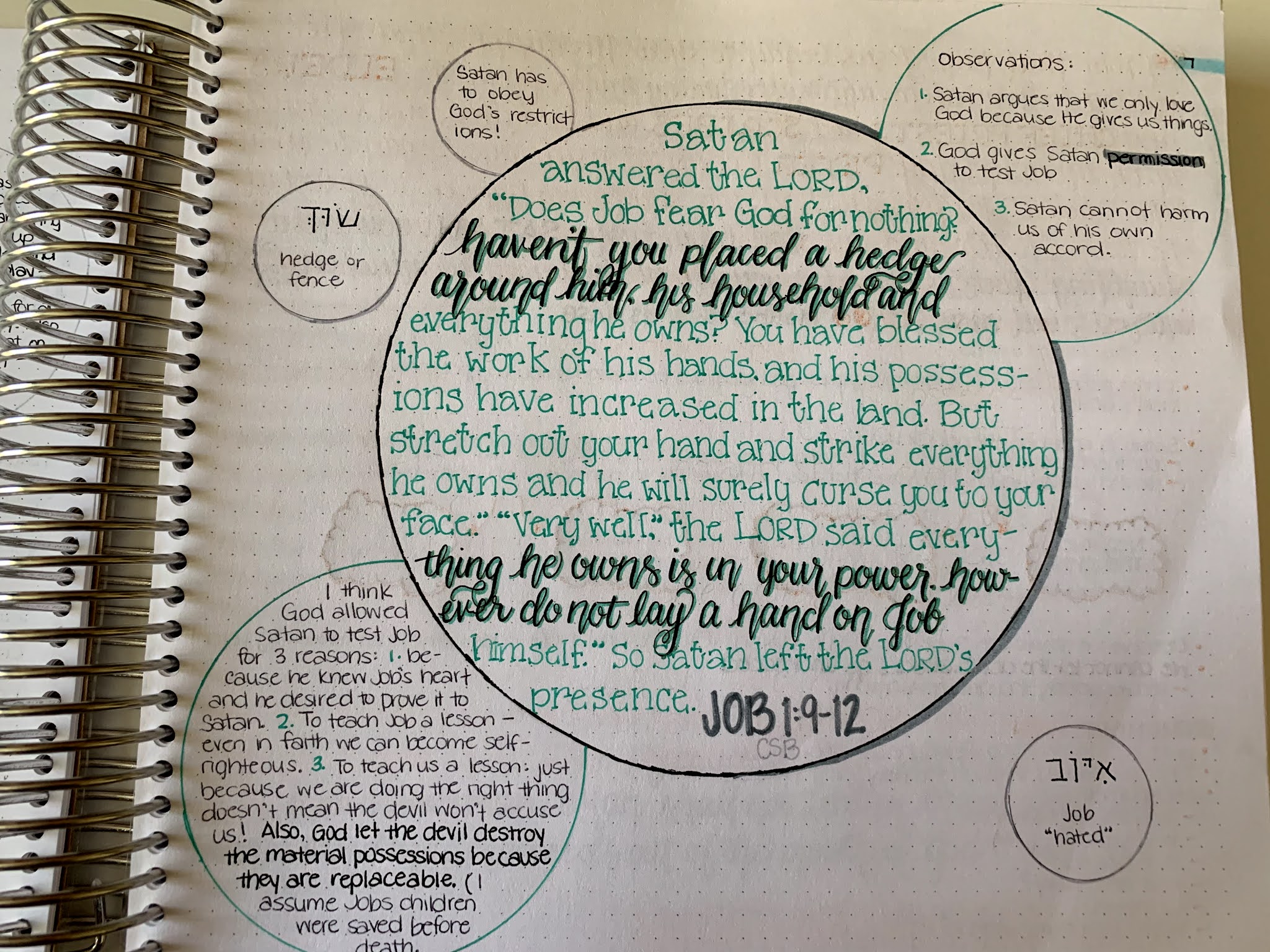
Recently, I started Scripture Journaling. Scripture Journaling is the process of writing out individual passages from the Bible to meditate on them, usually daily. I found a themed plan, entitled "Dealing with the Devil," by The Ruffled Mango.[1] I decided to start with this plan and share both my journal and my thoughts on the passages. I'm also chronicling the experience on my new YouTube channel. I hope you'll join me!

Genesis 3:1-5: The Serpent in the Garden

In the garden, when Satan makes his first appearance, he actually reveals a lot about his strategy:
  • He approaches Eve when she is alone
  • He twists God's words
  • He envokes FOMO (fear of missing out)
  • He offers Eve something she already has
  • He, likely, utilizes the fact that Eve added to God's Word

Alone

The only thing God said was not good before the fall, was that man be alone (Genesis 2:18). Satan captializes on the the fact that we are weaker and more vulnerable when we are alone. There are many passages in scripture reminding us not to forsake fellowshipping with our fellow believers (e.g., Hebrews 10:24-25) . When we isolate ourselves, we become vulnerable and Satan will leap at the chance to devour us.

Twisting Scripture

Satan manipulates us by taking scripture out of context and twisting it to fit his purpose. Often, he uses our weaknesses to make these incorrect interpretations of God's Word sound good. That is why it is important for us to know God's Word, inside and outside. By meditating on the Word and strengthing our relationship with God, we will be able to discern Satan's manipulations.

Fear of Missing Out

We always think we're missing something or that there's something better out there. Eve could eat from any tree in the garden except one, and that wasn't good enough. There are over 2,000 types of fruit in the world,[2] all of which would have been available in the garden. The odds that the fruit on the tree of knowledge was the best fruit in the garden would have been roughly 1 in 2000 or 0.5%, and just Satan convinced Eve that she was missing out by not being able to eat this fruit.

False Gifts

Satan lures Eve to eat the fruit by suggesting that in doing so she will become like God. The irony is that she is already like God. God created man and woman in His image, gave them dominion over the earth and the ability to create. Not only was Satan offering Eve something she already had, the ramification of his suggesiton almost cost her that very object. Once man ate from the Tree of Knowledge, we lost our dominion over earth (we gave it to Satan), we lost our ability to be good like God, and we were cast our of our palace (the garden). It is important for us to know that God has already made us heirs to the kingdom. As long as we follow Him, everything belongs to us anyway!

Adding to the Word

God told Adam and Eve not to eat the fruit, but when Eve talks to Satan, she says they're not even supposed to touch it! This is the beginning of a pattern with mankind (just look at everything Israel added to what God said). It's also a crack in God's perfect law for Satan to weasel into. Imagine this: Eve has convinced herself that part of God's rule is that they can't touch the tree, but she (or the serpent) is touching the tree and nothing bad has happened. This leads her to doubt anything bad will happen if she eats the fruit. However, it's based on faulty logic because God never said they couldn't touch the tree. We have to stick to the Word as written to avoid these types of situations (Deuteronomy 4:2; Revelation 22:18-19).

Job 1:6-12: Satan Accuses Job

At the beginning of Job, Satan goes before God. Based on the context that "Satan" means adversary in Hebrew,[3] it is is implied that Satan frequently uses this time to complain about or accuse mankind. Instead of waiting for Satan to call out a particular person, God offers Job as an exemplary human. Satan is not convinced, arguing that Job only loves God because God has made Job successful. God then allows Satan to take Job's possessions and good fortune.

Why Did God Allow This?

The major question is why did God allow Satan to test Job? I think there are a few reasons for this, all of which apply to us today:

First, people often think they know everything until they are proven wrong. Satan had his mind made up about Job and the only thing that would prove him wrong was seeing it for himself. God already knew Job's heart and knew how everything would play out, but Satan did not.

Second, to prove to the sons of God who were also present. When Satan appears before God, the sons of God are also present. There are many intrepretations of who that refers to, but like Satan, these are limited beings who do not know the outcome of the test. If they were within earshot, some might have agreed with Satan, so God had to prove to them, as well, that there are faithful humans.

Third, to teach Job a lesson. (Sidenote, did you know "Job" means hated in Hebrew?[4]) Job was a bit self-righteous and in the end, though he never wavers in faith, God does have to chastise him. Sometimes we need to be reminded to have humility, because no matter how great our faith, we still fall short.

And fourth, to teach us a lesson. The book of Job answers the ultimate queston of why bad things happen to good people. Just like we discuss Job's trials and come to knew understandings about how suffering relates to our relationship with God, Job and his friends did the same thing. In the end, they learned about their own flawwed thinking because of Job's situation. Sometimes, we are the friend learning from our friend's misfortune and sometimes we are the friend going through the misfortune.

Who Does Satan Accuse?

Since we're discussing strategy, a great question is who does Satan accuse. God presents Job as perfect because he has perfect integrity, fears God, and turns away from evil. I seems that these are therefore the principles Satan tries to accuse us of not having. Also, an important observation is that if we do possess all three of these qualities, it is likely Satan wants to prove we don't really have all of these characteristics.

Matthew 16:21-23 Satan Speaks Through Peter

In this passage, Christ attributes the words spoken by Peter as being from Satan. Christ identifies these words as a stumbling block and says the reason is because they put man's desires over God's desires. Satan uses us to express seemingly innocent thoughts that are actually contrary to God; though he can also use us to express thoughts that are obviously contrary to God as well. The major theme in this passage is putting self interest above God.

Peter loved Christ and did not want to see Him die—this is a human inclination and very natural. Many of us would have likely expressed the same sentiments had we been in Peter's shoes. However, it wasn't what God wanted. As a small child, I used to pray/wish the world never ended—that was self interest and self preservation, but it also serves Satan. Our selfish desires always serve Satan. In my case, if the world never ends, Satan is never punished for his deeds and is allow to continue ruling over our world. In Peter's case, if Christ never died, there would be no salvation.

It is important for us to identify our thoughts and discern whether they are of God or not, as well as, identify the speech of those around us. As yourself:
  • Why should I say this? (or why did they say it?)
  • Is it selfish?
  • Is it helpful?
  • Is it necessary?
  • Is it kind?

Matthew 4:1-11: Satan Tempts Jesus

Right before Christ starts His ministry, Satan comes to tempt Him. Christ fends off three attempts by Satan, each of which show Satan's tactics and the only way to respond.[4]

Temptations #1: Weakness

The first thing Satan does is attack Christ's weakness. After fasting for 40 days, it is not surprising that Christ would be hungry. Satan challenges Him to turn stones into bread. In this, Satan is both questioning His ability and tempting Christ to give in to the flesh's desires. Similarly, Satan will come to us when we are weak and tempt us to take something the flesh desires even if it's not appropriate.

Christ responds by quoting Deuteronomy 8:3.

Temptation #2: Promises

The second thing Satan does is attack the promise of God. Satan tries to get Christ to prove God is who He says He is. Satan wants us to believe we have the responsibility of answering for God or proving His existance, when that onus is on the Holy Spirit. Christ did not need to put Himself in harms way to prove God is God because both He and Satan already know exactly who God is. The same is true for us.

Once again, Christ responds by quoting scripture. This time He quotes Deuteronomy 6:16

Temptation #3: Desires

The final thing Satan does is attack a desire. Satan promises Christ rulership from the price of submiting to him instead of God. Like with Eve in the Garden, Satan is offering something already given. Christ is the Son of God, King of Kings and Lord of Lords. The kingdoms Satan was offering to Him were already His. The catch in these situtations is not if you will have the desires of your heart by how you go about trying to get them. Satan's way, usually the easy way or a short cut, is temporary and comes at a high cost. However if we keep the faith and do it God's way, we get lasting results.

Christ respons by quoting scripture again, and quotes Deuteronomy 6:13.

The fact that Christ's only response to Satan is to quote scripture should remind us of the importance of knowing God's Word and clinging to it.

Conclusion

These verses focused on the strategies Satan uses to trip us up and helped me reflect on ways to prepare myself for his attacks.

References & Footnotes

  1. "June Scripture Writing Plan". The Reffled Mango; visited October 4, 2020
  2. "Alphabetical list of Fruits". Fruits Info; visited October 16, 2020
  3. Strong's H347. Job". Blue Letter Bible; visited October 17, 2020
  4. I am aware that this passage is not included in the original list. I just felt it was relevant to the study and decided to slide it in.

An Army of One

Knowing their thoughts, he told them, “Every kingdom divided against itself is headed for destruction, and no city or house divided against itself will stand.Matthew 12 CSB

The US was built on division. This idea permeates through every fiber of our being. Despite being victims of oppression, assimilation, and injustice, we take these same ideals and inflict them on others (as well as ourselves). We cause harm to those hurting as we are, and we receive harm from those hurting as we are, so we segregate ourselves. We push away even those willing to help in anger, fear, and uncertainty. We are fighting a war as an army of one when we could be fighting as a united front. There is a history of minority groups being pitted against each other and it's time that we educate ourselves on these divides, the similarities and differences of our cultures and on the way white supremacy is propagated and inflicted between minority groups. It is time black lives matter to everyone.

The History of Division Among Minorities

From the inception of the US, there has been a plan to keep the elite rich and in power. Since they actually make up the minority, they had to make sure the majority didn't overthrow them. This is where we see division begin. Rich whites instilled a fear and hatred of slaves in poor whites, telling them that they were losing jobs (and therefore money) to slave labor. They elevated them by the nature of being white, as they were free and still "better" than the enslaved blacks, but worked to keep them poor and powerless.[6] As a result, poor whites and enslaved blacks were taught not to trust each other and most importantly, not to work together. If they had, they could have completely changed the landscape of the country.

This tactic was replicated within communities (namely by way of colorism) and between minority communities. By teaching one community to think they are not receiving resources because another community is getting that funding and then painting that community as undeserving, the system redirects the anger we should focus on policies and the rich, to people suffering just like us.

Many of our communities have the same problem manifested in different ways. For example, take the media. There isn't enough positive representation for any minority group. We're all relegated to stereotypical roles—the black athlete, the Asian nerd, the Hispanic/Latino maid (just to name a few). We shouldn't have to fight each other for a role or see another race's success as our failure. I was just as happy to see Crazy Rich Asians as I was to see Black Panther. Together we could have the power to force Hollywood to cast more people of color (in quality roles) and hire more people of color behind the scenes.

In some cases, however, the history is more nuanced. For example, when Asians began migrating to this country, they weren't received well. It's true that they weren't stripped of their heritage or forced into slavery as blacks, but it wasn't smooth sailing. Despite the education system teaching us WWII through the lens of the Holocaust and painting Germany as the big bad, it was Japanese Americans that the US put in internment camps[7] while the government hired Nazi Scientist (research Operation Paperclip). Even before that, Asian immigrants were heavily discriminated in the workforce (just like blacks). Since they were not allowed to become white collar workers, this led to the rise of small businesses like nail salons, restaurants, and beauty supply stores. These businesses were often opened in black neighborhoods. Today, Korean Americans own most of the beauty supply stores in the US and blacks spend the most money in this industry. For centuries, black people have indoctrinated to believe we are ugly and unprofessional in our natural state (research Sarah Baartman/The Hottentot Venus). From bleaching creams to toxic chemicals like lye for our hair, we are sold products to help us blend in and look more European. This is may not be overt racism, but it is a product of white supremacy or Eurocentric beauty standards. As such, the livelihood of these Korean American beauty supply store owners is dependent on upholding the belief that black women need these products and by controlling the flow of these products so that we don't "usurp" these businesses for our own community.[1][2][3][4]

On the other hand, many businesses in the black community that are owned by Asians (not just Korean Americans) have been targets during rioting. Not only does this add confirmation bias to negative attitudes they may have picked up from our society's general narrative about black people, but it adds personal hurt and damage into the mix.

Yet in 2020, the fact remains that there are immigrants being sexually assaulted and kept in cages at the border (many of them Hispanic or Latino), Asians have been violently targeted during the COVID-19 pandemic, black people are still being murdered or reported to the police simply for being black, and none of us can win our individual battles alone.

From A Christian Perspective

We have a duty to stop saying, "Me, me, me" and start working together. We have a responsibility to go beyond simply learning the gospel, but learning about each other. James 2:14-16 reminds us that we can't spread the gospel to people with out meeting their needs first. In that particular verse, the need is food or clothes, but in our society that need might be justice, validation, or support. We have to educate ourselves about how we internalized biases and how the system is structured to keep us at odds with each other so that we won't be at odds with each other.

Christ said a nation divided is headed for destruction and a house divided cannot stand. The adversary wants us divided. It hinders the spread of the gospel and it endangers our salvation. Racism is a concise way of saying, "angry with your brother without cause." Christ said that if we are angry with our brother without cause, we are guilty of murder. We cannot harbor hatred or prejudices against people without sinning, that's how I know Satan orchestrated racism. As a Church, however, we have all the tools we need to combat this particular epidemic.

We Are Called to Justice

Matthew 23:23 and Isaiah 1:17 are just two examples of God calling us to do justice. That justice isn't just for our own community. We much rally the troops whenever one of us calls. Every Church should be on the forefront of the fight for justice and equality of people. Whether my local Church is 99% or 1% , they should be fighting against injustices happening to .

Diversity Training

Most businesses invest in diversity training. Why doesn't the church? We're so busy claiming we are "neither Greek nor Jew" that we forget society doesn't see it that way. Never mind what happens inside the church, the truth is the world at large sees differences in us and we each have different experiences—race, class, gender, etc. all shape our experiences and world view. Public schools don't teach the history of each culture, and they definitely don't go into the nuances of racism. When you take that into account, and remember as stated earlier that racism is a sin, you would think we would create programs to combat it. Churches have AA meetings, singles ministries, family life programs, and more to help Christians adapt and grow in Christ. Why don't we have a diversity ministry?

Bible Verses to Review

  • Matthew 5:23-24
  • Matthew 12:25
  • Matthew 18:15-17
  • Matthew 18:21-22
  • James 2:14-16
  • Habakkuk 1
  • Isaiah 1:17
  • Matthew 23:23

#BlackLivesMatter

If you study the history of black people in America, you'll find that we've been paving the way for others for a long time. Blacks fought in WWII to liberate Jews from concentration camps and came back to a society that treated us like second class citizens. We fought in the American Revolution. We fought for Civil Rights that keep other minorities from being segregated as well. Yes, we have been helping (and occasionally hurting) other communities and yes, we need to be educated/invested in your plight too. I promise to stand with you when your life and your rights are at stake. Right now, however, it is the lives of black people that are being threatened. Do not leave us as an army of one, instead stand beside us, acknowledge that historically black lives have not mattered to the US, and affirm that black lives matter to you.

Educate Yourself

The only way to improve is to eliminate biases through education. We have to read and understand our own history (many of us don't even know that much). We also have to read and understand the history of others. It is 2020 and there are countless books, documentaries, tv shows, essays, short clips, TED talks, etc. about these topics, we just have to take the time view them. Once we clearly see the enemy's strategy, we can come together to dismantle the walls between us and start fighting together.

Posts from Last Week (Series on Christianity and Racism)

References & Footnotes

  1. Nikki Brown. "Being Followed Around a Korean Beauty Supply Store Made Me Rethink Where I Spend My Money". Essence. March 20, 2017
  2. Danielle Kwateng-Clark. "Outrage After Beauty Supply Store Owner Strangles Black Woman In Disturbing Video". Essence. March 14, 2017
  3. Interminority racism in the United States". Wikipedia; visited June 9, 2020
  4. Chelsea Black. "'Model Minority' Myth Again Used As A Racial Wedge Between Asians And Blacks". NPR. April 19, 2017
  5. Juliana Menasce Horowitx, Anna Brown and Kiana Cox. "Race in America". Pew Research Center. April 2019
  6. Keri Leigh Merritt. "Keeping Poor Whites & Blacks Apart: a Southern Tradition". The Bitter Southerner; visited June 9, 2020
  7. "Japanese Internment Camps". History. October 29, 2009

Most Likely To Betray You


Season 1 Episode 35


3Then Judas, his betrayer, seeing that Jesus had been condemned, was full of remorse and returned the thirty pieces of silver to the chief priests and elders. 4“I have sinned by betraying innocent blood,” he said.

“What’s that to us?” they said. “See to it yourself!” 5So he threw the silver into the temple and departed. Then he went and hanged himself. Matthew 27:3-5 CSB

Betrayal is always unexpected, and it always hurts. The Bible has many instances of betrayal, from sibling rivalries to Judas betraying Jesus. We spend a lot of time talking about the person who was betrayed and vilifying the betrayer, but what happens when we realize we have plenty in common the betrayer? The root cause of betrayal is always selfishness and we all fall prey to the temptation of selfishness. In this episode, let's talk about how we can avoid the pitfalls that lead to betrayal.

References and Footnotes

  • Another example of betrayal in the Bible is David's betrayal of Uriah (sleeping with Bathsheba then having Uriah killed).
  • Take Up Your Cross

    Would you risk your life to do the right thing? We often think this means grand gestures and big finales that are only seen on TV, but what if it's as simple as allowing yourself to be vulnerable and do something good for someone even if you fear a betrayal on their part? When the consequences of one choice could be detrimental to yourself, but the consequences of the other choice is stepping away from who God commanded you to be, what will you choose?

    Season 1 Episode J


    24Then Jesus said to his disciples, “If anyone wants to follow after me, let him deny himself, take up his cross, and follow me. 25For whoever wants to save his life will lose it, but whoever loses his life because of me will find it. 26For what will it benefit someone if he gains the whole world yet loses his life? Or what will anyone give in exchange for his life?Matthew 16:24-26 CSB
    00:01:21 Hey guys welcome back to the PSALMS to God podcast. So funny story: I was in the process of organizing my laptop and the files on my laptop, and I found this episode that I recorded months ago—months ago—Like probably around the time that I was starting the podcast, and that I never finished it. It's just like a half done episode, with kind of random notes and thoughts that I was trying to put together. And when I looked at it today, I was like "That was a great idea! It was a great episode. Why didn't I finish that?" I have no idea why I didn't finish it, and I have no idea why I was trying to organize files on my computer today, but I'm going to take it that was the Holy Spirit leading me back to that episode and telling me that I needed to record it and talk to you guys about it. So here we are.
    00:02:21 We're going to talk about Matthew 16:24-26, in the context of an experience that I had at the beginning of the year. So sometime in January, I was shopping. I went to Publix to get something—pretty sure based on the date that I wrote down that I was buying something for a potluck at the church that I attend. And when I went to Publix—there's a Publix nearby me that I called "The Shady Publix." Every time I go to this Publix, something weird happens, U do not like going to this Publix. I feel like... I just feel uncomfortable going to this Publix by myself at any time, because something weird always happens. So I refer to it as "The Shady Publix," but "The Shady Publix" was the most logical Publix for me to go to that day because it's actually near my job and in the direction that I was driving, for me to go to any other grocery store or any other Publix would have been going out of the way, and that just didn't make sense. So I had stopped there on the way back home. And when I stop there, soon as I pulled into a parking space, this man approached my car, and he came all the way up to the window—like the driver side window—and he started talking. And I was weirded out to say the least. Like I did not understand why he was coming up to my car, and why he was starting to talk to me. Like not even like, "Oh I let you get out of your car and approached you in the parking lot." Like he legit walked straight up to my car. I could not open the car door to get out had I wanted to, because he was standing like directly in front of the car, and so he basically said thatshe ran out of gas. And that's all he said. He didn't ask for money. He didn't ask for gas. He didn't ask for a ride to the gas station. He didn't ask for a phone to call a friend to take him to the gas station. Like to this day, I don't really know what his intention was. Like I don't know what he was...why he was approaching me.
    00:04:36 And in the moment, I was like this is super weird. This is super sketch. First of all, I don't look like the person that you should be approaching for this problem. And what I mean by that is: so when I was in South Carolina, I remember I had this situation where I needed a pocket knife. I was trying to open something and I felt like a pocket knife would be of assistance. I didn't have one. And I was walking across the campus at the university I went to, and I saw this this group of guys. They were dressed in camouflage and they looked like they did some hunting in their spare time, and I made the assumption that they would have a pocket knife, so I approached them and asked them for their help. I did not go to the girl that was walking by that was in heels and a dress and was like fully made up, because she didn't seem like she would have a pocketknife. Now that's very stereotypical she could have very well had a pocketknife; they might not have had a pocket knife, but the odds were that these gentlemen who were dressed like they go hunting frequently were more likely to have a pocketknife than this woman who is dressed like she was about to go give a presentation and would probably only have like a pencil or a USB drive or something. It's just there are certain people... Like, I mean its basically like if I'm trying to reach something on the top shelf and I go to somebody who is shorter than me for assistance. That doesn't make sense I would approach somebody who's very tall to try to help me.
    00:06:12 And so in the situation I'm like I don't know why you're coming to me I have a very small car. I don't look like I would have a gas can in the back of my car. My car is very old; it's not like I look like I have a lot of money, or I could just be, you know, throwing money at you. You know... It just seems like a really weird situation. So I was very, very hesitant, and the demeanor that I probably had was not a very pleasant or positive one, because I was just like "Please leave." That's what I was thinking in my head.
    00:06:52
    Photocredit: Unsplash.com/Vladislav Babienko
    But after the situation, the verses that I read in the beginning (Matthew 16:24-26) were the first things that popped into my head. And I was asking myself, "Why is it that we allow ourselves to be so afraid of other people?" And I know that... I know the answer: the media and what happens. Our society is completely screwed up. It is very possible that had I opened the door, or rolled down the window, or attempted to give this man some money, or let him borrow my phone, or whatever, that he might have reached in and tried to kidnap me. He might have tried to kill me. He might have tried to rob me. There is a very high probability, and considering where I live it's even higher of a probability that that could have just been somebody trying to mug me, but at the same time that also could have been an angel giving me a test. That... It could have been somebody, a genuine person, in need of help.
    00:07:59And I think the reason our society has the problems we have is that we don't help the people who need help, because we're afraid that they're one of these other people who don't need help. And you know the truth is, in this verse we often think about this in the context of martyrdom—like someone has asked you do you believe in God and you said yes even though it might cause problems. Basically, like how Hananiah, Mishael, and Azariah (better known as Shadrach, Meshach, and Abednego) had to make the decision not to kneel for the statue.[2] The king had already said if you didn't kneel in front of the statue he was going to kill you. So it's basically a public declaration of their faith in God when they decided not to bow; and they knew that there would be negative consequences—and of course God covered them in that situation. But really this verse in Matthew is talking about so much more than that. It's about not being afraid to do the right thing, regardless of the consequences. It's not just saying "I believe in God" and necessarily making that public declaration in such an obvious and overt manner. It's also about the actions that speak to your faith in God.
    00:09:27 So in that moment, I did not know what his intentions were. I didn't know if he was out to do some harm to me or if he was genuinely in need. And at the end of the day, I can't control his actions. I can only control my actions. I can't control whether he was going to try to mug me or whether he was going to try to rob me or whether he was genuinely seeking help, but I can control whether my intention was to do good to him or whether my intention was to ignore any sort of harm that might have been coming towards him or any sort of trouble that he may have been in. And what's even more ironic about all of this[4] is that I just did a podcast episode where the verse that I used to basically pull the episode together was Jeremiah 17:9-10, and the second part of that, verse 10, it talks about how God judges us based on our actions not on our heart—because the heart doesn't crazy things! So remember that when y'all out here saying "God knows my heart." The heart is wicked and deceitful, but it's our actions that really speak volumes because that's what we can control.
    00:11:03 A lot of times in moments like this we let fear keep us from doing something positive or from doing good. And that's a problem, because regardless of what was needed in that situation, regardless of whether I actually had money to give him or not—I didn't 'cause I never have cash—but even down to the demeanor that I had, the way I responded to that person, that is very significant, because that's a human being. Whether I decided to try to do something to help this person monetarily, whether I was going to give them my phone, whatever I decide to do or not to do, I did at least owe it to him to be polite, to show a Godlike character when responding to him,[3] and I didn't do that because I let fear dictate my actions. And fear is not of God. God does not want us out here being afraid to do good, and that's something we should definitely be talking about as we go through our walk and our journey with Christ.
    00:12:22So I'm curious what you guys would have done in that situation and how you would've felt about it. Would you have stopped to talk to the person? Would you have tried to help them out? Would you have done like me and been like "Yo, you just need to leave. Please leave me alone"? And there's no judgment because I already told you what I did, and I'm not even 100% sure that I would behave differently today.[1] It's a struggle, y'all; it really is. So hit me up on Instagram, let me know what you would do, and thank you guys for tuning in. You can find the transcript for this episode at www.psalmstogod.com/TakeUpYourCross. Don't forget to like and subscribe. See you next time!

    Footnotes and References

    1. In my mind I'd like to think I would behave differently, but I know that when you're taken off guard, you resort to instinct which is probably still going to say "stranger danger" in this case.
    2. Daniel 3
    3. How we treat people can have a profound impact on their psyche, how they value and perceive themselves.
    4. It's ironic because the verse I planned for the planned episode actually fit this unplanned episode better.

    With Liberty and Justice For All

    Deuteronomy 10:17-19 isn't the only verse that commands us to love and respect those who are not like us, so why are so many so-called followers of God overtly and passively racist? Why are so many willing to ignore the plights of others? Why are so many anti-immigrant? #LoveYourNeighbor

    Season 1 Episode E


    17For the Lord your God is the God of gods and Lord of lords, the great, mighty, and awe-inspiring God, showing no partiality and taking no bribe. 18He executes justice for the fatherless and the widow, and loves the resident alien, giving him food and clothing. 19You are also to love the resident alien, since you were resident aliens in the land of Egypt. Deuteronomy 10:17-19 CSB
    00:01:25
    Hey guys. Welcome back to the PSALMS to God podcast. So this past Sabbath, I was at Sabbath school and we were talking about the inclusion of everybody in the body of Christ. We're talking about a chapter in Ephesians[1] where, you know, it's basically going over the whole thing about how once you convert and once you believe in God, it doesn't matter if you are an Israelite or a Gentile. You're still a body of Christ and you have this—excuse me, you're still in the body of Christ and you still have the same rights; and you gain the inheritance of the Father just like anyone else.

    00:02:05
    And as we were talking about that concept, we started going through the Bible to a bunch of different verses that talk about strangers or foreigners in the land of Israel, and how the Israelites were supposed to be treating these people. As we were going through these verses I knew that I was going to do the podcast on basically all of these verses. A lot of them are exactly the same, but I just feel like, especially with it being Black History Month, that it's completely relevant and important to talk about.

    00:02:46
    Nitish Meena
    So one of the reasons it's important, like I said, it's Black History Month, and in the US there is a history of discrimination—whether it's because of race or nationality, there's also a history of discrimination based on people being poor and people being immigrants. We're seeing this playing out right now. All of this crazy foolishness that Donald Trump has said about immigrants, particularly about Mexicans. What he said about Haiti. And the whole foolishness about this wall—just there's a lot OK. You have to be living under a rock to not realize that people you're saying very hateful and harmful things about immigrants in our society, which is crazy because everyone's an immigrant or we were brought here as slaves in my case, or you're Native American, but nonetheless there is a problem. And that is deeply rooted in the history of America.

    00:03:52
    And if you know anything about slavery and about the history of Christianity in America, then you also know that white evangelicals have been trying to twist the Bible to say racist things from the beginning. They were trying to turn curses into things that they're not; they were trying to, you know, oh slaves you know "obey your master"—never mind about the right after that it says "masters be good to your slaves for you have a Master in Heaven"[2]—but they basically tried to make the Bible say what they wanted to say. And here in 2019, we have the issue that because of how they have treated the word of God and how they have perverted it there are a lot of Black people food do not subscribe to Christianity simply because they're viewing it through that lens, and it's seen as a racist religion. By all accounts that man-made version is racist, but that's not what the Bible says—and we're going to get to what the Bible says.

    00:05:01
    But outside my American experience, and the American context as a black person in the United States, this is also relevant to what's happening in Israel right now. If you follow history and if you follow current events or anything like that, then you would know that there is a lot of conflict between the Israelis and the Palestinians—and so there is a lot going on there, as well.[3] And of course, all of what's being said in the Bible also applies to the modern state of Israel and how they treat the Palestinians—and there's a lot of stuff that we can go into about that but we don't have that much time, so I'm just going to go straight to the verses.

    00:05:43
    So I read in the beginning, a verse in Deuteronomy or a couple of verses from Deuteronomy that basically summarize the whole of what all of the verses say. But just for, I don't know for clarity? For a thoroughness—thoroughness! That's the word I'm looking for. I wanted to read a couple of others, by no means is this all of them, because a lot of these verses are repeated; which means there's emphasis, which means God was serious about what He was saying and He didn't change what He was saying because He was serious about what He was saying. So in Exodus 22:21 it says "You must not exploit a resident alien or a oppress him since you were resident aliens in the land of Egypt."

    00:06:26
    And then if you continue into Deuteronomy, pass the verse that I previously read and into chapter 24 verse 14, it says "Do not oppress a hired worker who is poor and needy, whether one of your Israelite brothers or one of the resident aliens in a town in your land. You are to pay him his wages each day before the sun sets because he is poor and depends on them. Otherwise he would cry out to the Lord against you and you will be held guilty."

    00:07:06
    Later in that same chapter and verse 17 it says "Do not deny justice to a resident alien or fatherless child and do not take a Widow's garment as security." So once again you cannot deny justice to people just because they are not like you or because or because they are immigrants or foreign or whatever the case may be.

    00:07:28
    And then if you jump into the New Testament, because I know some of y'all a little rusty on the Old Testament. The New Testament says the same thing. From the words of Jesus Himself, in Matthew chapter 25 starting at verse 34, it says "The King will say to those on His right, come you who are blessed by My Father. Inherit the Kingdom prepared for you from the foundation of the world. For I was hungry and you gave me something to eat. I was thirsty and you gave me something to drink. I was a stranger and you took me in..." And then it lists some more things, but I really wanted to highlight the fact that he is including the strangers, the foreigners, the immigrants in this passage. Those who are blessed and inherit the kingdom of God are the people who took care of all people and not just those who looked like them.

    00:08:26
    And I think it's very important that we remember this, and that we remind those who are profaning the name of God by claiming that they are believers that they are following Christ, they're Christians, but are still spouting out racist propaganda, racist ideologies. They are discriminating against immigrants, discriminating against people because of their race, because of their wealth status or lack of wealth status, or any of those things.

    00:08:59
    Throughout my life I have noticed that is always those who have little that are taken advantage of, and a lot of times in our country, that is inclusive of immigrants because many times they don't necessarily know they're rights. Or for instance I've had situations where I've known people—like maybe you have like a child, like kids I went to school with, their parents came over. The children are first-generation American and their parents don't speak English. The children don't know what's going on and the parents can't fight for the child because they can't speak English. And teachers or the school—I should say the school system in general, or the the law system, systems in general are taking advantage of those people and that is not how the Bible outlines a good society and that's not how the Bible outlines God's Society. So we as followers of Christ should be breaking that tradition and we should be standing up for the immigrant, for the foreigners, for those who don't necessarily look like us. And we should be treating them as equals because God created us all to be equals.

    00:10:13
    So that is the message that I wanted to put out there today and I hope that you guys will think about that, and share that with your friends to need to hear it. If you needed to hear it, then I hope you received it in love and goodness. And I will see you guys for the next episode. If you want the transcript for this episode—and I will try to list out more of the verses,[4] I'm probably still not going to get them all 'cause ya'll the Bible is long and there a lot of them but I'll try to put in as many as I can in that transcript, you can find it at www.psalmstogod.com/liberty. Thanks again, see you guys next time.

    Footnotes and References

    1. Ephesians 2
    2. Ephesians 2:6-9
    3. "Israel/Palestine". Human Rights Watch; visited February 2019
    4. Exodus 12:49; 22:21; 23:9;
      Leviticus 16:29; 19:10, 33-34; 24:22;
      Numbers 35:15;
      Deuteronomy 1:16; 10:18-19; 14:29; 16:11-14; 23:7; 24:14-17, 19-21; 27:19;
      Matthew 25:35;
      Ephesians 2:19;
      Hebrews 13:2

    You Are What You Eat: Mark 7:15

    The most often quoted passage to excuse eating unclean foods is Mark 7:15. In this verse Jesus tells the Pharisees it isn't what goes into a man but what comes out of a man that defiles him. But is this verse actually giving us permission to eat whatever we want?
    Mark 7:15/Matthew 15:11
    There is nothing from without a man, that entering into him can defile him: but the things which come out of him, those are they that defile the man. Mark 7:15 KJV

    Introduction

    Photocredit: Unsplash.com/Ken Lawrence
    It's not what goes into our mouth that defiles us, but that which comes out of us. This is the go-to explanation for why we can eat whatever we want as Christians. It makes sense if you don't think about it too long, but when I stopped to ponder it for a minute, it wasn't what it seemed.

    Permission to Eat Anything?

    To argue that this gives us permission to eat unclean flesh, you have to interpret Mark 7:15 to mean we can ingest anything. After all Jesus is saying nothing external to us can enter and defile us. Can you drink bleach? How about tar? No? Certainly Jesus didn't mean we could just go off eat any and everything we see. Paul reaffirms this in 1 Corinthians 10:23.

    Let's think about this. When Adam and Eve ate the fruit of the Tree of Knowledge, what actually happened? Did they die right then? Did it bar them from enteral life? Did they become defiled? Adam and Eve suffered, but it wasn't the fruit's fault. Adam and Eve weren't punished because the fruit was bad, but because they chose to eat the fruit. Remember, the action of eating the fruit didn't start with the fruit, it started inside Adam and Eve, in their mind. Their disobedience to God is what defiled them and caused problems.

    Putting it in Context

    In the previous section, when I asked if you could drink bleach or tar, you may have rolled your eyes at me and thought I was out of line making such a comparison. After all, who would eat something that isn't even food? That's dumb, right? If you stayed the night at my house and I said feel free to eat anything you find in the house, you would automatically restrict that to that which you consider edible, right? You wouldn't attempt to eat my couch or cleaning supplies. Similarly, when Jesus spoke to His audience in Mark 7, they probably would have assumed Jesus was referring to things designed to enter the body. Unclean foods were never designed to enter the body. The Jews (which includes Jesus), would not have considered unclean flesh to be something to eat!

    If we read the verses leading up to that passage, we see that the squabble was over Jesus allowing the disciples to eat bread without washing their hands. There are no unclean foods in the passage.

    The Pharisees claimed the disciples had defiled themselves by eating clean food before washing up. Jesus chastises the Pharisees for following man made laws (washing of hands before eating) and not believing in their hearts. They followed the details of the law, but never made a relationship with God and had weak faith. This is the very definition of legalism. To make the situation even clearer, Jesus explains that whatever the people eat, it will eventually pass through the body and disappear. However, the evil thoughts in their hearts would stay within them; that is what defiles them.

    We have to remember that while Jesus' comments hold truths for us today, He was talking to a specific group of people. Jesus was essentially telling the Pharisees that they were worried about something as trivial as washing your hands before eating bread, meanwhile they were rotting on the inside with unclean thoughts and desires. Matthew 23:24-25 expounds on this. The Pharisees were concerned with the pots and pans they put the food in and making sure a fly wasn't in the water, but they would eat a camel (unclean) and take part in shady dealings. Jesus was calling them out for sweating the small stuff when they needed to be looking inward.

    Matthew 15

    Matthew 15 provides another reference for this encounter. As we continue through to the end of Jesus' explanation, He summarizes His point at the urging of the disciples. In this He specifies that He is permitting the eating of food with unwashed hands. Jesus' critique was not about clean and unclean food but about the tradition—made up by man—of washing up before eating foods already declared clean!
    These are the things which defile a man: but to eat with unwashen hands defileth not a man.Matthew 15:20 KJV

    Proof of Understanding

    When Jesus has this conversation, there are two groups present, the Pharisees and the disciples. The Pharisees were always at odds with Jesus, but the disciples spread and followed His teachings. This means, if the disciples understood Mark 7:15 to mean they were free to eat anything, that is what they would have taught.

    However, in Acts 10, some time after Jesus' crucifixion, we find Peter appalled that God would command him to eat an unclean animal. Yet, Peter is the one who asks for more clarity in Matthew 15:15. Peter vehemently denies ever eating anything unclean. Clearly, Peter didn't think Jesus had given them permission to eat unclean food when He told them it was the stuff within that defiles men.

    Up Next: Acts 10

    It's only natural that since we brought up Acts 10 we talk about that next. In the next post, I'll discus God commanding Peter to kill and eat unclean animals.

    DON'T MISS

    Book Review,Food,Testimony
    © 2022 all rights reserved
    made with by templateszoo