Showing posts with label Jesus. Show all posts

Matthew 1-2: The Birth of Christ

Discussion of the lineage and birth of Christ as well as the star signifying His birth and the gifts given to Him.

Lineage

Matthew starts off with the lineage and birth of Christ. Lineage was a major deal to the Israelites, in fact, in most societies bloodlines are very important. Several verses in the Bible articulate that the life of a person is in their blood. Our blood defines us—no, I'm not referring to blue blood or other worldly definitions. I'm referring to the very cells within our blood. The DNA contained in these cells is like a computer program that controls how we interact with the world around us. I don't want to get sidetracked, so if you want to know more about the life in the blood, check out my podcast episode on the topic.[8] The main point I'm making here is bloodlines are more than just wealth and worldly power passed down generation to generation, it's also Godly covenants passed from seed to seed. Because of this, the Jews meticulously kept up with bloodlines, searching for the promised seed (Genesis 3:15) that would defeat Satan.

The lineage presented in Matthew traces back to Abraham, and identifies Christ as a legitimate descendant of David with rights to the throne of Israel. That would be the end of the story, except Luke gives a very different lineage. There are many theories about why this is, which I've already covered in my post Harmonizing the Gospels: the Lineage of Christ. I don't want to be redundant, so I'm not going to go into detail about the lineage. I will say that there are multiple theories discussed in the post, and I fall in the camp of those who believe one lineage is that of Joseph (a legal justification for Christ's lineage) and one is that of Mary (a true bloodline lineage). Nonetheless, the early Church did not contest the written accounts, nor cry foul about such a glaring mistake; therefore regardless of why they are different, I am confident that the disciples and early church understood both of these lineages to be correct and valid.

Christ is Born

Matthew doesn't go into as much detail about the birth of Christ as Luke, but he does give us a few details to think about.

Mary & Joseph

When I look at the scenario of Mary and Joseph, I can't help but imagine this in today's crazy society. Can you imagine preparing for a wedding and finding out your fiancee is pregnant and you've never slept with her? While, I suspect how people external to the situation saw it would vary in our time (considering that premarital sex has been normalized, most would just assume it was Joseph's baby), the internal struggle each person experienced would have been very similar in today's time.

Today, Mary probably wouldn't worry about "slut shaming" or being condemned for having sex outside of marriage (depending on what circle she traveled in), but she would still be faced with the impossible task of convincing Joseph she hadn't been unfaithful. How crazy does it sound to say "I promise I'm a virgin...An angel told me I was carrying the Son of God, that's why I'm pregnant"? That probably sounded crazy then too. The only reason Joseph believed her is because the angel visited Joseph as well. Had Joseph not been visited by the angel, he would have left her. Sticking with the culture of Mary's time, her parents would have been furious if she'd gone to them; an illegitimate pregnancy would eliminate most decent prospects in marriage. Mary had to step out on faith that God would work things out. We aren't told how many people knew this information or how deep into the pregnancy she was when she got married, so we don't know how people around her reacted (if they reacted at all) but when she accepted what the angel told her, she had to accept the possibility that she would never be accepted into society again.

From the text, we know that Joseph was definitely not convinced by whatever Mary said (and who could blame him!?). It took an angel confirming that matter (as it should) for him to settle in to his role, but what is interesting is how Joseph intended to handle it. He could have been bitter and nasty about it; he could have made a spectacle of her. However, Joseph had resolved to handle the issue discreetly. This is a clear depiction of the man God chose to raise His son.

Both Mary and Joseph's reactions to the situation are indicative of why God chose them in the first place. Aside from being descendants of David to fulfill the prophecy, both bore the fruit of the Holy Spirit. God was entrusting this couple with His only son; He had to know they would make good parents.

The Wise Men & The Star

One of the most popular aspects of the birth of Christ is that of the star. One thing I could never understand as a child was why only the magi saw the star. Herod seems utterly baffled at its appearance and can't determine how old the child is based on the information. If the star was abnormally bright, wouldn't Herod have seen it and remembered? The cartoon-ish way Christians portray this element as a large gleaming star hanging above the manger is ridiculous and clearly false. A more likely scenario is that a sign played out in the heavens (see Genesis 1:14 for the purpose of the stars to be signs).

In some translations, the men who come to see Christ are the "magi" in others they are called "wise men." The original Greek is μαγοζ, which was a term applied to "the wise men, teachers, priests, physicians, astrologers, seers, interpreters of dreams, augurs, soothsayers, sorcerers, etc." in that culture. We can already see why some translators favored the term wise men, a term that could encompass many of the other terms. A compelling theory I've run across leans toward them being "astrologers."

I use the term astrologers loosely because there's context that needs to be applied here. In Matthew's day, anyone who studied the stars in any form or capacity was an "astrologer." Today, we have to terms for people concerned with the stars: astronomer or astrologer. Astronomers study the movement, behavior, life/death and inner workings of stars, while astrologers seek to connect those things to how events play out on earth. If you grew up in church you were probably taught that astrology is bad. I want to challenge that notion a bit wit this Bible verse:
14Then God said, “Let there be lights in the expanse of the heavens to separate the day from the night, and they shall serve as signs and for seasons, and for days and years; 15and they shall serve as lights in the expanse of the heavens to give light on the earth”; and it was so. 16God made the two great lights, the greater light to govern the day, and the lesser light to govern the night; He made the stars also. 17God placed them in the expanse of the heavens to give light on the earth, 18and to govern the day and the night, and to separate the light from the darkness; and God saw that it was good. 19And there was evening and there was morning, a fourth day. Genesis 1:14-19 NASB
In Genesis 1:14 we are told that God created lights in the sky not just for seasons and tracking time, but also for signs. So there is some relevance to "reading the stars." The thing to keep in mind is that it is not the stars making things happen. The stars are merely testifying to what God has already spoken (Psalm 19). Keep that in mind as you read what I'm about to type.

There is a theory that the star referenced in Matthew 1 is actually the behavior of a star over time (there are also theories about conjunctions of planets forming a really bright star, but that goes back to my question of why no one else seemed to notice). Many cultures have a zodiac and while they may ascribe slightly different names, the constellations are fairly consistent. One of the signs in the zodiac is Leo, the Lion. The lion was connected with the tribe of Judah and is connected to the Messiah (Who is the Lion and the Lamb). The brightest star (well, star system, but it appears as a single star to the naked eye) in Leo is called Regulus which comes from the Latin rex and means "little king."[1] Also in the sky is the planet Jupiter, which isn't a star but does appear as a light in the sky. Jupiter is named after the Roman god who was "king of the gods;" it was regarded as the king planet. Some who've studied the stars have identified interesting interplay with these three signs in the sky around the time of Christ's birth. This behavior is as follows: Jupiter (the king planet) passes through the lion near Regulus (the king star), goes in to retrograde (which mean it appears to go backwards, passing Regulus in the opposite direction), then crosses Regulus again. This pattern would have taken quite some time to complete, but the wise men would have seen the king planet "crown" the king star in the lion. It's not hard to see how that would be interpreted as the Messiah (the lion of Judah) being born (little king); especially if you were familiar with prophecy and understood the 70 weeks of Daniel. If you dig into it, though, there's even more with Virgo (the Virgin), Venus (the mother star), Mercury (the child star), and prophecy given in Revelation by John... If you're interested in this theory, I found a great video on YouTube that goes in to more detail (he goes into a lot of other things too; I encourage listening to the whole series, but I am linking the part specific to the star at the nativity). This theory explains why no one else noticed the star.

Herod and the Massacre of the Innocents

When the wise men get to Jerusalem they tell Herod why they're in town, and Herod is not happy to hear that the true King of Jerusalem has been born. Here I want to insert some context that will be reoccurring theme in the gospels: the Jews thought the Messiah was going to restore Israel to the splendor of Solomon. Essentially, they expected something much closer to what we expect for the second coming. In Herod's mind, this child would grow up and overthrow both him and the Roman government that gave him authority. This is why from birth, Christ was seen as a threat to power.

Herod, being led by Satan, does the same thing Pharaoh did while Israel was awaiting a Savior in Egypt (Exodus 1): he kills all the children. This fulfills a prophecy given by Jeremiah 31:15. During this atrocity, Mary, Joseph, and their newborn baby hide in Egypt, which also fulfills a prophecy (Hosea 11:1). Please note that the family hiding in Egypt follows the pattern started with Abraham of hiding in Egypt when there is trouble in Israel.

Nazarene

Before we end the chapter, we are told that Joseph and his family settle in Nazareth to fulfill a prophecy that the Messiah would be a Nazarene. There are two major things to point out about this revelation.

First, the reference to this prophecy appears to be lost. Many theories have been ascribed to what is being referenced here. Some believe there was a book that has not been added into our canon. Others believe it is a reference to Him being despised (Isaiah 53), because in John 1:46 we learn that the residents of Nazareth are not held in high esteem.[3][4]

Second, Nazarene is not the same as Nazarite. I've heard many people confuse this. Christ was a Nazarene because He was raised in Nazareth (similar to how I would be considered a Carolinian because I was raised in the Carolinas). Christ did not take a Nazarite vow, as evidenced by His consumption of wine (Numbers 6; Luke 7:34-35).

Frankincense, Gold, and Myrrh

The 3 gifts given to Christ are very fitting. Each represents a part of the Messiah's purpose. Frankincense was associated with the priests (Leviticus 2). Gold was associated with kings (). Myrrh was associated with death (Mark 15:23).[5][6][7]

Also, a common misconception is that there were 3 wise men; this assumption comes from the fact that they gave 3 gifts. It could just as easily been ten wise men or two wise men—the Bible does not specify that each man gave one gift, only that there was more than one man and 3 gifts given.

References

  1. Larry Sessions. "Meet Regulus, The Lion’s Heart". Earth Sky. May 1, 2020
  2. "Solar System Exploration: Jupiter". NASA; visited July 2021
  3. "The Messiah would be called a Nazarene". Jews for Jesus; visited July 2021
  4. "What prophecy is Matthew 2:23 referring to regarding Jesus being a Nazarene?". GotQuestions.org; visited July 2021
  5. Eric Zielinski. "Gold, Frankincense & Myrrh – The Truth About Their Significance". Natural Living Family. June 23, 2020
  6. Clint Pumphrey . "What Are Frankincense and Myrrh?". How Stuff Works. October 16, 2018
  7. "Why Did the Magi Bring Gold, Frankincense and Myrrh?". Biblical Archaeology Society. June 15, 2021
  8. Ree Hughes. "The Life is in the Blood". PSALMS to God. June 23, 2021

Harmonizing the Gospels: The Lineage of Christ

The lineage of Christ is crucial to Him fulfilling prophecy. Is it possible that the Bible contradicts itself on this fundamental point?
The lineage of Christ is given by Matthewm disciple of Christ, in Matthew 1:1-17 and Luke, a contemporary of Paul, in Luke 3:23-38. This is given to us to substaniate Christ's bloodline and prove Him to be a legitimate heir to the throne of David. Not only was this significant from a legal standpoint for the kingdom of Judah, but also a requirement of the Messiah foretold in prophecy (Jeremiah 23:5-6; Isaiah 11:1) Although Luke doesn't start with this information the way Matthew does, both present it early in their writings becuase of it's importance. If either man was presenting a man from the Tribe of Benjamin as a the long awaited Messiah, everyone would know the person was not the Messiah.

Is it a Contradiction?

Unfortunately, Matthew and Luke didn't give us the same lineage. Biblical scholars have been debating since who knows when about why these lineages are not the same. Let's dive into it.

Differences

One difference between Matthew and Luke is that Luke goes all the way back to Adam, while Matthew only goes back to Abraham. This, of course, is merely preference. From David back to Abraham (and in theory to Adam), Matthew and Luke are in 100% aggreement. After David, however, the list is very different. Luke traces the lineage through David's son Nathan, while Matthew traces the lineage through David's son Solomon. There's minor overlap, such as Zerubbabel and Sheatiel, between David and Joseph, but there's definitely more difference than similiarity. One possibility is that one person is presenting a legal lineage, while the other is presenting a blood lineage. For some this may be confusing but I'd like to use my own family to show how this happens in modern day. We'll start with some easy examples and then get to some more complex ones.

One of my cousins' mother died in childbirth. Her father wasn't present so my cousin was raised by her maternal grandparents. Legal custody of the child belonged to the grandmother. Any inheritance my cousin received came straight from her grandparents. If they were royal, the succession would have been grandparent to grandchild with no mention of the mother even though the mother is part of the blood lineage. If we call my cousin Anna, her mother Bonnie, and her mother Connie,[1] a blood based lineage would look like Connie begot Bonnie and Bonnie begat Anna. A legal lineage would look like Connie begot Anna.

Now let's make it a little more complex and use the case of my own mother. When my mother was 12 she went to stay with her aunt and ended up staying there for the rest of her childhood. My great-aunt became her legal guardian and often if you hear me reference my maternal grandmother, I am actually speaking of my great-aunt, not my biological grandmother. My mom became my great-aunt's only daughter, so in turn my mom inherited all her clothes, shoes, jewelry, etc. when my great-aunt passed away. A legal the lineage went from my great-aunt to my mom. Lets call my great grandmother Dorothy, my biological grandmother Elaine, her sister (my great-aunt), Francine, and my mom Gertrude.[1] A legal lineage would look like Dorothy begot Francine and Francine begot Gertrude, while a blood lineage would look like Dorothy begot Elaine and Elaine begot Francine.

It's quite common where I'm from for families to adopt children within the family, but there's also the possibility of adopting a stranger. I have an aunt (by marriage) who was adopted by people completely unrelated to her. In that case you would see no overlap when comparing her legal versus blood lineage. For those with this lived experience, it's easy to see how both David's son Nathan and David's son Solomon could be listed as ancestors. Remember I gave you short examples from my family's modern history, if we tried to track it back centuries, who knows how many times switches like these could have occured? Something my family has in common with the Israelites is surviving captivity. I don't know what turmoil happened during the Babylonian, Greek, and Roman captivities of Israel, but chattel slavery in the United States allowed families to be sold and separated such that there were probably many babies raised by non-blood relatives. I say this to say if you were able to trace down my information and compare the legal record to the blood record, likely it would be just as convouluted.

Paternal vs. Maternal Relatives

Another idea put forth is that Matthew is giving Jesus' paternal lineage while Luke is giving his maternal lineage. There are two Biblical things that support this. First, in Luke 3:23, Luke prefaces the lineage in calling our attention to the fact that Joseph is Jesus' legal father but not His real father by saying it's commonly thought that Joseph is the father of Jesus. When my great-aunt died, my blood aunts and uncles showed up, and many people who grew up with my mom were confused because it was commonly held that my great-aunt was her mother. Second, if we look at Mary's reaction to the angel announcing her pregnancy in Luke 1:26-36, Mary doesn't question the assertion that her son would be of the lineage of David. If an angel came to me and said I was pregnant and my child would be the long lost heir to the throne of France, one of my first questions would be "but the baby isn't French?" It is very possibile that Mary was a descendant of David herself.

Now, things get really interesting. Technically speaking, Israel was a patriarchal society. Usually the first born son is who inherited glory from the father. Notable exceptions include Seth, Isaac, Jacob, and Solomon, who were not the first born sons, however they were still sons. With that line of thinking, many would ask how can Jesus be a legitimate heir to the throne of David when He doesn't have an earthly father? Just as people do today, men could legally adopt a heir and leave their inheritance to the son they've chosen, which would still allow Joseph to pass an inheritance down to Jesus. However, what's more interesting is that though rarely discussed, women could pass on inheritances too. In Numbers 26, we learn of Zelophehad who only had daughters, and in Numbers 27 they are given the right to inherit their father's property. In these verses, it is declared that a woman with no brothers who marries into her own tribe, is able to inherit from her father. When Jesus is crucified, Mary has a sister present with her (John 19:25), but the Bible never mentions Mary having a brother. It is very possible the Mary is descended from David, married into her own tribe, and inherited the lineage of David to pass to her first born son. This would also explain the need to prove Davidian descent on both sides.

What do I Believe?

What do I believe? I actually think both scenarios are true. I think Luke is providing us with Jesus' lineage through Mary while Matthew is providing it through Joseph. I think there is still some interplay of legal versus blood lineage as seen in the overlap of Shealtiel in both lineages. Matthew says Jeconiah is the father of Shealtiel, but Luke says Neri is the father of Shealtiel. Both Shealtiels have a son named Zerubbabel, making it seem as though this is the same person. In this regard, it's seems that one person is telling us who legally was the father of Sheatiel (whether like scenario 1 that I gave above or like scenario 2), while the other person is telling us who is the blood father of Sheatiel. Judging by the fact that all the kings of Judah are listed as descendants, it seems like the most likely candidate to be the legal lineage of Christ.

The Obvious Discrepancy

One thing I want to point out for skeptics, or for those who often engage in conversation with skeptics, is the logical problem of this being an actual contradiction. Archeologists have found many scrolls containing the story of Christ, some even claim to be the work of disciples such as Peter and Thomas. Beyond that there is the Apochrypa, a set of books deemed cannon by some and uninspired by others. There are even modern texts (I refuse to call them Bibles) that have been rewritten by translators (example: The Passion Bible, The Story, etc.). Knowing the importance of lineage, why would they leave a contradicting lineage in the Bible for 2,000 years. Most likely, the early Christians understood the lineages for what they are. Peter, Paul, etc., must not have had any concerns with the lineage. Otherwise they would have condemned the Gospel of Luke. When the text was translated to English in the dark ages, the book still could have been dropped or they could have forced the lineages to be the same; it's not like Google was around to let anyone know what happened. In those early days, if the intent had been to start a new religion, doesn't it make sense that those rising to power would eleminate anything that discredits them? During the dark ages, the Catholic Church had unrestrained power, wouldn't they have censored the blood line? It would have been so easy to fix!

Is Christ a Levite?

I've also heard people say Christ is actually a Levite, that He is both from the tribe of Levi and the tribe of Judah. Those who argue this then assert that by birth He has right to both the throne and the crown. The only way I surmise people make this assumption is through the connection of Elizabeth, mother of John the Baptist, and Mary. In Luke 1, Elizabeth is described as a daughter of Aaron, which makes her a Levite. However, Elizabeth is only described as a relative or cousin of Mary. There's no information on whether this a maternal or paternal relative. Why does that matter? Because tribal affiliation generally passed through the father. This is why a woman with no brother could only inherit if she married into the same tribe; this kept the inheritance within the tribe.

Elizabeth would have inherited her status as a daughter of Aaron from her father. So Elizabeth's father would need to be one related to Mary and he would need to be related to her through her father. If other generations exist between them, male relatives would need to connect them all the way for the assumption to hold. However, we aren't given the precise relationship Elizabeth has to Mary. There's a 50/50 chance it's her father that relates to Mary, but then there's another 50/50 chance that it's Mary's father that is related to Elizabeth. For just those two things to hold, there's only a 25% chance.

I admit its not impossible, but if Mary is a Levite, then the lineage in Luke can't be that of Mary. This would mean you would have to revist that idea of legal versus blood lineages. To me, there aren't enough overlaping names for me to believe that the only difference in the lineages presented are who actually raised a person. For that reason, I don't think there's much to the theory that Christ is also a Levite even though the theology of Levite + descendant of David = Priest + King is very compelling.

References and Footnotes

  1. None of the names given in these scenarios are real (if you couldn't tell by the alphabetical pattern)
  2. E. Earle Ellis. "St. Luke". Encyclopedia Britannica; visited June 2021
  3. Erik Manning. "A Hopeless Bible Contradiction? Why do Matthew and Luke Give Us Two Different Geneaolgies For Jesus?" .Is Jesus Alive?. June 25, 2019

The Life is in the Blood

Blood is physical, its spiritual... Blood is our life force. Today, we're talking about how views on the blood have evolved and how they tie in with the gospel!
But you shall not eat flesh with its life, that is, its blood. Genesis 9:4 NASB

This episode talks about all the ways humans have viewed blood, what our blood tells us, and how that relates to the Word! Spoiler alert: everything points to the gospel. It points to Yeshua/Jesus/Christ/Messiah! It points to YHWH's heart! It points to the presence of the Holy Spirit.

Bible Verses on Blood and Life

  • Genesis 9:4
  • Leviticus 17:11, 14
  • Deuteronomy 12:23
  • Psalm 72:14
  • Ezekiel 33:5
  • John 6:53-54
  • Revelation 12:11

References

  1. "Blood offerings". Britannica; visited June 2021
  2. Maria Cohut. "Bloodletting: Why doctors used to bleed their patients for health". Medical News Today. November 16, 2020
  3. Dennis J Mcarthy. "The Symbolism of Blood and Sacrifice". Journal of Biblical Literature. June 1969

Dealing with the Devil (Part 1)

Introduction

Recently, I started Scripture Journaling. Scripture Journaling is the process of writing out individual passages from the Bible to meditate on them, usually daily. I found a themed plan, entitled "Dealing with the Devil," by The Ruffled Mango.[1] I decided to start with this plan and share both my journal and my thoughts on the passages. I'm also chronicling the experience on my new YouTube channel. I hope you'll join me!

Genesis 3:1-5: The Serpent in the Garden

In the garden, when Satan makes his first appearance, he actually reveals a lot about his strategy:
  • He approaches Eve when she is alone
  • He twists God's words
  • He envokes FOMO (fear of missing out)
  • He offers Eve something she already has
  • He, likely, utilizes the fact that Eve added to God's Word

Alone

The only thing God said was not good before the fall, was that man be alone (Genesis 2:18). Satan captializes on the the fact that we are weaker and more vulnerable when we are alone. There are many passages in scripture reminding us not to forsake fellowshipping with our fellow believers (e.g., Hebrews 10:24-25) . When we isolate ourselves, we become vulnerable and Satan will leap at the chance to devour us.

Twisting Scripture

Satan manipulates us by taking scripture out of context and twisting it to fit his purpose. Often, he uses our weaknesses to make these incorrect interpretations of God's Word sound good. That is why it is important for us to know God's Word, inside and outside. By meditating on the Word and strengthing our relationship with God, we will be able to discern Satan's manipulations.

Fear of Missing Out

We always think we're missing something or that there's something better out there. Eve could eat from any tree in the garden except one, and that wasn't good enough. There are over 2,000 types of fruit in the world,[2] all of which would have been available in the garden. The odds that the fruit on the tree of knowledge was the best fruit in the garden would have been roughly 1 in 2000 or 0.5%, and just Satan convinced Eve that she was missing out by not being able to eat this fruit.

False Gifts

Satan lures Eve to eat the fruit by suggesting that in doing so she will become like God. The irony is that she is already like God. God created man and woman in His image, gave them dominion over the earth and the ability to create. Not only was Satan offering Eve something she already had, the ramification of his suggesiton almost cost her that very object. Once man ate from the Tree of Knowledge, we lost our dominion over earth (we gave it to Satan), we lost our ability to be good like God, and we were cast our of our palace (the garden). It is important for us to know that God has already made us heirs to the kingdom. As long as we follow Him, everything belongs to us anyway!

Adding to the Word

God told Adam and Eve not to eat the fruit, but when Eve talks to Satan, she says they're not even supposed to touch it! This is the beginning of a pattern with mankind (just look at everything Israel added to what God said). It's also a crack in God's perfect law for Satan to weasel into. Imagine this: Eve has convinced herself that part of God's rule is that they can't touch the tree, but she (or the serpent) is touching the tree and nothing bad has happened. This leads her to doubt anything bad will happen if she eats the fruit. However, it's based on faulty logic because God never said they couldn't touch the tree. We have to stick to the Word as written to avoid these types of situations (Deuteronomy 4:2; Revelation 22:18-19).

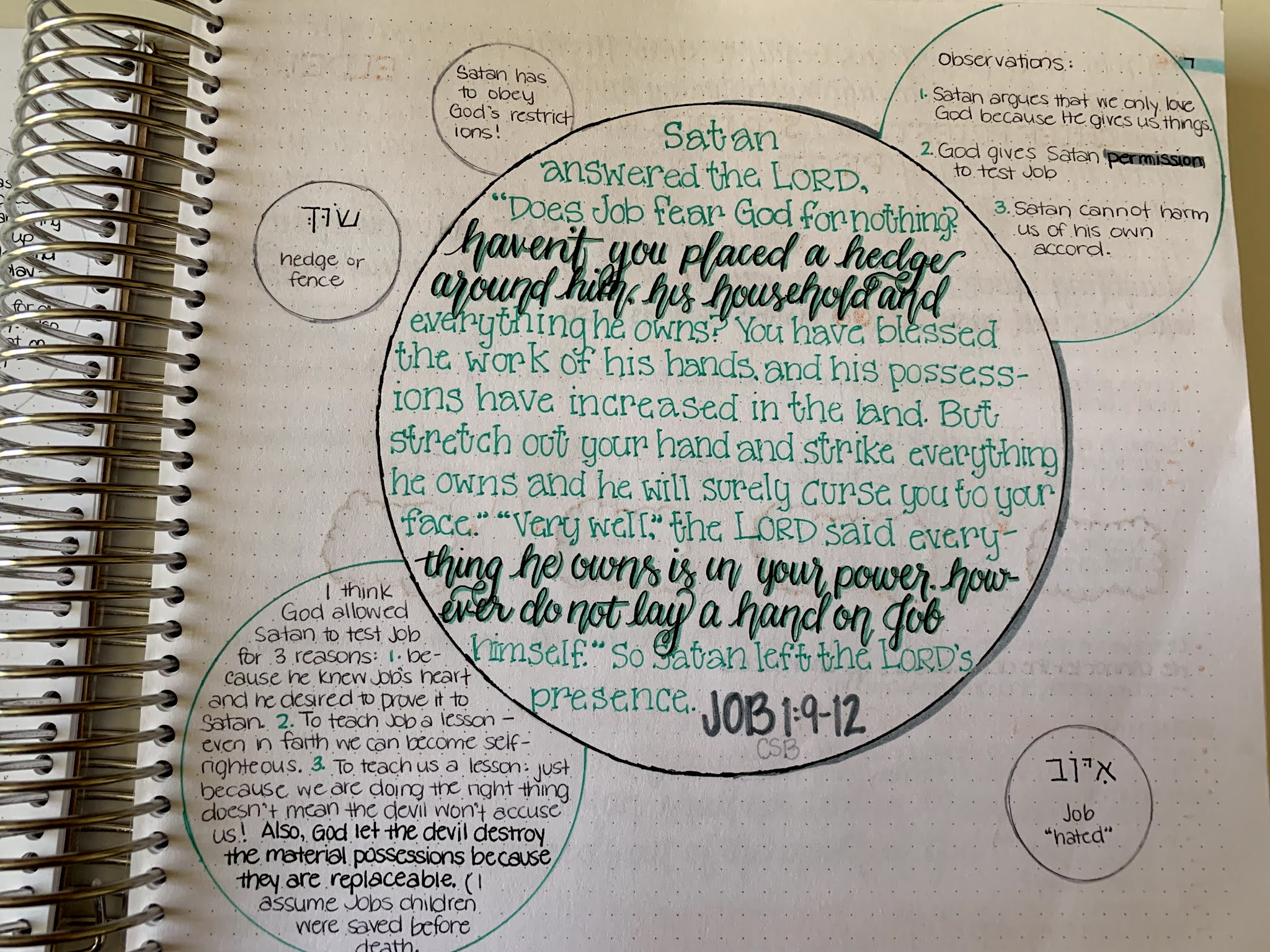
Job 1:6-12: Satan Accuses Job

At the beginning of Job, Satan goes before God. Based on the context that "Satan" means adversary in Hebrew,[3] it is is implied that Satan frequently uses this time to complain about or accuse mankind. Instead of waiting for Satan to call out a particular person, God offers Job as an exemplary human. Satan is not convinced, arguing that Job only loves God because God has made Job successful. God then allows Satan to take Job's possessions and good fortune.

Why Did God Allow This?

The major question is why did God allow Satan to test Job? I think there are a few reasons for this, all of which apply to us today:

First, people often think they know everything until they are proven wrong. Satan had his mind made up about Job and the only thing that would prove him wrong was seeing it for himself. God already knew Job's heart and knew how everything would play out, but Satan did not.

Second, to prove to the sons of God who were also present. When Satan appears before God, the sons of God are also present. There are many intrepretations of who that refers to, but like Satan, these are limited beings who do not know the outcome of the test. If they were within earshot, some might have agreed with Satan, so God had to prove to them, as well, that there are faithful humans.

Third, to teach Job a lesson. (Sidenote, did you know "Job" means hated in Hebrew?[4]) Job was a bit self-righteous and in the end, though he never wavers in faith, God does have to chastise him. Sometimes we need to be reminded to have humility, because no matter how great our faith, we still fall short.

And fourth, to teach us a lesson. The book of Job answers the ultimate queston of why bad things happen to good people. Just like we discuss Job's trials and come to knew understandings about how suffering relates to our relationship with God, Job and his friends did the same thing. In the end, they learned about their own flawwed thinking because of Job's situation. Sometimes, we are the friend learning from our friend's misfortune and sometimes we are the friend going through the misfortune.

Who Does Satan Accuse?

Since we're discussing strategy, a great question is who does Satan accuse. God presents Job as perfect because he has perfect integrity, fears God, and turns away from evil. I seems that these are therefore the principles Satan tries to accuse us of not having. Also, an important observation is that if we do possess all three of these qualities, it is likely Satan wants to prove we don't really have all of these characteristics.

Matthew 16:21-23 Satan Speaks Through Peter

In this passage, Christ attributes the words spoken by Peter as being from Satan. Christ identifies these words as a stumbling block and says the reason is because they put man's desires over God's desires. Satan uses us to express seemingly innocent thoughts that are actually contrary to God; though he can also use us to express thoughts that are obviously contrary to God as well. The major theme in this passage is putting self interest above God.

Peter loved Christ and did not want to see Him die—this is a human inclination and very natural. Many of us would have likely expressed the same sentiments had we been in Peter's shoes. However, it wasn't what God wanted. As a small child, I used to pray/wish the world never ended—that was self interest and self preservation, but it also serves Satan. Our selfish desires always serve Satan. In my case, if the world never ends, Satan is never punished for his deeds and is allow to continue ruling over our world. In Peter's case, if Christ never died, there would be no salvation.

It is important for us to identify our thoughts and discern whether they are of God or not, as well as, identify the speech of those around us. As yourself:
  • Why should I say this? (or why did they say it?)
  • Is it selfish?
  • Is it helpful?
  • Is it necessary?
  • Is it kind?

Matthew 4:1-11: Satan Tempts Jesus

Right before Christ starts His ministry, Satan comes to tempt Him. Christ fends off three attempts by Satan, each of which show Satan's tactics and the only way to respond.[4]

Temptations #1: Weakness

The first thing Satan does is attack Christ's weakness. After fasting for 40 days, it is not surprising that Christ would be hungry. Satan challenges Him to turn stones into bread. In this, Satan is both questioning His ability and tempting Christ to give in to the flesh's desires. Similarly, Satan will come to us when we are weak and tempt us to take something the flesh desires even if it's not appropriate.

Christ responds by quoting Deuteronomy 8:3.

Temptation #2: Promises

The second thing Satan does is attack the promise of God. Satan tries to get Christ to prove God is who He says He is. Satan wants us to believe we have the responsibility of answering for God or proving His existance, when that onus is on the Holy Spirit. Christ did not need to put Himself in harms way to prove God is God because both He and Satan already know exactly who God is. The same is true for us.

Once again, Christ responds by quoting scripture. This time He quotes Deuteronomy 6:16

Temptation #3: Desires

The final thing Satan does is attack a desire. Satan promises Christ rulership from the price of submiting to him instead of God. Like with Eve in the Garden, Satan is offering something already given. Christ is the Son of God, King of Kings and Lord of Lords. The kingdoms Satan was offering to Him were already His. The catch in these situtations is not if you will have the desires of your heart by how you go about trying to get them. Satan's way, usually the easy way or a short cut, is temporary and comes at a high cost. However if we keep the faith and do it God's way, we get lasting results.

Christ respons by quoting scripture again, and quotes Deuteronomy 6:13.

The fact that Christ's only response to Satan is to quote scripture should remind us of the importance of knowing God's Word and clinging to it.

Conclusion

These verses focused on the strategies Satan uses to trip us up and helped me reflect on ways to prepare myself for his attacks.

References & Footnotes

  1. "June Scripture Writing Plan". The Reffled Mango; visited October 4, 2020
  2. "Alphabetical list of Fruits". Fruits Info; visited October 16, 2020
  3. Strong's H347. Job". Blue Letter Bible; visited October 17, 2020
  4. I am aware that this passage is not included in the original list. I just felt it was relevant to the study and decided to slide it in.

Would You Rather?: Betray or Deny

This post received a comment suggesting that this question should not be asked. I would like to clarify that the answer to this question is not to suggest that you should actually betray or deny the Messiah—though we do both in our lives whether we are ready to admit it or not—but to recognize the potential to do either in ourselves. To realize just how much like the people of the Bible we truly are. By understanding the motives and the possible reasoning behind their failures and identifying where we align with these motives and reasonings, the hope is that we can avoid their pit falls. I would also like to clarify that "equal desiring" means "equally not wanting" in this case, in other Would You Rathers it could mean "equally wanting."
Would you rather is a fun game to play, particularly when getting to know someone. A person is asked to choose between two things of equal desiring—making it hard to decide and opening dialouge as to why the person chooses the option they choose. Recently I stumbled accross several versions of "Would You Rather?: Bible Edition" and found the questions quite intriguing. I've decided to answer one every Sabbath. Let me know your answer to today's "Would You Rather?" in the comment section.

Would you rather betray Jesus or deny Jesus?

Answer: Deny

Backstory

Judas Betrays Jesus

Judas, one of the 12 disciples, makes a deal with the authorities to turn identify and turn over Jesus in exchange for money.[1]

Peter Denies Jesus

Peter, also one of the 12 disciples, denies that he knows Christ three times the night that Jesus is taken by the authorities.[2]

Rationale

Depending on how you look at it denying your friendship with a person can be a betrayal, but I think actions boil down to two factors: motivation and consequence.

Judas' motivation for betraying Jesus isn't explicitly given in the text. Some believe it was solely out of greed to get the 30 pieces of silver, others believe it was to "force" Jesus in to taking over the kingdom—remember many thought the Messiah would overthrow Rome and restore Israel to is David-era glory. Because there was money exchanged, I believe his motivation was greed (the love of money is the root of all evil!). Judas was ready to jeopardize his friendship with Jesus, the freedom of the disciples, Jesus' life, and all they had worked for, for a handful of silver. That is the Spirit of covetousness. When we stop caring what happens to those around us just because something seemingly benefits us, we're crossing a dangerous line. A large-scale, modern example of this is covered in The Devil We Know, a documentary about DuPont sabbotaging the water supply around the world in order to continue profitting from Teflon.
Then when Judas, who had betrayed Him, saw that He had been condemned, he felt remorse and returned the thirty pieces of silver to the chief priests and elders, Matthew 27:3 NASB

Peter's motivation was likely fear. I imagine Rome had a "guilty by association" type of system, as many modern countries still operate this way. For instance, if you're at a party where drugs are present, you can be arrested too. If you have knowledge of a crime and don't report it, you're considered an accessory. By modern definition, the disciples would have been considered accessories to Jesus' "crime" and likely would have been arrested too. After Jesus was taken and made it clear that He wasn't gong to put up a fight, Peter and the rest of the disciples went into survival mode. In Peter's case, he sought to put distance between himself and Jesus to avoid the same fate. The most modern example I have of this (where its not just in jest) occurred in my family during my grandfather's era (so early 1900s). There was a portion of my family that was born light enough to pass for white and some of them chose to do so to reap the benefits of being white in the Jim Crow era. In order to do so, they had to deny everyone in the family who could not or would not pass.

Of course neither of these motivations are good, but Peter was forced into survival mode by a situation he had no control over. Judas created the situtaion. I feel that Judas was more deliberate in his action; he thought it out enough to approach the authorities, make the deal, and actually carry out the plan. Judas' actions were premeditated.
56But a certain maid beheld him as he sat by the fire, and earnestly looked upon him, and said, This man was also with him. 57And he denied him, saying, Woman, I know him not. Luke 22:56-57 KJV
The second aspect I mentioned was consequence. I had a friend once tell me he'd rather have someone intend to shoot him but miss than to have someone who loved him but accidentally shot him. In this way, we can have harmless intentions but create very harmful situations. The consequence of Judas' betrayal was the death of Christ. The consequence of Peter's denial was...nothing.

Judas' betrayal doesn't just end with Christ being captured, Christ is tortured and murdered. It doesn't end there either though. In the aftermath of Christ's death, Judas kills himself. Absolutely nothing good comes from his actions (well, minus the fact that we all have enteral salvation now but that was going to happen anyway). On the other hand, Peter eventually repents of his actions, and goes on to become a prominent figure in spreading the gospel.

Ultimately, we make mistakes all the time and in a way, each time we sin we betray or deny God. However, it is our motivation and our willingness to change that ultimately matter. So at the end of the day, I would choose to be a flawwed human who learned from my mistakes and caused little harm over a flawwed human that let my choices be the death of me and another person.

Which would you rather do?

References and Footnotes

  1. Luke 22:1-48
  2. Luke 22:54-62
  3. I found many versions of "Whould You Rather?: Scripture Edition"; this question was found in a version made by Megan of Church Leaders

Would You Rather?: Feed vs. Heal

Would you rather is a fun game to play, particularly when getting to know someone. A person is asked to choose betwen two things of equal desiring—making it hard to decide and opening dialouge as to why the person chooses the option they choose. Recently I stumbled accross several versions of "Would You Rather?: Bible Edition" and found the questions quite intriguing. I've decided to answer one every Sabbath. Let me know your answer to today's "Would You Rather?" in the comment section.

Would you rather be able to feed 5,000 people with five loaves and two fish or heal someone’s blindness?

Answer: be able to feed 5,000 people with 5 loaves and 2 fish

Backstory

Feeding the 5,000

There are two occasions where Jesus feeds a large multitude, but the one one we're focusing on today is when he fed 5,000+ people with only 5 loaves of bread and 2 fish.[1] The disciples were worried, as they knew they didn't have enough food to feed the multitude, but Jesus made the food stretch and we are told that everyone was satisfied. Something people often miss in the narrative is that the number 5,000 only applies to the men present, there were also women and children who ate!

Healing the Blind

Jesus also spent a lot of time healing. One particular instance of Him healing is when He restores sight to a man who was blind from birth.[2] On lookers were shocked that Jesus was able to heal someone who had always been blind. In fact, many did not believe and it caused a bit of a contraversy. This miracle actually led Christ to affirming His divine nature.

Rationale

Based on personal experience, I had a hunch the number of people starving in the world is much greater than the number of people who are blind. In 2016, 10.7% of the world was suffering from undernurishment; this amounts to 815 million people.[3] In contrast, about .52% of the population was blind (about 39 million people) in 2010.[4] Feeding those without access to food seems to be the better choice as I could help more people.

However, as I thought about it, I realized there is more to it than just how many people could be helped. Being blind is unfortunate, but you can live a long and healthy life in that condition. In Biblical times, disabilities such as blindness doomed you to poverty. If a person was born blind there may be gossip about the sins of the parents causing the blindness and other manner of supersition (e.g., John 9). The result was that those born blind or who went blind during those times (and up until recently) had no income and were pariahs in society. This made it much more difficult to survive. Today, fortunately, there are tools to aid those who are blind and help them still be able to function in our society. While it's not ideal—I don't think anyone wants to be blind, it's not life or death. (Disclaimer: I recognize that since I am not blind and have not had anyone close to me that is blind, there may be a lot more to this than I think. For those who are closer to the situation, I would love to hear your perspective in the comment section!)

Conversly, not having the propper nurishment is life or death. Difficiencies in minerals and vitamins can even lead to blindness (as well as many other illnesses). A person can only live about 40 days without food (provided they have great water consumption)![5] Thinking back to images of the food shortage in Venezula[6] and reading about the starvation that claimed many lives in North Korea during the 90's,[7] I can see so much benefit to being able to feed a large amount of people on very little.

Which would you rather do?

References and Footnotes

  1. Matthew 14:13-21
  2. John 9
  3. Crystal Lam. "2018 World Hunger and Poverty Facts and Statistics". World Hunger Education. May 25, 2018
  4. "Global data on visual impairment". World Health Organization; visited August 28, 2020
  5. How Long Can You Live Without Food?". Healthline. January 17, 2018
  6. Stephania Taladrid. "Venezuela’s Food Crisis Reaches a Breaking Point". The New Yorker. February 22, 2019
  7. Paul Chisholm. "The Food Insecurity of North Korea". NPR. June 19, 2018
  8. I found many versions of "Whould You Rather?: Scripture Edition"; this question was found in a version made by Stephen Pepper of Youth Workin' It

The Purpose of Israel

And it shall come to pass
That just as you were a curse among the nations,
O house of Judah and house of Israel,
So I will save you, and you shall be a blessing.
Do not fear,
Let your hands be strong.' Zechariah 8:13 NKJV

Why create a nation?
  • Preserve a culture, way of life (the law), and history
  • Allow for specific prophecy concerning the Messiah

Bible verses tracing "the Seed"
  • Genesis 3:15 (Prophesy)
  • Genesis 4:25 (Seth)
  • Genesis 21:12 (Isaac)
  • Genesis 22:18; 26:4 (blessing the nations)
  • Acts 3:25
  • Acts 13:23 (Jesus)
  • Romans 1:3
  • Romans 9
  • Galatians 3:16,19,29
  • 1 John 3:9

Significance of the Seed
In the episode, I discus the fact that this Seed is a reference to the Messiah, Who brings salvation to the world. However, there is a deeper layer that I did not get a chance to cover. Seed represents reproduction. Not only is the Messiah a descendant of Eve, as prophesied, but He sent the Holy Spirit to reproduce His character in us. We are in turn supposed to sow seed in His image. Wee see this metaphor of seed continuing in The Parable of the Sower (Matthew 13).

Indeed He says,
‘It is too small a thing that You should be My Servant
To raise up the tribes of Jacob,
And to restore the preserved ones of Israel;
I will also give You as a light to the Gentiles,
That You should be My salvation to the ends of the earth.’ Isaiah 49:6 NKJV

4 Biblical Reasons Why I Don't Celebrate Christmas

It's been quite a while since I stopped celebrating Christmas, and no I'm not a Jehovah's Witness. Christmas is America's favorite holiday, and as the season dawns I am inevitably asked to explain why I don't celebrate Christmas. I have several posts on the blog about the history of Christmas and it's pagan origins, I'll list them in references for those who are new to the site. However after overhearing a church leader who knows the history of Christmas "explain" to members of the church why he thinks they can celebrate the holiday, I realized I needed to approach this topic from a Biblical basis not a historical one.

The leader's main point was from 1 Corinthians 8:
4As concerning therefore the eating of those things that are offered in sacrifice unto idols, we know that an idol is nothing in the world, and that there is none other God but one. 5For though there be that are called gods, whether in heaven or in earth, (as there be gods many, and lords many,) 6But to us there is but one God, the Father, of whom are all things, and we in him; and one Lord Jesus Christ, by whom are all things, and we by him. 7Howbeit there is not in every man that knowledge: for some with conscience of the idol unto this hour eat it as a thing offered unto an idol; and their conscience being weak is defiled.1 Corinthians 8:4-7 KJV

His argument was that because we know that the pagan deity originally worshipped on this day is not real, we are free to celebrate the holiday as we choose. I can see how if you have a strong attachment to the holiday and are looking for support, this quote would seem to do the trick. However, we can't just take one quote from the Bible and transplant it into our modern world. We have to look at context and scripture as a whole. It is for that reason, I want to present my reason for not celebrating it from a Biblical context.

Shadrach, Meshach, and Abednego Did Not Bow To The Idol

In Daniel 3, the king of Babylon creates a golden statue of himself meant to be worshipped—an idol. The king declares that anyone not bowing to the statue would be thrown in the fiery furnace. Shadrach, Meshach, and Abednego did not bow to this statue when the time came and were thus thrown into the furnace, but were saved by God, Who joined them in the midst of the furnace.

Shadrach, Meshach, and Abednego were obviously loyal followers of God; they had strong faith and trusted in God to see them through their situation. They knew that the idol set up before them was not a god and had no power over the true God. However, it would have been a sin for them to bow before this statue and would have revealed much about them:
  • Their fear of death
  • Distrust that God protects those who stand for Him
  • A desire to fit in
  • False witness: pretending to worship and thus giving credence to a false god
  • and many more
So, what's the difference between bowing to an idol and eating meat offered to idols? That's what we need to know to understand how this applies to us today.

Historical Context

Today, when you want meat, you go to the local grocery store and buy it. In Biblical days, that's not how things worked. Animals were always slaughtered as an offering to some deity. Sometimes it meant the animal was reduced to ashes, but sometimes it was probably closer to a cookout or a barbecue. If you read the beginning of Leviticus as well as the passages on the Feast Days, you'll notice that the priests and the offerers, were meant to eat the meat of the sacrificed animal. The most well known example of this is the Passover lamb. They were to kill the lamb as a sacrifice to God, and then eat the meat of the lamb in celebration of the Passover. Animals weren't just killed and consumed because someone had a craving for chicken the way we do now. Wether a person had their own animals to kill or had to buy meat from a marketplace, that animal was killed in a sacrifice before it made it to the table.

So, if you lived in Israel, the meat sold in town or served to you at your neighbor's house was probably offered to God first. However, if you lived in the city of Corinth, as the recipients of Paul's letter did, the meat around town was probably sacrificed to some pagan god worshiped by the Romans or the Greeks. This is why people were concerned about consuming that meat.

The difference in consuming this meat and bowing to a statue is active and direct participation in worship of an idol versus an indirect participation. There's a major difference in me taking an animal to a pagan temple and offering it to this false deity then eating the meat and me simply accepting meat offered to me at my neighbor's dinner table. The former being closer to what the king of Babylon was attempting to get Shadrach, Meshach, and Abednego to do, requires the person to go through the motions of worshipping a false deity, whereas the latter is simply a consequence of living in a fallen world.

Modern Examples

Because it is the season, most things in the store have Christmas packaging. Just the other day I saw Walgreen's had made an aisle for "Christmas" candy. If I go to the store and buy a piece of chocolate that has Santa on it, that's a consequence of the fact that I live in America (Rome). I'm going to tear the wrapper off and throw it away, because I just want the chocolate inside. That's different from purposefully buying decorations and decorating my house.

God Does Not Change

One of the arguments the leader brought forth was that Christmas isn't associated with paganism today. I imagine that was brought up in rebuttal to Jeremiah 10:2-4 or 1 Thessalonians 5:22. These verses tell us not to participate in pagan customs and to maintain an image of goodness. The logic put forth here only holds in a select circle. I disagree with the concept that Christmas isn't associated with paganism, or rather I would argue that Christmas isn't associated with Christ.
  1. If Christmas was associated with Christ, there would be no reason for the slogan "Jesus is the Reason for the Season"
  2. If Christmas was associated with Christ, there would be a massive uproar and breach of separation of church and state in that it is a federal holiday
  3. Many of my friends who are atheist, agnostic, or members of an entirely different religion love and celebrate Christmas
  4. Every Hallmark and Lifetime Christmas movie is about finding love, magic, and enjoying the season, but has not a single mention of Christ
I could go on for days, but I think the above list should suffice. Besides, I want to look at this point as though the assumption that Christmas is associated with Christ and Christianity is true. Would it be ok for us to celebrate it now just because it's no longer associated with paganism?

Well, first and foremost, ignorance is bliss (until it gets you in trouble). I don't believe God holds us accountable for things we have no way of knowing. Information hasn't always been easily accessible; that's one of the reasons traditions stick better than the actual Word of God. I know people today who truly believe Christ was born on the 25th of December, and without a doubt over the centuries many people truly believed this. I don't think God is going to say them "hey, you didn't know, but eternal death to you anyway." What I'm discussing concerns those of us that do know or have the ability to learn but choose not to because we don't want to change.

For I am the Lord, I change not;Malachi 3:6

Malachi 3:6 says God doesn't change. When you think about the verses I mentioned earlier (Jeremiah 10:2-4 and 1 Thessalonians 5:22), it's easy to say that it is wrong to participate in pagan festivals. Most Christians today would agree that they have no business playing with a Ouija board or trying out voodoo. Many would still tell you it's wrong to celebrate Halloween, for the same reasons. When Christmas was Sol Invictus or Saturnalia, the early Christians would have known not to go near it. If it was not ok then, how can it be ok now when Malachi 3:6 tells us God doesn't change?

Murder was wrong when Cain killed Abel. Murder was wrong when David had Uzziah killed. Murder was wrong in Jesus' day (Matthew 5:22). Murder is wrong today. The same is true of worshipping idols. To quote Shakespeare, "a rose by any other name would still smell as sweet" and a pagan holiday by any other name is still a pagan holiday.

No Other God

Let's go back to the idea that we know there are none in the same league as God. The pagans actually thought their gods could defeat the Most High God—we see these examples throughout the Bible—but we know there is only one God in Heaven and He reigns supreme. Knowing that God is the only God and only serving God seem to be different things sometimes, though.

Unfortunately, we create our own gods and give them power over us. This is precisely what Adam and Eve did in Genesis 3. Remember, the word "lord" means master. The Lord God is our master. By listening to someone or something over Him, we have chosen a new master. Even though that person or thing may not be a god, we have made them a god in our life. That is, by definition, what consumerism has done to Christmas. People have to have the perfect tree, the perfect lights, the perfect presents, etc. There's a concept of a "good" Christmas vs. a "bad" Christmas. If Christmas is about worshipping God, how do you have a bad one? It's only possible if you let other things creep in.

The fact is, the holiday was created for a pagan deity. Even though he is powerless in the face of the Most High God, people have given this deity power and no matter how hard you try to Christianize the holiday, that pagan deity is lord over it. That's why it's so easy to fall into the trap of consumerism. When asked about the meaning of Christmas, most Christians (and non-Christians) do not say Christ. I've heard "it's about giving" and "it's about family" the most.

My question is, knowing that God never told us to celebrate birthdays (Ecclesiastes 7:1), knowing that Christ was not born on December 25, could you skip Christmas? Whatever it is you do traditionally for the holiday, could you put it aside and treat that day like a regular day? Can you imagine doing it for one year? For two? For ever? If the idea of abstaining from the holiday for even one year bothers you, a false god has power over you. If the idea of giving it up for a little while seems doable, but you could never give it up forever, a false god has power over you. The reason I can tell you this is because I struggle with giving up things too. It took me 4 years to start keeping Sabbath after I started coming to the realization of its importance. I still haven't given up cheese or soda. I'm not judging you, because just like Christmas has power over you, cheese has power over me. I'm simply making you aware of the fact, because you can't combat it until you admit it's a problem.

False Witness

There are plenty of passages telling us not bear false witness, though usually specified against a neighbor, there are also passages telling us not to add or subtract from the Word of God (re: don't bear false witness against God, either). Bearing false witness against God is the devil's greatest tool. How do you take down a leader? Defame his character, and make him look unreliable. I could write a whole book on ways the modern church bears false witness to God, but let's stick to the topic at hand...

For Those Who Engage in Santa

Among Christians who choose to celebrate Christmas, some allow Santa and some don't. I have a whole blog post on the trouble with Santa, so I won't go into detail about that, but I want to reiterate the harm of lying (bearing false witness) to your children about Santa. In an episode of 7th Heaven, when the youngest daughter discovers that Santa (along with the Tooth Fairy, the Easter Bunny, etc.) aren't real, she assumes her parents lied to her about God too. A growing portion of society believes God is a fairy tale like Santa. We, as Christians, have a responsibility to treat God differently, to take Him seriously and to make clear distinctions between fantasy and truth.

Discovery of the Truth

I remember being about eleven or twelve when I discovered that the name I call my uncle is not his name. It's not his first name; it's not his middle name; it's not descriptive... Imagine you've known someone your whole life thinking their name was Robert and you find out their name is actually William John (names are completely random and not my uncle's actual names). I was so confused.

I recognize this confusion in my friends who have abandoned God due to the lies of the church. Let's face it, most people aren't steeped in the Word. Most people don't read the Bible monthly, let alone weekly or daily, not to mention digging deeper to be able to understand context or correlating across books and chapters. A lot of people's entire world has been shattered by the revelation that Christmas has nothing to do with Jesus (among other things). When people discover the religion of the antichrist, the mother god, father god, and son god worship that began with Nimrod, Semiramis and Tammuz,[14] they see parallels in the modern church and decide the whole thing is false. They've been taught their whole life that pagan worship is false, and now what they've been worshipping all their life is the same as what they were taught to reject.

The antichrist isn't a single person that acts in a blatant sinister and evil manner. The antichrist is a power, a fusion of government and religion that seeks to take the place of God's true kingdom. That's always been Satan's goal: to replace God. It's not that this religion is the exact opposite of what God has commanded us, it's that it is being followed in place of God. Some of it will be true and very compelling, but the way we can spot the difference is by identifying the lie.

Here is the lie:
  • Replacing Semiramis with Mary and then elevating Mary. Examples include claiming that Mary was a perpetual virgin, praying to her, creating and bowing to statues of her
  • Asserting that Mary's miracle birth coincided with Semiramis', essentially demoting Christ to the role of Tammuz (who was not a miracle birth and is not the Son of God).
  • Including all the original sun worship elements, such as aligning the date with the winter solstice, halos, and traditions of Sol Invictus/Saturnalia/Yule
Then, before you know it, you're celebrating the false religion in place of the true Word of God.

So many people have trouble separating Christ's birth from the pagan holiday, that understanding the above negates His entire birth in their mind. The first time someone told me Christmas was not in the Bible, I could not differentiate between the holiday we celebrate and the narrative of Christ's birth in Luke 2. It takes a strong foundation and understanding of scripture to learn the truth about Christmas and understand that it has no bearing on Luke 2 because Christ wasn't born on December 25 and Satan has been trying to counterfeit God's promise of salvation since it was prophesied in Genesis 3:15. The reason this is so hard for most people? The church is bearing false witness against the God they claim to serve. In doing so, we endanger the souls of many.

What Does it Mean?

Primarily, it means you will never hear me telling people "Jesus is the Reason for the Season." I am not going to be shouting lies from the rooftop. I am not putting up a tree in my house or "decking the halls" with garland, because I know why that tradition exists. I am not out spending all the money I don't have to buy gifts for people because the world has said that is what Christmas is about. If I see something I think you'll like, I'll buy it when I see it and give it to you when I see you. Giving is 24/7/365.

Do I watched the hallmark movies? Sometimes. Like with the Nutcracker (which I'm going to see a variation of this evening), the story isn't always about Christmas, it just takes place during Christmas. If the focus of the movie is pagan (like The Santa Clause series, Elf, etc.) I'm not going to watch it. You have other examples like This Christmas, which is about a family coming together and it just happens to be set around Christmas. Or the Nutcracker (I just love the music), which is simply about the dream the main character has on Christmas Eve. In those cases I let the Holy Spirit determine what is and is appropriate. Who knows, 5 years from now I may look back at this post and say the god of Christmas still had it's hooks in me and I shouldn't have been watching any of this either.

Am I rude to people who do celebrate Christmas? Not at all. I know that most people celebrate the holiday and most are not aware of the complex history of it. Think of how long this post is, and I have numerous posts that go into more detail and discus things I haven't mentioned here listed below. That's a lot of research, a lot of time, and a long journey. I don't expect people to be in the same place I am. I also know that when the cashier at the grocery store says "Merry Christmas" or "Happy Holidays" they don't want a dissertation. I have no problem with "Happy Holidays" as it includes Hanukkah, which Jesus celebrated (John 10:22). When people say "Merry Christmas", I simply say "I don't celebrate it but thanks, and I hope you enjoy yours."

References

  1. Ree Hughes. "Day 1: The Etymology of Christmas. PSALMS to God. December 25, 2015
  2. Ree Hughes. "Day 2: The Origin of December 25. PSALMS to God. December 26, 2015
  3. Ree Hughes. "Day 3: The History of Santa Claus. PSALMS to God. December 28, 2015
  4. Ree Hughes. "Day 4: Giving Gifts. PSALMS to God. December 28, 2015
  5. Ree Hughes. "Day 5: Lights of the Season. PSALMS to God. December 29, 2015
  6. Ree Hughes. "Day 6: The War on Christmas. PSALMS to God. December 30, 2015
  7. Ree Hughes. "Day 7: Carol of the Bells. PSALMS to God. December 31, 2015
  8. Ree Hughes. "Day 8: Depression and Christmas. PSALMS to God. January 2, 2016
  9. Ree Hughes. "Day 9: Why Red & Green?. PSALMS to God. January 3, 2016
  10. Ree Hughes. "Day 10: Frosty the Snowman & Co.. PSALMS to God. January 5, 2016
  11. Ree Hughes. "Day 11: Christmas Was Un-American Once. PSALMS to God. January 5, 2016
  12. Ree Hughes. "Day 12: The Meaning of Christmas. PSALMS to God. January 6, 206
  13. Ree Hughes. "Is Santa Claus Replacing Jesus". PSALMS to God. December 5, 2015
  14. I found a claim online that the idea the idea of Semiramis, Nimrod, and Tammuz is actually made up. (See here) I did not research the claim so I cannot speak to it's legitimacy, but regardless of where the the trio of mother god, father god and son god came into being, you can in fact see this pattern repeated in many religions. The History of Religion series by TruthUnedited on YouTube is a great way to learn about this deception.

Alone


Season 1 Episode 36


3Then Elijah became afraid and immediately ran for his life. When he came to Beer-sheba that belonged to Judah, he left his servant there, 4but he went on a day’s journey into the wilderness. He sat down under a broom tree and prayed that he might die. He said, “I have had enough! Lord, take my life, for I’m no better than my fathers.” 5Then he lay down and slept under the broom tree.

Suddenly, an angel touched him. The angel told him, “Get up and eat.” 6Then he looked, and there at his head was a loaf of bread baked over hot stones, and a jug of water. So he ate and drank and lay down again. 7Then the angel of the Lord returned for a second time and touched him. He said, “Get up and eat, or the journey will be too much for you.” 8So he got up, ate, and drank. Then on the strength from that food, he walked forty days and forty nights to Horeb, the mountain of God. 9He entered a cave there and spent the night. 1 Kings 19:3-9 CSB

Is it true that you should never be "alone" in your walk as a Christian? Several people have suggested just that, but I think it's a lot more nuanced than that. In fact I think at times you have to stand alone to grow your faith. Let's talk about how alone time builds your relationship with God and the Biblical basis for it.

References and Footnotes

  • Moses at Mt. Sinai - Exodus 19
  • Elijah alone in the wilderness - 1 Kings 19:1-9
  • Messiah alone in the wilderness - Matthew 4
  • Fruit of the Spirit: Gentleness featuring Val

    When I first think of gentleness, I don’t think of me, or anyone in my family. I was locked into a definition of the word that doesn’t fully encompass what it truly means. David, the warrior, was gentle. Jesus, who ridded the Temple of gamblers, was gentle... So I had to redefine the word based on The Word.

    Season 1 Episode 24


    A soft answer turneth away wrath: but grievous words stir up anger. Proverbs 15:1 CSB

    Time
    00:01:04Ree: Hey everybody! Welcome back to the PSALMS to God podcast! Today I have another guest with me, and this time I am back to inviting family to the podcast. This person is really important, and I'm really excited to have them on the podcast, because they have been extremely influential in my life; and you can thank them or blame them—depending on how you feel about the podcast—for me actually having a podcast. So this is my cousin Val. Obviously because she's my cousin, I've known her forever! She's known me before I knew her. She was actually my teacher in elementary school, She was my keyboarding teacher—so you can also thank her for me being a computer scientist, because that's kind of the foundation of working with computers. And then when I got older, she became the Bible study/youth ministry person at the church. She started our youth ministry program, and that's where I learned that I could read the Bible and study it for myself—so that's how I ended up here with this podcast! And now, she does a lot of things with the youth. She is a pastor, and it only seems right to have her on the podcast. So welcome to the podcast, Val!
    00:02:30Val: Thank you! Hello, hello, hello! I am so glad and excited to be here, and I am truly humbled by all that you have said. Oh, my heart is melting. I am so very, very proud of you, though. I tell you. I couldn't even begin to take any credit; I give it all to God, because you are truly powerful, and I thank God that you are such the world changer that you are. So I thank you, because you inspire me to want to be better and do better.
    00:03:02R: Oh man. Circular... Circular inspiration! That's how Christian Fellowship is supposed to work.
    00:03:08V: Cool. So True. Now can we pass that on to the World?
    00:03:09R: Yes. So, since I started doing the podcast, I’ve been doing a series on the Fruit of the Spirit, because I feel like I believe we focus on loving God, and you know believing and all of that stuff, but we don't really think about how that should be changing us as a person, and how that should be reflecting in our everyday life. And I realized that a lot of the Fruit of the Spirit, I don't actually sit down and think about what it means or how it's applied to life. And so I started from the first Fruit of the Spirit—they're all listed in Galatians 5 starting in verse 22—and I've been working my way through. And now we're at gentleness.
    00:03:53V: Nice!
    00:03:54R:
    Photocredit: Unsplash.com/John Reign Abarintos
    And when I started looking at gentleness, I was I was a little shook, because when I first read the word, I was like, “Gentleness?” I was like I don’t think I know anybody that I would describe as gentle.
    00:04:17V: And I don’t know how you called me on this.
    00:04:19R: I was talking to my parents, and I was like, “Nobody in our family is gentle!” We some blunt, short tempered—
    00:04:34V: Uh huh
    00:04:35R: I've started to get worried. I was like, “I don’t have this fruit.” Not only do I not have this, I don't know who to call!
    00:04:44V: And again, you called who? I’m sure I was not your first thought.
    00:04:52R: The deeper I got into it, I actually surprised myself. So I wanted to start... This one is actually going to be a little bit closer to a word association than the other ones, because I really wanted to get out what it actually means to be gentle.
    00:05:09V: Good.
    00:05:10R: So when you hear the word gentle, what do you think?
    00:05:13V: Oh wow. When I hear the word gentle, I think not of me. I’d probably go with what you said earlier about “Oh wow. Hold on. That does not explain... It doesn't really relate to us. But…” Yeah, but when I think of the word gentle, I usually think of someone who may be meek and a little less like back than myself. But I also think about how when an individual is actually gentle, it could cause a person to actually be drawn more to you. So when I think about gentle, I don’t think about me.
    00:06:06R: Yeah. I started writing down things... One of the things I wrote was not blunt, which like I said, I feel like everybody in our family is blunt.
    00:06:15V: Right, right.
    00:06:16R: You know, I wrote down, like, selfless, giving without expectation, showing compassion, able able to deal with like fragile situations; I wrote down comforting, soothing, easygoing—
    00:06:33V: Oooh I like those.
    00:06:34R: And then I looked it up online, and somebody wrote down “humble, polite, and restrained behavior.[1] And I was like “Yeah… That's kind of what I think about when I think about gentleness!”
    00:06:50V: OK. OK.
    00:06:51R: So then I was like, so who? I can't think of a person, like a person I know.
    00:06:58V: Yeah, we can only call Jesus. I’m sorry.
    00:07:00R: So I was like, who in the Bible did they describe as gentle? And of course they described Jesus as gentle. And so I started looking at these verses, and you know there's a verse where Paul says that he comes to people with the gentleness of Christ.[2] I was like, “Yeah, Jesus was gentle!” But then I remembered, Jesus threw the money changers out the temple[3]—
    00:07:24V: Uh oh. You’re about to get serious now. Now it gets deep.
    00:07:29S: Yeah… and I was like, so gentle doesn't mean that you're a pushover; it doesn't mean that you never speak up, and it doesn't mean you're weak.
    00:07:41V: Right. Right. And if it's saying the word gentle, considering that Strong's: it's talking about χρηστότης (chréstotés),[4] which means usefulness. Then if he's turning over the tables, then he's doing it for our good, for their good, and it was useful, because it was a message that even now, we could benefit from—in terms of what's supposed to happen at church. But when people talk about Jesus, and they say “Oh well He was so meek and mild—
    00:08:20R: Jesus had some comebacks.
    00:08:23V: Thank you! Like we'll sit on the same side of the fence and we can really go all day on that one, because I think people fail to see—which is why we lose so many people in church, because when reality sets in, it's like we lied to people. Because yes He was gentle, but on the same token, I think it all as to with what the situation calls for.
    00:08:52R: Yes. Um, I'm going to continue that thought, but before that I'm going to insert, because you mentioned χρηστότης (chréstotés)[4] which is the Greek word that is used in the original. It’s actually there in the original translation of the Septuagint and in the New Testament where gentleness is used as the Fruit of the Spirit.[5] And in some translation it says kindness. And then, I also looked up in Hebrew, for if you're looking to the Old Testament, there's the word chesed[6]—I’m probably pronouncing this wrong; sidenote: I'm learning Hebrew, so bear with me on that—
    00:09:33V: You did that
    00:09:34R: But that's the word that is used in the Old Testament. But back on the situation, so another person that I thought about from the Bible that is also actually gentle that you would not think about is David. We think of David as being a warrior; he slayed Goliath. He was out there doing battle, and he was you know kicking butt and taking names. But when Saul cracked up, and you know. that his possession on with these demonic spirits, it was David playing the harp that soothed him/ David had the gentle hand to soothe him. And David also, when Saul turned and tried to kill David, David didn't kill Saul. He just kept, you know, moving from place to place to avoid Saul. So even though he was a warrior, he was actually gentle.
    00:10:27V: Exactly. And also, I like the fact that you brought David up, and you said the very first thing that you said about him, in terms of what he could have done. Because that spoke volume. Because had the wherewithal, he had the ability to take Saul, but he chose not to. I love the fact that you chose him, because gentleness quite naturally has to be the Fruit the Spirit for him to be able to actually with hold what he had, because that type of disdain... I'm sorry, if you're trying to kill me and I choose—
    00:11:10R: Right!?
    00:11:11V: OK, but he chose to move from place to place; that's only having God in you.
    00:11:18R: Yes, and there's a verse I wrote down... James 3:17. It talks about how gentleness comes from God. Obviously, we know if it's a Fruit of the Spirit, you have to get it from the Holy Spirit, bu that that verse reiterates like you can't do that on your own.
    00:11:36V: Exactly. Exactly.
    00:11:38R: You can't make that kind of decision on your own.
    00:11:43V: That takes a little more wisdom than our own.
    00:11:46R: Yes.
    00:11:47V: And strength.
    00:11:49R: And so, you know, after I thought about Jesus, and I thought about David, and how they... You know they had these gentle moments, but they also had these moments where they were you know they were just real. I started to realize that it's more about how you handle certain situations. So another example from Jesus that popped into my head is when he talks to the Samaritan woman.[7] I mean he's basically reading her, ‘cause he's telling her, you know, “You done had 5 husbands,” and all this stuff.He put it all out there. He didn't sugarcoat it; He didn't like dress it up, but He approached her in private.
    00:12:30V: Right. Right.
    00:12:31R: I wrote down that gentleness is that you feel loved in the process of being told, because what happened is he told her exactly what the deal was, but at the end of it she repented. Because she felt loved in what He was expressing. So that it's a way of being able to tell the truth, in love.
    00:12:55V: Right Right. You know that I think that's what's actually missing, not just... And I speak a lot about what I feel about the Church, when I say the Church I mean the Church as a whole, in terms of the Church and the institution. But ultimately that's across the board, though. Because even in places that, where you have employers, when you have employers who are dealing with employees, you have to have that level of gentleness. Because if not, you will lose respect for those individuals, quickly. When you're saying, “Well I need you to do so and so,” but if you're saying that you need someone to do something, and you say that, and then you have a harshness in your voice (as opposed to a gentleness), you will get something done a whole lot quicker with the gentleness as opposed to the harshness.
    00:14:05R: Yeah. You catch more flies with sugar and honey than with vinegar.
    00:14:09V: Exactly! I think that’s why this podcast is so important, especially to—not just to believers, but also for a lot of younger people, because for a lot of younger people it gives understanding. as to, you know, being a little more tolerant. Because I think both sides; intergenerational we could use more tolerance and more resilience.
    00:14:38R: Yeah. With all of that in mind, I revisited this question of knowing people who are gentle, and I started thinking more about how people approach situations, and how people handle specific situations. And the first situation that popped up into my head is from elementary school. I can't remember if I was in 4th or 5th grade, because I'm getting old, and that was a long time ago.
    00:15:10V: And she’s nowhere near my age. Thanks Ree.
    00:15:16R: But, I was either in 4th or 5th grade, and they were having a play at the school. And I tried out for the play with all my friends. Everyone that I was friends with made the play, like they all got a part in the play, but I did not. I don't even know, like I’ve never had goals to be like an actress or anything like that. That's never been my thing, but I think at the time, I just felt left out, because you know in elementary school—and even in middle school and high school—friendship is kind of based on... It’s just being in the same place at the same time, you know? My friend group typically changed based on what class I was in—’cause we had lunch together, we had recess together. And then as I got high school, most of my friends were in band, because we were always together and things like that. So when all my friends were in this play, and I realized that I wasn't going to be in the play. It’s like OK, so you guys are going to be at the play practice and the rehearsals, and then I'm not going to be there. So when I do see you, I'm going to be like a third wheel, because you're going to be talking about this play all the time that I'm not involved.
    00:16:26R: And so I think... You know and of course, like at that age, you just feel like the world is ending—like you ain't never going to have no more friends, it's horrible, like you're a failure. I don't know why, but you just, everything hits you so much harder when you're younger.
    00:16:43R: And I remember, we must have found out like who made the list and everything right before lunch. So we go to lunch, and we're in the cafeteria. We’re standing in line waiting to get food, and I bent down to tie my shoe. And I think when I bent down to tie my shoe, all of this just kind of hit me. And I did not want to get up. Like I'm basically tying my shoe forever, like about to cry. Just in my feelings about the fact that I have not made this play.
    00:17:17R: And I don't know if you remember, ‘cause you sound like you don't know where the story is going. but...
    00:17:24V: No but actually, believe it or not, a lot of things slide pass my memory. Not that I don’t want to remember it, but it hurts my heart to hear it.
    00:17:37R: So, there are I am, at in the cafeteria, tying my shoe for way too long, not getting up, and there's a teacher, who comes out of the computer room.
    00:17:50V: Huh? Which was my room?
    00:17:52R: Yeah! It was you! You came out of the computer room and you saw me there tying my shoe for forever, and you came and got me out of line to ask me what was going on, and what was wrong.
    00:18:08V: Oh my God! Are you serious?
    00:18:10R: Yeah. And you're the one who told me that the world was ending because I wasn't in this play.
    00:18:15V: God look at you! Jesus! Whoo, thank You, Jesus.
    00:18:19R: And I remember I was like... I was like, “Yeah in that moment, you knew exactly what to say.” I don't remember exactly what you said, but I know that you said something that made me feel better about the situation. Like in that moment, you know, you didn’t can come out and be like “Haha, you didn't make it.” But you, like you came and you were like “OK, I'm going to take you, and I'm going to talk to you.
    00:18:47R: And you know for those who are listening, I have a cousin that is the same age as me. We're both cousin. It’s her niece.[8] And so we were in the same class and she was one of my friends that actually made it into the play.
    00:19:00V: Oh no!
    00:19:01R: Yeah, so when you walked up, you know, everyone was celebrating, and she was saying like “Yay, I'm in the play!” and I'm just like on the ground, like trying not to cry, and so like in that moment you knew that I needed attention. And I'm sure like afterward you came back to congratulate everybody, but I was thinking about that and I was like that is a characteristic gentleness.
    00:19:23V: Oh my Gosh! you just really, really, really, just made my day. I’m still hurt by that, but you know that the irony is that for you to tell me that, you have really just taught me something. And I'm thinking about me as if it weren't even me that did that, if it makes sense. I'm thinking about that person that actually did that, and it's like, when I think back to when you were in the fourth or fifth grade, like that was when I was first moving back down here. So many things were happening in my life during that time, and to hear you say this. And I’m so full, because I’m like “God, I thank You. That You never, you know, allowed me to get so focused on myself, that I forget to do, or neglect to do, what is necessary, even in those times. You know what I mean? Because, if anybody only knew the level of turmoil that I had actually been going through about that time, now—leaving Philadelphia, which you know the money that I made, and you know my cost of living. Everything was pretty good there. I could have been doing better, but I mean my skills were, you know, getting up there. I was, really.. It was like a come up. And so, when I came back, I was trying to get back to that place I was there, which it just seemed like it was a mountain to climb. But to hear this story, now. It’s just… Oh my gosh, it's like so unbelievable. And then for me to like not particularly remember it, I’m humbled. You know what I mean? Believe it or not yeah. I thank God for you, and I thank God that He allowed that situation that happened.
    00:21:24R: Yeah, I mean every moment is a moment to learn.
    00:21:28V: Amen! Oh my gosh, you are so right.
    00:21:32R: After I thought about that, I remember, of course time passed, and when we got into our teen years and you started, you know, the Bible study... You know, I distinctly remember there being push back. You know any time there's change, people in the church get a lil’ concerned, and they don't necessarily like these ideas.
    00:21:56V: Right.
    00:21:57R: And you know, I'm sure we didn't make it easier. Just to give the listeners some background, the church that I grew up in, we are basically all related. So, not only do you have church drama, you have family drama, as well.
    00:22:17V: So True.
    00:22:18R: So we were all about the same age, and we're all like cousins, and we're teenagers... So, we had our dramas and everything. And I remember like we used to have our little rifts or whatever and you would basically have to play like mediator in Bible study.
    00:22:36V: Yes. And we were like pretty much close family.[9]
    00:22:43R: Yeah
    00:22:44V: Like how do you do this?
    00:22:46R: But I remember, like we loved going to Bible study. Earlier in the episode, you were talking about gentleness draws people to you, and I was like “Yeah! I’m glad she said that,” because we loved going to Bible study. And even when I stopped going to that particular church, I used to still come to Bible study.
    00:23:16V: I remember some too.
    00:23:19R: If my memory is serving me correctly, when you left—so you know, she got married and then she and her husband went to her husband’s church; her husband also a pastor, and so they left. And if I remember correctly, I think pretty much everybody[10] stopped going to that church after you left.
    00:23:42V: Oh wow. I’m surprised God still loves me.
    00:23:50R: But I was like yeah there is definitely a gentleness there, even though it's not what we typically think of as gentle; it’s not the first thing that comes to our mind, but like the feeling is there.
    00:24:01V: Awww
    00:24:02R: So I was like I gotta cal Val because it just makes sense to call Val to talk about gentleness.
    00:24:03V: Wow! I don’t know id Wally would agree with that. My husband would be like “what?”
    00:24:15R: Well, tell him to listen to the episode!
    00:24:20V: Yeah right? Yeah, you can teach him. You know it’s funny also that you mentioned about the closeness of everyone, because there was something that RaSha’d[11] said to me like a long time ago. And now listening to you say that, it was like again, I’m humbled by all that. But now you know when you look back on things you pretty much want to tell God thank You for… You be like, “Yes! I’m glad I handled that right.” He was mentioning something about... We were talking about youth ministry, and he said “yeah you know there were times where even though I was your son, I felt like everybody else got better treatment.” I was like well it’s kind of like when you're in a classroom, and nobody should ever give their own child preferential treatment.
    00:25:16R: Yeah, now that you mention it, I do feel like you treated everybody the same. Like it... like I definitely feel like if he did something, you know you was going to call him out for it. And I feel like, like I said, we're all cousins and because I was basically growing up an only child at the time, when I think about it these were like my siblings. And I mean that's how it felt, like we were all just siblings. You know like, I said this is a small family church. It’s the South. Everybody had permission to beat us. Like I felt like if you acted a certain way, she might come ‘cross the table on you, and the probability was just as high for him as it was for anybody else.
    00:26:01V: Or as he would put it: or worse. Exactly though.
    00:26:08R: But you know, that's what that's what made it that's what made it feel like home.
    00:26:13V: Right, you kind of miss those days though.
    00:26:15R: Yes. Yeah, yeah. Now that I'm older and I'm trying to teach youth, I’m like “Oooo weee. How she did that?”
    00:26:22V: You have it. You got it. I already know that you got it. Everybody says, “Shiree’s just like Val. So I’m like OK, you need to own it. In that sense.
    00:26:34R: Had a couple of questions that are for you, more so as a youth leader and as a pastor, and also you know as a parent. ‘Cause you know your walk with Christ changes in each season of your life. You know, you have your season when you're a baby, when you're a teenager, when you're a young believer. And then I've noticed like now that I'm a young adult, things mean different things and I'm starting to learn more. And I assume you know, should God bless me with a husband, things will change once, you know, I transition into married life; and if I have a child, I assume things would change even more as a parent. Since I can only provide the perspective of the young and the single. I was like let me ask Val some questions about gentleness as we grow.
    00:27:23R: The first question that I wanted to ask is as a pastor, how do you deliver the Word of God gently? Like we talked about how Jesus pulled the Samaritan lady to the side, like He met with her in private, to tell her about herself. And I feel like, when you listen to pastors, you have the pastors who are up there just giving you a feel good sermon, and they ain’t really telling you like it is. They just telling you something to make you clap your hands and shout amen. But then you have the pastors that have people kind of like scared to come into the church, ‘cause you know they might be just stepping over the bounds just a little. And like you kind of want to be in the middle, where it's like you're telling the truth but in a way that people will repent and do better.
    00:28:16V: Right, right,
    00:28:17R: And so like how have you been navigating that?
    00:28:18V: Oh my goodness. That’s interesting that you would ask that. But a very long time ago, God was very specific with me. I’m kind of shocked that I was called into the ministry; I was really shocked. Because one I do not like talking in front of a lot of people. Two, I definitely don't like standing in front of people. Three, I don't like people looking at me—
    00:28:46R: You sound like Moses right now.[12]
    00:28:48V: Oh my gosh! You would have to say that as I’m sitting here with Exodus open in my Bible. Yeah, believe it or not, one of my life verses is about Moses actually. But, essentially what God really said to me, and he was very specific about it, was the verse where he talks about don't be afraid of men and their faces.[13] I’m one that… It’s pretty, like you said, it’s profound, actually because they're there were seasons in my life where I just could not say anything. And I just I'm really grateful for him because those are the seasons where He preserved me. And the reason why I say that was because how I would deliver that type of message would be based upon Him. And so, God knows what you need when you need it. Like I'm not one that would say that I'm all out for topical sermons in terms of you know okay for the next two months we're going to just, you know, preach about this, because I just—I mean I love structure, don't get me wrong. But I'm one that I really believe that whatever God has for an individual is what He has for them. And so when He's giving it, you want to be careful to say what He says. And when I heard those words, and I hear them often, where He’s literally saying to me, “You say what I say.” People have, you know, pretty much tried to make me feel like, you know, you have to do this, and you have to do that. People even try to give you a message. And even though I don’t preach every Sunday,[14] I go whenever I'm called to preach, however wherever I’m called to, I’m careful—making sure that I'm hearing from God and not from people.
    00:30:52V: And so, in order for me to deliver that message the way that He would have me to deliver it… Number one, I know that God would not humiliate people; that's not being gentle.
    00:31:06R: Exactly.
    00:31:07V: I know that he would give you a word, just like you stated earlier with with Jesus. He put it out there, but He was careful how He put it out there. Remember when she came to, when the woman was at the well, she came at a time of day where there wasn't a whole lot of people there—
    00:31:25R: And he knew that!
    00:31:26V: Exactly! Because Jesus was strategic that way. It was like, because He was led by God Himself, He knew when to go and when not to go, where to be and where not to be You see what I’m saying?
    00:31:41R: Yes! And He sent the disciples off so that it would just be the two of them.
    00:31:46V: Exactly! And so, believe it or not, that's how I live my life now. And when I say I live my life now is like that, you know that I left the school district. During that season that I was leaving the district I was making the decision: OK, do I go full-time with this nonprofit? Which more less is pretty much... It looks … It kind of resembles the church; it kind of resembles what God is calling for the Church to do, in terms of social justice and in terms of making sure the people aren’t oppressed. And so essentially during that time frame, a lot happened again, you know what I mean? I’m just one that God let stuff happen. I be—as everyone always says, I’m always innocent, but as He's allowing things to happen, all I’ve learned to do is accept what He allows. Because I know that he's allowing it for a purpose, and so if Satan comes for me, obviously God has already given me the tools to deal with what he has coming.
    00:33:04V: And so, just in this past few seasons in terms of, you know, how I say things and what I say to people, I literally was at a point where I really did not preach many messages. I did more speaking to people directly. And so God had me in a season, where as He was preparing me for my next level and my next season, He was also doing something in terms of shielding me. So when I say that I trust God, when I can't trace Him, that's why; because He will always give you a hedge of protection. Like He will have it so that people will not call you to preach. People will not… And you know they may think they’re doing it to harm you, or they may think you know, “We don’t want to hear from her right now;” well that’s fine. Because I know that God has you in a holding pattern for a reason, and so when he shielding you and putting you in that holding pattern, you have to be able to hear from Him for what He's going to do for His people. Anything that happens in your life is not for you. Your anointing was never meant to be for you. Any words that God gives me to speak to people, no matter where I am, whether I’m in the pulpit or not in the pulpit, I have to give it to people the way that God says it. And that means that I won't do it in a way that is offensive to them and cause them not to come into the fold. That's what's missing. If you do not deliver this the way that God will have you to deliver it, you are ultimately causing individuals to lose out on what God so freely gave to us. If I give a gift, you would offend me if you don't take that gift. God gave us a gift. When He allowed His Son to die on that cross, He gave us a gift, and that gift was for the body. And so because that gift was for the body, who are we to cause anybody to be denied of that gift. So I can't let my harsh words cost someone salvation; it’s not mine to give. And they're not my people.They're God's people, and when it comes to souls, we are called to save souls, we're called to bring souls to Christ. God does the saving. He said one plants, one waters, but I'll provide the increase. And so if you see that there is a decrease in the Church, it's because somebody denied somebody of the water that was necessary. There's a thirst and a hunger for righteousness, but not when you see people that are being rude, and mean, and obnoxious from the pulpit, and being Bible toting bullies.
    00:35:54R: That was a great answer. You over there preaching a word!
    00:35:57V: Uh oh. Ok, let me pass the hat.
    00:36:03R: And then, the other question I had was, how do you feel like being a parent has affected your ability to deliver things gently? Because you know I think God gives us the roles of parenting so that we also understand His predicament, because He's the Father and that's our parallel. And I was wondering, obviously God is the originator of gentleness, and like I said, I'm not a parent, but I know that when I was a kid, I might have said and done some things that probably made my mama want to snatch my life back. And so I can only imagine[15]... I was just wondering how that impacted your ability to deliver things gently.
    00:36:57V: Wow. You know, God really does have a sense of humor. It’s so interesting that I wasn’t called into the ministry until he was old enough to be away. But that’s so interesting that you would ask that, because you know that once we got married, we had to raise our son who is actually not my biological child, but yet still, we couldn't necessarily show that. And so in terms of gentleness, and being parent… Being a parent number one, is by far one of the greatest gifts that, you know, anyone could have. However it also comes with challenging times, and because it comes with challenging times, parents have the unique responsibility of making sure that they're in the face of God all the times. Because without having His loving-kindness, you could really have a very, very difficult household. You need God because first of all when husband and wife are coming together, you are kind of like soldering two different personalities, because they have to merge. And so in order those two to become one, they have to come into alignment, they have to come into agreement. And so bringing a third individual into that ultimately means that there will be a cause for a lot of submission. Because that child is going to be the embodiment of what happens in that home, and so because of your example, it is imperative that we remember as parents that those little people grow up to be big people. And so we can either make them as little people, or we can break them as little people.
    00:38:53V: Ultimately, I think that what it would call for is for you to have a genuine relationship with God, because even when you were talking about the scenario about when you were tying your shoe, I had to know that there was another individual there besides those students, and the mother in another individual should be the one that would actually go to you. There should never be a time when an individual is going through on their own, whether you're a child or an adult, because we're here to bear each other's burdens. And when we look for comfort, we can't be so caught up in ourselves that we don't see another person hurting. And so compassion is one that God has given us as a gift. He’s given us a spirit of compassion, so who are we not to share it with others?
    00:39:49R: Yeah! So one of the things, after I was going through all that and I was like, “Yeah. Yeah this is cool,” I realized I had looked up gentleness as a Hebrew word and as a Greek word, but I didn’t actually look it up as an English word, and so I finally got around to looking up the English definition.
    00:40:07V: I thought you were about to say Aramaic. I was like oh gosh, whoa!
    00:40:10R: No. I'm not that good, yet! But when I looked up the English dictionary version, I ended up looking it up in Merriam Webster[16] and I found something that blew my mind. So the very first definition of gentle as an adjectives is belonging to a family of high social standing. You know for the first time I understood the word “gentleman,” because you know they have the word gentleman. I always thought it just meant, you know, he's not a thug, but the way that word actually came into being is that these were men who were from families of high social standing. And what really blew my mind with that being the very first definition is the only way you can receive the Fruit of the Spirit is that you have accepted Christ, you've accepted the Holy Spirit. That means you have surrendered to God, which means He has adopted you as a son or daughter,[17] which means you are a child of the Most High; which means you belong to a family of high social standing.
    00:41:40V: Wow! Look at God! We’re royalty!
    00:41:43R: And I just like “Oh!” I mean if you keep reading the definition, it gets down to like you know delicate and kind, amiable, things like that, but it it mainly focuses on, you know, there are multiple places where it talks about high social standing. And I often wonder because I went back and looked, and there's actually another Fruit of the Spirit that is kindness, which is closely related to gentleness. And I was like I wonder if when he said gentleness, when they first you know translated the Bible into English, and translated you know that word to gentle, I wonder if they actually meant this first definition, that just by nature of accepting the gift that God gave us, we now belong with family of high social standing—and of course with that comes responsibilities.
    00:42:44V: Right. Right. Interesting!
    00:42:48R: Yeah, that was like my mindblower. Like whoa! I was like, this is what happens when you actually look words up in the dictionary. Finding out words I've been using my whole life don’t mean what I thought they meant.
    00:43:05V: You know what? Believe it or not, word studies are probably my favorite, because like when I started going to BSF, that was one of the things that—oh, Bible Study Fellowship—that was one of the things that actually drew me to that. Because they were so in depth, and because of the fact that they literally will teach you things like homiletics and hermeneutics and would give you that push, just to make you just say ”OK, wait I want to know this. I want to know more.” God is so awesome. When we tell people, “Well, make sure you read The Word,” I feel like we do people an injustice, because we don't explain to them what that actually means to read The Word. Because when you talk to anybody, they almost have the same conversation or response: like “I do, but I puts me to sleep.” And I'm just like wait, but The Word of God is like full, and—
    00:44:23R: Rich!
    00:44:24V: Yeah, I'm like I can go and look up one thing, and before I know it, I'm just sitting there like finding something else and going to something else. Like I just can't stop. You know what I mean? Ee always talked about how when you accept Christ, that when you're reading The Word, that God is actually coming into alignment with His Son and that that connection and that relationship; it's so empowered, and it fills us. And so I'm like “No, I don't want to go to sleep. I want more! That would wake you up.”
    00:45:15R: Did you have any final thoughts on gentleness that you wanted to share with the listeners?
    00:45:24V: I like what you said earlier about James 3, and if I can go back to James 3 with you in terms of James 3:17, wherein it said: “ But the wisdom that is from above is first pure, then peaceable, gentle, and easy to be intreated, full of mercy and good fruits, without partiality, and without hypocrisy.” That is so profound.
    00:46:07R:Yes.
    00:46:08V: Oh my goodness that is so major.
    00:46:09R: I feel like this Bible verse—I mean no shade in the Bible verse that is up in the church that I grew up in. It's a great verse— but I feel like this Bible verse should be hung on every wall in every Church.
    00:46:47V: Yes! When we actually think about His goodness and then we we turn around and come in contact with other individuals, how could we even say that we are His children if we don't do these things, in terms of the Fruit of the Spirit, and if we don’t pay homage to that particular verse? We need that! I’m sorry, but that verse was like a mind blower and you know everything you know goes back to interpretation for different stages in life. You know what I mean? I think that’s one that we could possibly say, you know, that God does give wisdom. And even with this that particular verse that He’s pretty much like laying it on the line. You know that goes hand-in-hand with Fruit of the Spirit, because it goes on to say that again pure, friendly, gentle. OK? Sensible, kind, genuine and sincere. But you know what I mean?
    00:48:00R: You gotta have all of it!
    00:48:02V: Exactly! And if we don't do that as the body, ultimately it’s going to be a sad day trying to get people to come to Christ. I mean the Bridegroom is looking for His bride.
    00:48:16V: This is great! I love it!
    00:48:20R: Thank you so much for coming on the podcast!
    00:48:23V: Thank you. Oh my goodness, I’ve had enough church just right now. I’m so full!
    00:48:33R: Alright guys, thank you for tuning in. I hope this was helpful for you guys and beneficial, and that we all know more about what gentleness actually means and how to apply it to our day-to-day lives. As always, citations and transcripts will be in the show notes at www.psalmstogod.com/gentleness. Don't forget to like and subscribe! And I will see you guys next time.

    DON'T MISS

    Book Review,Food,Testimony
    © 2022 all rights reserved
    made with by templateszoo