The life of Abigail is given in 1 Samuel 25. In our introduction to her, we are told that she is intelligent and beautiful, a description that should not be taken lightly. Growing up I heard about Abigail maybe once or twice, but we never really discussed her in detail nor the implications of her behavior on the expectations of being a woman of God.
Showing posts with label YouTube. Show all posts
1 Samuel
Bible Study
Breakfast & Bible
David
imported
People
Women
YouTube
The life of Abigail is given in 1 Samuel 25. In our introduction to her, we are told that she is intelligent and beautiful, a description that should not be taken lightly. Growing up I heard about Abigail maybe once or twice, but we never really discussed her in detail nor the implications of her behavior on the expectations of being a woman of God.
Mediate Like Abigail
The life of Abigail is given in 1 Samuel 25. In our introduction to her, we are told that she is intelligent and beautiful, a description that should not be taken lightly. Growing up I heard about Abigail maybe once or twice, but we never really discussed her in detail nor the implications of her behavior on the expectations of being a woman of God.
Breakfast & Bible
Genesis
imported
Leah
People
Women
YouTube
The Life of Leah
The Bible doesn't give us much to work with when it comes to the life of Leah, first wife of Jacob, but there are definitely tidbits to be gleaned. As one of the most relatable women in the Bible, I think it's important we look at her story and try to understand it from all angles.
Weak eyes sounds like someone with vision trouble to me. Someone in my Sabbath school kept saying she had a lazy eye (I'm not sure where the person deciphered that). Tender eyed makes me think of someone who is gentle and meek being contrasted with someone who is more "in your face." Of course I wouldn't be me if I didn't suggest we go straight to the source!
The Hebrew text uses two words to describe Leah: רַךְ and עַיִן.
רַךְ can mean anything from tender to fainthearted. The official definition says that it means tender or soft, which by implication means weak.[1] Note that this isn't weak in the sense of failing, but weak in the sense of gentle. The same word is used in Deuteronomy 28:56 to describe dainty women and in 2 Samuel 3:39 to describe David as vulnerable. Another example is in Proverbs 15:1: the word rendered "soft" is the same in Hebrew.
The second word (עַיִן) is usually translated as "eye" but it is also translated as face, color, or presence in some places—sometimes it's even translated as fountain or well![2]
The phrase could mean anything from she had a soft presence to she had poor sight (or a lazy eye). What's more is that using Hebrew grammar and the use of the letter "waw" to join the clauses, an argument can be made to tranlsate the verse to use the disjunctive "but" or the conjective "and." Given the latter, the text would read, "Lead was tender eyed and Rachel was beautiful."< a href="#three">[3] Combining that with the ambiguity of the original text, it could actually read "Leah was of soft presence and Rachel was beautiful." We really don't know...
There are several theories about what this phrase actually means, and some of them include a belief that Leah was also beautiful.[4]
There are a couple interesting things here. The main thing is that after all but one of her sons' births she makes reference to her posistion with Jacob. The inference being that she thought Jacob would love her if she gave him a son or that she was being rewarded for not being loved through children. Note that in that time (really even through modern day) a woman's only value was her ability to provide a male heir. The one child she seems to have for herself and simply praises God for without mentioning Jacob is Judah. It is from Judah that we get Boaz, David, Solomon, and eventually the Messiah. It is from Judah that we have the lineage of kings! It is from Judah that the southern region of Israel inherited the name Judea and it's inhabitants would eventually be known as Jews...
Also from Leah is the tribe of Levi, the priests of Israel. All other tribes of Israel were "lost" to Assyria;[5] so we only know of Leah's descendants today and only Leah's descendants are carrying on the legacy.
I make this observation because it is Leah, not Rachel, who is buried in the family tomb. Jacob chose to be buried with Leah instead of Rachel which I find odd.
Another thing I'd like to point out is that just because Jacob favored Rachel, it doesn't mean he mistreated Leah. The fact that Leah had seven children proves that something was going on between them. Now sure, it could have been "duty," but if Leah was "ugly" and truly hated Jacob could have neglected to sleep with Leah. Do you really think Solomon slept with all 1000 of his wives regularly?
I don't know that we'll ever know the exact situation for Leah, but I like to think that even though she wasn't Jacob's favorite, she still managed to live a happy life.
Was Leah Ugly?
Many people assume Leah was ugly because when she is introduced, she is contrasted to her sister's beauty.Leah was tender eyed; but Rachel was beautiful and well favoured. Genesis 29:17 KJVThere are actually several reasons the author could have made this contrast, some of which don't end with Leah being "ugly." In fact, it might not even be a contrast! Below are some thoughts and research on this particular verse.
Dominant Attributes
Have you ever been in an interview where they ask you to describe yourself? Or better yet, they ask you how your friends would describe you? Think of someone you know well; what is the first word that pops in to your head to describe them? Now, thinking more broadly, if you did this exercise for everyone you know, how many times would beautiful be the first word that came to mind? Just because that isn't the descriptor that first comes to mind doesn't mean the person is ugly; it simply means other adjectives are more prominent. Even for someone as high profile as Beyoncé, this first thought that pops in to my head is not beautiful (it's along the lines of her dedication to putting on a high quality show). What we can say for a fact is that the most distinguishing feature for Rachel was beauty, but something else shined brighter for Leah.Comparisons
Speaking of Beyoncé, can you imagine being Solange? I could definitely see someone penning a sentence like "Beyonce was beautiful, but Solange was deep." Both women are beautiful and perhaps both women are deep, but Solange is known more for her sound than her looks. Most people are average looking (that's the definition of average after all). Each of us would be the Solange to Beyoncé, but that doesn't mean we're ugly. Fortunately, most of us aren't surrounded by models, which means it's not as obvious how average we are.What Was With Her Eyes?
Granted, a lot of speculation hinges on just want Leah's descriptor means. There's no ambiguity in the description of Rachel as beautiful, but what does it mean to be "tender eyed" (KJV)? Some translations render this as "weak eyes" (NIV, NASB). One translation actually says "Leah had lovely eyes" (Good News Translation). So what does that actually mean?Weak eyes sounds like someone with vision trouble to me. Someone in my Sabbath school kept saying she had a lazy eye (I'm not sure where the person deciphered that). Tender eyed makes me think of someone who is gentle and meek being contrasted with someone who is more "in your face." Of course I wouldn't be me if I didn't suggest we go straight to the source!
The Hebrew text uses two words to describe Leah: רַךְ and עַיִן.
רַךְ can mean anything from tender to fainthearted. The official definition says that it means tender or soft, which by implication means weak.[1] Note that this isn't weak in the sense of failing, but weak in the sense of gentle. The same word is used in Deuteronomy 28:56 to describe dainty women and in 2 Samuel 3:39 to describe David as vulnerable. Another example is in Proverbs 15:1: the word rendered "soft" is the same in Hebrew.
The second word (עַיִן) is usually translated as "eye" but it is also translated as face, color, or presence in some places—sometimes it's even translated as fountain or well![2]
The phrase could mean anything from she had a soft presence to she had poor sight (or a lazy eye). What's more is that using Hebrew grammar and the use of the letter "waw" to join the clauses, an argument can be made to tranlsate the verse to use the disjunctive "but" or the conjective "and." Given the latter, the text would read, "Lead was tender eyed and Rachel was beautiful."< a href="#three">[3] Combining that with the ambiguity of the original text, it could actually read "Leah was of soft presence and Rachel was beautiful." We really don't know...
There are several theories about what this phrase actually means, and some of them include a belief that Leah was also beautiful.[4]
Marriage to Jacob
One of the biggest mysteries in the Bible (in my opinion) is how Leah ended up married to Jacob in the first place. There are so many questions:- Israelite weddings have several part—like the marriage feast. Presumably these traditions either date all the way to Hebrew traditions (meaning Laban would have honored them too) or are some combination of Egyptian and Caananite traditions with the Hebrew traditions. Either way, during that time, weddings were more than just the one day of feasting and ceremony, so did Leah have her face covered for every part of the celebration?
- Where was Rachel? If you have identical twins and swap them, it makes sort of makes sense that the groom doesn't know the one he wants to marry is in the audience, but if they aren't identical twins, wouldn't Jacob have looked out in the audience and seen Rachel?
- If Rachel didn't look enough like Leah to pass as being Leah in the audience, why didn't Jacob wonder were Leah was? Surely the sister of the bride would be in attendance to your wedding, right?
- Did Rachel know the wedding was happening? Why didn't she say anything?
- Why did Leah agree to marry a man who wanted to marry her sister? Did she have a choice?
- Jacob could have known what was happening and chosen to go alog with the cherade, knowing Laban would have to give him Rachel eventually. This would imply he also wanted Leah as a wife.
- Leah could have had feelings for Jacob despite his desire for Rachel.
- Leah may not have had any suitors and it may have been her only shot at marriage.
- The same way Abraham and Isaac sent for wives from among their own people, Laban may have thought the other men were not worthy of his daughters and thus desired both be married to a near kinsman.
- The Red Tent (a fictional novel inspired by Jacob's family and his only named daughter, Dinah) postulates that Rachel asked Leah to take her place because Rachel was afraid
Getting to Know Leah
Not much is said about Leah, but we do get a glimpse of her thoughts as she names her children.| Birth Order (to Leah) |
Birth Order (to Jacob) |
Name | Meaning | Leah's Comment |
|---|---|---|---|---|
| 1 | 1 | Rueben | Behold a son | Surely God has looked on my affliction (Genesis 29:32) |
| 2 | 2 | Simeon | Heard | Because the LORD has heard I was hated (Genesis 29:33) |
| 3 | 3 | Levi | Joined to | Now this time will my husband be joined to me (Genesis 29:34) |
| 4 | 4 | Judah | Praised | Now I will praise to the LORD (Genesis 29:35) |
| 5 | 9 | Issachar | There is recompense | God has given me my hire (Genesis 30:18) |
| 6 | 10 | Exalted | Zebulun | Now will my husband dwell with me (Genesis 30:20) |
| 7 | 11? | Dinah | Judgment | - |
Also from Leah is the tribe of Levi, the priests of Israel. All other tribes of Israel were "lost" to Assyria;[5] so we only know of Leah's descendants today and only Leah's descendants are carrying on the legacy.
Happily Ever After?
Based on the expressions she has after each child, it would seem that Jacob never cared for Leah, but when you look at the overall story, I'm not so sure. We know that Rachel died giving birth to Benjamin, her second child and Jacob's 12th son. How long after that did Leah live? It's possible that their relationship thrived after the death of Rachel.I make this observation because it is Leah, not Rachel, who is buried in the family tomb. Jacob chose to be buried with Leah instead of Rachel which I find odd.
Another thing I'd like to point out is that just because Jacob favored Rachel, it doesn't mean he mistreated Leah. The fact that Leah had seven children proves that something was going on between them. Now sure, it could have been "duty," but if Leah was "ugly" and truly hated Jacob could have neglected to sleep with Leah. Do you really think Solomon slept with all 1000 of his wives regularly?
I don't know that we'll ever know the exact situation for Leah, but I like to think that even though she wasn't Jacob's favorite, she still managed to live a happy life.
References and Footnotes
- "H7390. רַךְ". Blue Letter Bible; visited May 20, 2022
- "H5869. עַיִן". Blue Letter Bible; visited May 20, 2022
- Paul Tanner, ThM, PhD. Hebrew Syntax. 1997-2004; visited May 20, 2022
- John J. Parsons. "Leah's Weak Eyes". Hebrew 4 Christians; visited May 20, 2022
- I put lost in quotations because there is a verse that says people from the other tribes moved to the southern kingdom during the split, and the tribe of Benjamin also resided there. Thus, technically these tribes still existed, but it is generally thought that they were absorbed in to Judah and Levi.
1 Kings
2 Kings
Breakfast & Bible
Christian Walk
imported
Jezebel
Women
YouTube
Although sexual immorality is a sin, thus making the spirit of sexual immorality a legitimate concern, the Jezebel Spirit is often used by members of the church to attack anything that they perceive as representing female sexuality. Not only have I seen heels associated with the spirit, but jewelry and makeup, as well. While adornment and the concept of modesty are whole topics in and of themselves, they are entangled with the concept of the Jezebel Spirit. Anything that people perceive as a woman doing to seduce a man is often lumped in with the Jezebel Spirit. And while many (probably even most) woman are not thinking about men when they put on their jewelry or do their makeup, those who consider it part of the Jezebel Spirit see it as being done to beautify oneself for the purpose of seduction.
The second thing I did was use the search feature in a digital Bible to find all the references pertaining to Jezebel in the Bible. To my surprise, there are actually two Jezebels mentioned in the Bible: one in the Old Testament and one in the New Testament.
There are, however, a few verses in 2 Kings 9 that seem to explain the link. Jehu says Jezebel has a cult of prostitution (and witchcraft). Also, when Jezebel sees Jehu approaching, she puts on makeup and adorns her head—eye makeup is only ever referenced in the Bible in conjunction with rebellion. This would explain why some pastors denounce makeup and jewelry as part of the Jezebel spirit, and is the only link between Queen Jezebel and sexual immorality.
While a case could be made that this is in fact the origin and root of the Jezebel Spirit, I have to point out two important things before you build a case for this as doctrine. Number one: prostitution, harlotry, and adultery are often used to describe Israel when the nation turns away from God (Hosea is the perfect example of this). Knowing that Jezebel did in fact lead Israel astray and that she is being associated with witchcraft, prostitution may not be a reference to literal prostitution and physical sex, but a statement of her treachery toward The Most High God. Number two: although Jezebel puts on makeup and adorns her head, there is no indication that she does this to seduce anyone or for sexually immoral reasons. Remember she is the queen of a nation and sees a dignitary approaching. This isn't much different than if you were to see someone approaching you door and you brushed your hair or changed into more appropriate clothes. As queen, it's likely that there was an expected look that she felt the need to convey when Jehu arrived.
If the woman is actually being called a Jezebel, this would be evidence that the concept of the Jezebel Spirit was present during the early church and is not a modern invention. It would also solidify the notion that it references the infamous queen of Israel. However, it is also possible that this is a woman named Jezebel who has no relation to the aforementioned Jezebel.
Either way, it is this Jezebel that is explicitly said to have committed acts of sexual immorality and led the people to commit sexual imorality. It seems to me this is where the concept of the Jezebel Spirit, specifically relating to "looseness" and "sexual immorality" gets its origin.
That being said, it is possible that yet still this isn't about literal sex. As mentioned above, the Bible intertwines the concept of idolatry and adultery (sexual immorality). Not only is the Jezebel of Revelation linked with false doctrine and idolatry by way of consuming meat sacrificed to idols, she is being discussed in Revelation, a book full of symbolism. If you step back just one chapter you will see a brillant description followed by an explanation of symbols. Sometimes in Revelation the symbol definitions are in the book (as in Revelation 1), but other times the symbols are given in other books (such as Daniel). Throughtout the Bible a woman represents a church. In Revelation we already see two women contrasted to represent the true Church and remnant (Revelation 12) versus the apostate church and antichrist powers (the Whore of Babylon). The woman spoken of in Revelation 2 could reference a splinter church or sect within the church that was teaching false doctrine. In this case, sexual immorality might not be literal but a reference to idolatry.
Who Was Jezebel?
The Jezebel Spirit
Someone once told me that heels, specifically stilettos, where part of the Jezebel Spirit. If you grew up in the church, especially if you're a woman, you've probably heard of the Jezebel Spirit. Ususally it is applied to women who seem "loose" or promiscious. It is a spirit of haughtiness and sexual immorality, said to be derived from the evil queen who ruled the Northern Kingdon of Israel for a time.[3][4]Although sexual immorality is a sin, thus making the spirit of sexual immorality a legitimate concern, the Jezebel Spirit is often used by members of the church to attack anything that they perceive as representing female sexuality. Not only have I seen heels associated with the spirit, but jewelry and makeup, as well. While adornment and the concept of modesty are whole topics in and of themselves, they are entangled with the concept of the Jezebel Spirit. Anything that people perceive as a woman doing to seduce a man is often lumped in with the Jezebel Spirit. And while many (probably even most) woman are not thinking about men when they put on their jewelry or do their makeup, those who consider it part of the Jezebel Spirit see it as being done to beautify oneself for the purpose of seduction.
The Jezebel Trope and Racism
We know that Jezebel is often used as a slur or deragatory to refer to women, but as a black woman I also associate Jezebel with a trope that has been used to exploit black women. In media, black people are usually pigeon holed in to a handful of roles. For black women you typically have the Mamie figure (e.g., all the women in The Help), the magical Negro (e.g., Bonnie Bennett in The CW's The Vampire Diaries), the strong black woman (e.g. almost any role played by Janet Jackson or Gabrielle Union), and the Jezebel (e.g. any hip hop music video), just to name a few. In modern society, the Jezebel role is quite popular. When attributed strictly to prostitution, Halle Berry's role in Monster's Ball comes to mind first (she even won an Academy Award for the role). LisaRaye in The Player's Club also comes to mind. Usually, however, it's not outright prostitution but a hyper sexualization of the actress and character. Here, I think of many of Megan Good's roles, such as in Think Like A Man. The movie Cuties, though supposedly a commentary on hypersexuality, not only sexualizes young girls, but puts a young black girl at the forefront of this 'sexual discovery.' Nicki Minaj, in general, but specifically in the movie Barbership: The Next Cut. This topic is too large to cover here, but I did want to point out that the Jezebel Spirit is often pointed toward black women disporportionately.[9][1]Modern Arguements Against The Jezebel Spirit
Naturally, today's society pushes back on this concept. Many people seek to redefine Jezebel and repair her damaged repuation.[5][6][7][8] Some compare the smearing of Jezebel's character by associating her with prositution to modern sexism. They argue that because she was powerful, those who opposed her countered by attacking her sexuality. Others argue that it's a case of Biblical authors being taken too literally, as sexual immorality is often used as a desciptor when talking about Israel's idolatry. So, I asked myself, "Who was Jezebel, really?"Who Was Jezebel
The first thing I did was look up the origin and meaning of "Jezebel." In Hebrew the name is actually Izevel and it is linked to Ba'al worship. Likely it means "unexalted" or "where is the prince?"—the latter being a reference to Ba'al worship.[1][2]The second thing I did was use the search feature in a digital Bible to find all the references pertaining to Jezebel in the Bible. To my surprise, there are actually two Jezebels mentioned in the Bible: one in the Old Testament and one in the New Testament.
Old Testament Jezebel
Jezebel of the Old Testament is introduced in 1 Kings 16:31 as the daughter of a king who marries Israel's king. She and her husband worship the Canaanite god Ba'al and lead Israel to do the same. The most significant things attributed to Jezebel during her life are the following:- Turning the people away from YHWH and toward Ba'al
- Murder of the prophets of God (1 Kings 18:4)
- Antagonizing Elijah the Prophet (1 Kings 19)
- Having Naboth killed so her husband can take Naboth's property (1 Kings 21)
There are, however, a few verses in 2 Kings 9 that seem to explain the link. Jehu says Jezebel has a cult of prostitution (and witchcraft). Also, when Jezebel sees Jehu approaching, she puts on makeup and adorns her head—eye makeup is only ever referenced in the Bible in conjunction with rebellion. This would explain why some pastors denounce makeup and jewelry as part of the Jezebel spirit, and is the only link between Queen Jezebel and sexual immorality.
While a case could be made that this is in fact the origin and root of the Jezebel Spirit, I have to point out two important things before you build a case for this as doctrine. Number one: prostitution, harlotry, and adultery are often used to describe Israel when the nation turns away from God (Hosea is the perfect example of this). Knowing that Jezebel did in fact lead Israel astray and that she is being associated with witchcraft, prostitution may not be a reference to literal prostitution and physical sex, but a statement of her treachery toward The Most High God. Number two: although Jezebel puts on makeup and adorns her head, there is no indication that she does this to seduce anyone or for sexually immoral reasons. Remember she is the queen of a nation and sees a dignitary approaching. This isn't much different than if you were to see someone approaching you door and you brushed your hair or changed into more appropriate clothes. As queen, it's likely that there was an expected look that she felt the need to convey when Jehu arrived.
New Testament Jezebel
Arguably, the Jezebel mentioned in the New Testament (Revelation 2:20-23) could actually be a reference back to Queen Jezebel of the Old Testament. The NIV, CSB, ESV, KJV, NKJV, NASB all read as though the author is speaking of a woman named Jezebel. However, the CJB and NLT read as though the woman in question is being called a Jezebel.If the woman is actually being called a Jezebel, this would be evidence that the concept of the Jezebel Spirit was present during the early church and is not a modern invention. It would also solidify the notion that it references the infamous queen of Israel. However, it is also possible that this is a woman named Jezebel who has no relation to the aforementioned Jezebel.
Either way, it is this Jezebel that is explicitly said to have committed acts of sexual immorality and led the people to commit sexual imorality. It seems to me this is where the concept of the Jezebel Spirit, specifically relating to "looseness" and "sexual immorality" gets its origin.
That being said, it is possible that yet still this isn't about literal sex. As mentioned above, the Bible intertwines the concept of idolatry and adultery (sexual immorality). Not only is the Jezebel of Revelation linked with false doctrine and idolatry by way of consuming meat sacrificed to idols, she is being discussed in Revelation, a book full of symbolism. If you step back just one chapter you will see a brillant description followed by an explanation of symbols. Sometimes in Revelation the symbol definitions are in the book (as in Revelation 1), but other times the symbols are given in other books (such as Daniel). Throughtout the Bible a woman represents a church. In Revelation we already see two women contrasted to represent the true Church and remnant (Revelation 12) versus the apostate church and antichrist powers (the Whore of Babylon). The woman spoken of in Revelation 2 could reference a splinter church or sect within the church that was teaching false doctrine. In this case, sexual immorality might not be literal but a reference to idolatry.
Conclusion
As a believer in the Most High God and a servent of the Messiah, my duty is to seek truth, not to follow the trends or what I desire to be true. My goal is to please the Father, not society and not myself. As a millennial and US citizen, my upbringing naturally biases me against the concept of The Jezebel Spirit. This is something I have to be aware of as I read the text and must constantly pray over to ensure I hear God's voice clearly. When I studied this topic, I tried to study from both points of view and in the end, I do believe there is a seductive spirit in our world. Whether this spirit should be attributed to Queen Jezebel or the false prophetess Jezebel, I'm not sure. I do not think all aspects of female sexuality should be lumped in with this spirit, either. God created both male and female as sexual beings to enjoy each other sexually (in marriage); therefore, female sexuality is natural. That being said, I do believe there are things best left for intimacy (re: strictly between a woman and her husband). My conclusion would be that each person should search themselves for motive. Do I behave this way or dress this way because it's who I am and it's comfortable, or becasue I seek attention or validation or because I'm mimicking the people I see on TV? If the Holy Spirit is convicting me, then I'm probably wrestling with a sexual spirit. However, if I pray and the Spirit does not convict me, it is not a sexual spirit (or I've grieved the Holy Spirit away and all hope is lost...but let's assume none of us are doing that!).References
- "Strong's H348. ". Blue Letter Bible; visited March 12, 2022
- Mike Campbell. "Jezebel". Behind the Name; visited March 12, 2022
- "What is the Jezebel spirit?". GotQuestions.org; visited March 12, 2022
- Hope Bolinger. "What is the Jezebel Spirit". Christianity.com. February 7, 2022
- Aysha Winstanley Musa. "Don’t believe The Handmaid’s Tale: the original Jezebel has been much maligned". The Conversation. July 18, 2017
- Wednesday Martin. "Who Exactly Was the Original Jezebel?". Lit Hub. September 20, 2018
- Nyasha Junior. "Jezebel Isn’t Who You Think She Is". Dame Magazine. November 5, 2019
- Heather Donckels. "Book asserts Jezebel was anything but a prostitute". The Spokesman-Review. November 10, 2007
- Janet Howe Gaines . "How Bad Was Jezebel?". Biblical Archaeology Society. March 24, 2021
- "The Jezebel Stereotype" Ferris State University; visited March 12 ,2022
- "Mammy, Jezebel and Sapphire: Stereotyping Black women in media". Al Jazeera. July 26, 2020
Growing in Christ
Podcast
Proverbs
Season 3
YouTube
Condemnation, Correction, & Conviction
Do you know the difference between condemnation, correction, and conviction? How about where they fit in our journey as Christians and how the interplay with one another? Let's talk about these 3 important C's
7One who corrects a scoffer gets dishonor for himself,
And one who rebukes a wicked person gets [a]insults for himself.
8Do not rebuke a scoffer, or he will hate you;
Rebuke a wise person and he will love you.
9 Give instruction to a wise person and he will become still wiser;
Teach a righteous person and he will increase his insight. Acts 2:42 NASB
Condemnation
- Bible Verses on condmenation
- Job 10:2
- Proverbs 12:2
- Condemnation can be a judgment by God or a weapon weilded by Satan
- Satan tries to convince us we are condemned and unworthy of salvation; Satan is a liar
- We should never condmen anyone, instead focus on forgiveness (Matthew 18:22-35)
Correction
- Bible Verses on correction
- Proverbs 9:7-9
- Proverbs 13:24
- Correction is needed to help us grow
- It must be delivered in love, however
Conviction
- Must be internal
- The Holy Spirit convicts us of sin
- This is what gives us the motivation to change and be more Christ-like
References
- "Condmenation". Merriam-Webster; visited June 2021
- "Correction". Merriam-Webster; visited June 2021
- "Conviction". Merriam-Webster; visited June 2021
Art
Christian Walk
Growing in Christ
YouTube
War Binders / Spiritual Journaling
I've been keeping a journal for as long as I can remember. About 4 years ago that journaling turned into something more spiritual; instead of poetry and short stories, it started recording Bible studies, sermons, prayer lists, etc. During the month of May I didn't get to do much journaling and consequently, I didn't read the Bible as much either. For me the process of journaling helps me focus, but it also motivates me to want to study the Word. When I finally settled in to my new place, I was stumped at where to pick up. These types of blocks are common in creative spaces (even in Computer Science), and are almost always solved by going to inspirational sources. I watch a ton of journaling videos, and not just the ones that pertain to scripture—mental health journaling, bullet journaling, art journaling, and more. This reminds me how much I love to journal and gives my ideas for what to do next. Once I got moving again (last Thursday), pages started to flow easily. Before I knew it, I was at page 100 and I thought that deserved a celebration. In hopes that some of this will inspire you as well, I uploaded a video that shows the evolution of my spritual journaling over 4 journals.
Let me know what helps you get creative and your favorite way to journal in the comments below!
Christian Walk
Growing in Christ
Journaling
YouTube
2021 War Binder: Setup + What is it?
Check out one of the ways I strengthen my relationship with God in my latest YouTube video.
I finally ended up with the sweet spot last year this time when I created a journal I called "Woven Together." Before I started it, I made a mental list of what I liked about bullet journaling and what I liked about the bible study journal.
Then I combined them!
Instead of a "table of contents," I have a "list of lists." It's essentially a collection of collections I want to create. After I create the collection, I add the page number to the original list. The primary function of these collections is to brain storm what topics, passages, and words I'm going to study, but I also add collections like favorite worship songs, women of the Bible, favorite passages, names of God, ways to be a better neighbor, etc. When I sit down to study the Word, I flip to my collections and pick a word, passage, or topic to study.
I've really enjored this format and think this is how I'll be journaling for a while. It's really helped to put God at the center of everything. Since I'm coming to the end of that journal, I decided to continue with "Woven Together: Volume 2" in 2021. This time I added back in some of the planning aspects of the bullet journal and I think it's better balanced than the first time I tried this. Do you journal? What style is your favorite?
What is a War Binder?
From what I've seen on the interwebs, war binders were inspired by the movie War Room. War binders are kind of like prayer journals; they're meant to strengthen your relationship with God. It may include scriptures, bible studies, prayers, reflections, etc. To be honest, even though I've seen the movie, I didn't know war binders were a thing until after I had created about 3! My journal consists of notes I take while studying the Bible independently and in small groups, sermon notes, prayer lists, word studies, and many other things. So I think it earns the distinction as a war binder.What is a Bullet Journal?
Bullet journals were invited by Ryder Carroll and popularized on YouTube, Pinterest, and Instagram. Often shorted to "bujo," bullet journals are an alternative to traditional planners. It's a system using lists and symbols to organize (and simplify) the planning process. The typical bullet journal contains monthly layouts, weekly layouts, habit trackers, and collections (a collection is basically a list). The beauty is that you can add to or remove whatever you want from the system because you create it as you go. No two bullet journals are the same. I joined the bullet journal world around 2015 because I loved the flexibility and the creativity.The Mash Up
For a while, I had a notebook for my bible study group and a notebook for my bullet journal. That didn't work so well, so I created the first iteration of my war binder/bullet journal mash-up. It was too bullet journal-y so it didn't really make sense. I was really bad at filling in the table of contents, so bible studies, sermon notes, and devotions were lost in the many pages of the journal. It was a bullet journal, with random studies thrown in. So I went back to separate journals, but something still wasn't quite right.I finally ended up with the sweet spot last year this time when I created a journal I called "Woven Together." Before I started it, I made a mental list of what I liked about bullet journaling and what I liked about the bible study journal.
| Bullet Journal | War Binder |
|---|---|
|
|
Instead of a "table of contents," I have a "list of lists." It's essentially a collection of collections I want to create. After I create the collection, I add the page number to the original list. The primary function of these collections is to brain storm what topics, passages, and words I'm going to study, but I also add collections like favorite worship songs, women of the Bible, favorite passages, names of God, ways to be a better neighbor, etc. When I sit down to study the Word, I flip to my collections and pick a word, passage, or topic to study.
I've really enjored this format and think this is how I'll be journaling for a while. It's really helped to put God at the center of everything. Since I'm coming to the end of that journal, I decided to continue with "Woven Together: Volume 2" in 2021. This time I added back in some of the planning aspects of the bullet journal and I think it's better balanced than the first time I tried this. Do you journal? What style is your favorite?
Favorites
Testimony
YouTube
#TestimonyTuesday - Season Finale of 2020
My 2020 ended with a bang. I've been neglecting the blog because a lot has been going on, but hopefully now that things are sorted out, I'll have more time to start posting again! In my final Testimony Tuesday of 2020, I shared just how much has been going on lately and how God brought me through it. I hope your 2020 ended in a much smoother way, but even if it was just as rocky as mine, I know God is taking care of it for you.
Bible Study
Favorites
Prophecy
Revelation
Satan
YouTube
Satan's Defeat | Dealing With the Devil (Part 6)
Introduction
This is the final peice in a series on a study I did, entitled "Dealing with the Devil," and based on a 30 day scripture plan I found by The Ruffled Mango.[1] In this post, I'm covering the last 4 days—we're going to look at:- Revelation 12:7-10
- Revelation 20:7-15
Revelation 12:7-17: The Battle in Heaven
Satan and his angels go to battle against Michael and his angels. Michael and his angels represent the kingdom of God and are victorious in battle. Upon defeat, Satan is cast down to earth—not hell. This moment in Revelation is thought to be the moment when Jesus/Yeshua ascends to heaven after the resurrection. This is when He truly took the throne. That put us in a "transitional" state, much like that of the U.S. at the moment. Satan refuses to acknowledge God's victory, but the fact is, the day is coming when Christ will come to collect His kingdom.Now judgment is upon this world; now the ruler of this world will be cast out John 12:31 NASB
8And He, when He comes, will convict the world regarding sin, and righteousness, and judgment: 9regarding sin, because they do not believe in Me; 10and regarding righteousness, because I am going to the Father and you no longer are going to see Me; 11and regarding judgment, because the ruler of this world has been judged. John 16:8-11 NASB
Revelation 20:7-15: Satan Defeated For Good
Ultimately only those who submit to Christ are spared from the second death. When Satan is defeated, all those who sided with him, are also defeated. This passage is heavy, but only for those who are not written in the book of life. Those in the book of life are the ones who keep the commandments of God and have the testimony of Christ. We can be thankful knowing that eventually, the devil's reign of terror will end and no one will have to deal with him ever again!References
- "June Scripture Writing Plan". The Ruffled Mango; visited October 4, 2020
Spiritual Gifts
Testimony
Tongues
YouTube
Did I Just Interpret Tongues?
I'm not sure what happened, but one night I dreamed a word that turned out to be a real word in Swahili! Have you experienced this? How does God usually communicate to you?
1 Corinthians 12
Acts 2
Scripture References
1 Timothy
Bible Study
Coveting
Family
Journaling
Leadership
Satan
Violence
YouTube
Though this passage is likely referring to leadership within the church, it is fitting for all areas of our life. We should be exemplifying this definition of leadership in every aspect of our lives. Remember, just because you are not officially a leader, it doesn't mean soemone isn't looking up to you as a leader!
One thing I'd like to call attention to is the statement that a leader should not be a novice. In most organizations I've been in, the president of the organization is required to have been in the organization for some period of time and to have held a position within the executive board (e.g., Vice-President, Treasurer, or Secretary) prior to becoming president. It is unwise to have someone who doesn't understand the process, the history, or the mission, in a position of power.
Knowing this, it also makes sense that the fist test of leadership is your own life and family. Note, that is not to say that if your family does not fit the perfect image that you are a bad person or even that you are a bad leader, however it does mean that perhaps you time should be spent with your family instead. I've often wondered if the reason peacher's children have a reputation for actting out is because they are seeking attention from a parent who gives all their attention to the church. Sometimes we are capable of providing the necessary attention and dedication to both, but sometimes we are not. In the latter case, it's ok to take a break or to step down to focus on family.
We each have a responsibility to hold our leaders to this definition of leadership and to be leaders by this definition.
Leadership | Dealing With the Devil (Part 5)
Introduction
This is a continuation of a study I'm doing on "Dealing with the Devil," based on a 30 day scripture plan I found by The Ruffled Mango.[1] In this post, I'm covering days 19 and 20—we're going to look at:- 1 Timothy 3:1-3
- 1 Timothy 3:4-7
3This is a true saying, if a man desire the office of a bishop, he desireth a good work. 2A bishop then must be blameless, the husband of one wife, vigilant, sober, of good behaviour, given to hospitality, apt to teach; 3Not given to wine, no striker, not greedy of filthy lucre; but patient, not a brawler, not covetous; 1 Timothy 3:1-3 KJV
1 Timothy 3:1-3: Characteristics of a Leader
This passage defines the traits of a "bishop" (KJV) or "overseerer" (NASB), which is simply put, a leader. These traits are echoed in Titus 1:7-9.Though this passage is likely referring to leadership within the church, it is fitting for all areas of our life. We should be exemplifying this definition of leadership in every aspect of our lives. Remember, just because you are not officially a leader, it doesn't mean soemone isn't looking up to you as a leader!
Good Traits to Have
- Blameless
- Monogamous
- Vigilant
- Sober (Sober-Minded)
- Hospitable
- Good Behavior
- Teacher
- Patient
Bad Traits to Have
- Drunken
- Quarrelsome
- Violent
- Greedy
- Covetous
4One that ruleth well his own house, having his children in subjection with all gravity; 5(For if a man know not how to rule his own house, how shall he take care of the church of God?) 6Not a novice, lest being lifted up with pride he fall into the condemnation of the devil. 7Moreover he must have a good report of them which are without; lest he fall into reproach and the snare of the devil. 1 Timothy 3:4-7 KJV
1 Timothy 3:4-7: Pride & Rapport
In the next part of the passage, 2 major things are called out as being behind the fall of a good leader: pride and ill rapport with the poor.One thing I'd like to call attention to is the statement that a leader should not be a novice. In most organizations I've been in, the president of the organization is required to have been in the organization for some period of time and to have held a position within the executive board (e.g., Vice-President, Treasurer, or Secretary) prior to becoming president. It is unwise to have someone who doesn't understand the process, the history, or the mission, in a position of power.
Knowing this, it also makes sense that the fist test of leadership is your own life and family. Note, that is not to say that if your family does not fit the perfect image that you are a bad person or even that you are a bad leader, however it does mean that perhaps you time should be spent with your family instead. I've often wondered if the reason peacher's children have a reputation for actting out is because they are seeking attention from a parent who gives all their attention to the church. Sometimes we are capable of providing the necessary attention and dedication to both, but sometimes we are not. In the latter case, it's ok to take a break or to step down to focus on family.
Conclusion
This passage teaches us about the importance of leadership. The reason it is important to follow God's outline of leadership and to elect Godly leaders is because this is the easiest way for the devil to "take over." If Satan can cause one leader to fall, he can wrestle many souls from God. A perfect example of this is all the heinous crimes committed by so-called leaders of the church, such as the phedophila scandal in Catholicism, that turns people away from God.We each have a responsibility to hold our leaders to this definition of leadership and to be leaders by this definition.
References
- "June Scripture Writing Plan". The Ruffled Mango; visited October 4, 2020
- "Strong's G1985. ἐπίσκοπος". Blue Letter Bible; visited November 7, 2020
- "Strong's G4131. πλήκτης". Blue Letter Bible; visited November 7, 2020
1 Corinthians
2 Corinthians
Acts
Bible Study
Romans
Satan
YouTube
Dealing With The Devil (Part 3)
Introduction
This is a continuation of a study I'm doing on "Dealing with the Devil," based on a 30 day scripture plan I found by The Ruffled Mango.[1] In this post, I'm covering days 10 through 14—we're going to look at:- Acts 13:8-12
- Romans 16:19-20
- 1 Corinthians 5:1-5
- 2 Corinthians 2:10-11
- 2 Corinthians 11:12-15
Acts 13:8-12: Elymas Tries To Sway the Proconsul
Satan uses Elymas, a sorcerer, tried to sway the proconsul (a man of power[2]) from the faith and it ended up backfiring on him! In this passage, we learn that Satan uses trickery and deceit to accomplish things, but we also learn that when we stand up to him, God uses those moments to bring believers to His side instead.Romans 16:19-20: Simple Concerning Evil
Despite their obedience, Paul chides the people on being "wise to that which is good and simple concerning evil." This hit personally, because I have a tendency to complicate issues. We thinking and overthink until we end up not sure which way is up and which way is down. Satan can use this to his advantage.1 Corinthians 5:1-5: Separate From Evil
In this passage we learn about a church that struggled to separate themself from evil. A rotten apple spoils the whole bunch! There were 2 key points I took from this passage:- The devil isn't always external; sometimes we are our own adversary
- If we need to separate from someone, the goal should be to ultimately get them back to Christ
2 Corinthians 2:10-11: Forgiveness is Key
This passage focused on forgiveness and the fact that when we don't forgive each other, the devil can get a foothold in our relationships. It reminded me of church hurt and how we both push people away and allow ourselves to be pushed away. The devil wants us to be separated because that is when we are at our weakest point.2 Corinthians 11: Stay The Course
Sometimes we're tired, overlooked, and overworked; but if we don't do what God calls us to do, the devil will certainly send someone to replace us. There are many false prophets who are just waiting for the spotlight and with that spotlight they can do a lot of damage. It is our responsibility to be where God tells us to be, doing what He tells us to do so that the devil doesn't get to voice his deceit.Conclusion
The biggest take away I took from this selection of passages was that we must call out false teaching and evil. We must take a stand and declare the goodness of God to contrast the devil's darkness. This is how we win souls for Christ and how we keep ourselves from being deceived.References
- "June Scripture Writing Plan". The Reffled Mango; visited October 4, 2020
- "Proconsul". Dictionary.com; visited October 23, 2020
- "Strong's G5218. ὑπακοή". Blue Letter Bible; visited October 23, 2020
Journaling
Tips
YouTube
How I Create My Notebooks for Journaling
I recently made a new notebook, so I decided to take you on that journey with me and share some of my tips.
Supplies You Will Need
Binding System
There are lots of binding systems out there. You'll want to choose the one you like best and gather supplies for it. I used the 4:1 pitch coil binding system, so all I needed was my hole puncher and a coil. If you aren't at the point that you want to invest in a binding system, you can get coil, comb, and heat shrink binding at stores like Staples and FedEx for a fairly reasonable price.Choose What Kind of Paper You Want
I use 65lb white dot-grid paper for most of my notebooks. You can also use patterned paper or lined paper. This is where you get to have fun with the flexibility. If you use "heavy" writing materials in your notebook, like watercolors, brush pens, paint markers, markers, etc., you'll want heavier paper to avoid bleed-through and ghosting. You can use blank paper, or you can print a dot-grid pattern on it. There are also templates for lined paper online.Put it Together
For my coil binding system, I need a pair of pliers to finish it off. You may or may not need this for your system.
Acts
Bible Study
Judas
Luke
Mark
Peter
Satan
YouTube
Note that "seeds fallen to the way side" are seeds separated from the group. In the previous post, we determined that fellowship between Christians is crucial to our walk with Christ and warding off the devil. Another important understanding of "seeds fallen to the way side" is that these seeds are not where they are supposed to be and that makes them vulnerable. If they were in the garden (the proper place), there would likely be a fence and scarecrow protecting them from being devoured before even sprouting.
When I read these verses, I focused more on the applicaiton to protecting self than the question of if I sow seeds in the wrong place. The major concern that struck me was "what if I'm on the path?" Have you ever had a Bible Study or discussion about the Word and you dismissed it? Or maybe you read a few verses and by the time you got to the end you forgot what you've read? I felt like these were examples of me not being in the right place to cultivate the Word.
So, I asked my self, how do we create an envirnoment in our minds that ensures we aren't "on the path"? The following is what I came up with:
In cartoons, there's always the scene where an angel of God is on one shoulder telling the character to do right, while the devil is egging the character on to do wrong from the other shoulder. In real life, God gives us free will and each second of the day we are presented with choices. When we start choosing to listen to the devil more that God's Spirit, we are giving the devil control of our life. This is how he gains a foothold and is able to manipulate our actions.
This is one reason he targets those close to us, but another reason is that they have our trust. We usually trust those closest to us to give us good advice, to keep us safe, and not to put us in compromising situations. This means we are more likely to go along with them. There are people I know that I would never travel with because even though I like them well enough, I have no idea what they will get into. My closest friends, however, I trust to share my values and not put me in an uncomfortable position. Because of this, I'm more likely to go on a trip with one of the latter over the former. So, Satan knows to get to me, he too has to come through the latter.
The saying "choose your friends carefully" rings true here. We want to surround ourselves with people who have our back, but more importantly, we want to surround ourselves with God-fearing men and women who are actively fighting off Satan's attacks.
Four things stood out to me in this passage: Christ already knew the devil's plan, Christ warns Peter about said plan, Christ prays for Peter's faith, and Christ aknowledges that He and Peter will be separated for a time.
Yet, Christ knew Peter would regret His denials and find His way back. Christ didn't have to reveal any of this information to Peter, but by doing so, and by giving Peter a specific task to complete upon his return, Christ exemplifies His forgiving nature and love. When Peter fails, he isn't just left with the feeling that Christ is saya "I told you so." The last thing Christ said about the incident was "when you come back to Me." This means we can return and we will be forgiven!
Like with Peter (from part 1) and Judas, Ananias and Sapphira let Satan guide their actions rather than God. These action (e.g., lying, greed, etc.) are easy to recognize as ungodly. When we have ideas that do not please Him, Satan has put them in our head and carrying out such an action is an offense to God himself, not just the person we hurt (or lie to in this case).
Dealing With The Devil (Part 2)
Introduction
This is a continuation of a study I'm doing on "Dealing with the Devil," based on a 30 day scripture plan I found by The Ruffled Mango.[1] In this post, I'm covering days 5 through 9—we're going to look at the parable of the Sower, the betrayal by Judas, Peter denying Christ, and Ananias and Sapphira's lies.Mark 4:2-4: The Parabale of the Sower (pt. 1)
The Israelites lived in a agrarian society, so analogies to farming or taking care of livestock was the perfect way to explain things to them, and Christ utilizes this in most of His parables. In this case, He speaks of a sower (or farmer) who is sowing (planting) seeds. Plants, vines, and fruit have a long history in the Word—Matthew 7:15-20; John 15; Romans 6:21-22; Ephesians 5:8-10; Colossians 1:10; James 3:17-18; Galatians 5:22-23. From these passages we know this is related to our behavior.Note that "seeds fallen to the way side" are seeds separated from the group. In the previous post, we determined that fellowship between Christians is crucial to our walk with Christ and warding off the devil. Another important understanding of "seeds fallen to the way side" is that these seeds are not where they are supposed to be and that makes them vulnerable. If they were in the garden (the proper place), there would likely be a fence and scarecrow protecting them from being devoured before even sprouting.
Mark 4:13-15: The Parabale of the Sower (pt. 2)
Later in the chapter, Christ explains the parable for us, so we don't have to do any guess work about what He means. He identifies the seeds as the Word and the fowl of the air as Satan. Essentially Christ is saying that when you sow the Word in an unprotected place, Satan will swoop in and steal that information before it can take root.When I read these verses, I focused more on the applicaiton to protecting self than the question of if I sow seeds in the wrong place. The major concern that struck me was "what if I'm on the path?" Have you ever had a Bible Study or discussion about the Word and you dismissed it? Or maybe you read a few verses and by the time you got to the end you forgot what you've read? I felt like these were examples of me not being in the right place to cultivate the Word.
So, I asked my self, how do we create an envirnoment in our minds that ensures we aren't "on the path"? The following is what I came up with:
- Be mindful of what we allow to take up space in our mind
- Pray for retention of the Word
- Be intentional when reading the Word
- Be intentional when listening to the Word
Luke 22:2-4: Judas Betrays Christ
I knew Judas betrayed Christ, everyone knows that. However, I never noticed that the Bible tells us Satan entered Judas. There were three main ideas that I dwelt on after reading Luke 22:2-4.What Does it Mean to be Possessed?
Hollywood has given us very interesting ideas of possession, albiet some passages in the Bible do warn of depravity due to possession. However, in each of the last three passages discussed in the post, you'll see evidence of Satan wielding control over someone and it doesn't look like a madman. Sometimes, people give the devil full access of their mind and body for lengthy periods of time, but in these cases it appears to be a single bad decision.In cartoons, there's always the scene where an angel of God is on one shoulder telling the character to do right, while the devil is egging the character on to do wrong from the other shoulder. In real life, God gives us free will and each second of the day we are presented with choices. When we start choosing to listen to the devil more that God's Spirit, we are giving the devil control of our life. This is how he gains a foothold and is able to manipulate our actions.
Choose Your Friends Carefully
The passage starts off talking about Jesus' enemies, but that's not who Satan enters. Satan goes for the someone close to Jesus, someone in His inner circle. People in our inner circle see us at our best and our worst; they know our flaws and weaknesses. They know exactly the kind of information Satan needs to exploit us.This is one reason he targets those close to us, but another reason is that they have our trust. We usually trust those closest to us to give us good advice, to keep us safe, and not to put us in compromising situations. This means we are more likely to go along with them. There are people I know that I would never travel with because even though I like them well enough, I have no idea what they will get into. My closest friends, however, I trust to share my values and not put me in an uncomfortable position. Because of this, I'm more likely to go on a trip with one of the latter over the former. So, Satan knows to get to me, he too has to come through the latter.
The saying "choose your friends carefully" rings true here. We want to surround ourselves with people who have our back, but more importantly, we want to surround ourselves with God-fearing men and women who are actively fighting off Satan's attacks.
Don't Let Satan Use You
Speaking of God-fearing men and women, we have to be that for our friends. Just like Satan used Judas, he can use us against our friends. When we find ourselves plotting for someone's downfall, that's an indicator that Satan is putting thoughts in our head. It's one thing to think someone should go to jail for a crime, but when we wish bad on people our of jealousy or spite, there's a problem. When we aren't happy for our friends' success or we're ready to tell their business to people we know don't like them, there's a problem. If we find ourselves in these situations or feeling like this, we need to take it to God immediately, because likely, Satan is in our head.Luke 22:31-32: Satan Wants Peter
Satan didn't just go for one person in Jesus' inner circle. He also wanted to take Peter away from the faith. I see Peter's experience more like a Job experience, in the sense that Christ knew Peter had the faith to maintain their relationship.Four things stood out to me in this passage: Christ already knew the devil's plan, Christ warns Peter about said plan, Christ prays for Peter's faith, and Christ aknowledges that He and Peter will be separated for a time.
God Knows All
God is omniscient; He knows all of His creations better than they know themselves. Since Satan is one of God's creations, this is true for him too. Satan can't outsmart God or catch Him off guard. This means He knows exactly which one of His children Satan is plotting against and exactly what test Satan will put before them.God Warns Us
Because God knows what's coming, He often sends us a warning to help us avoid Satan's traps. There are at least three examples of this that come to mind: God warns Cain that sin is lurking before Cain kills his brother (Genesis 4:6-7); Christ sublty tips Judas off to His knowledge of the betrayal, which is in time for Judas to take a different course of action (Matthew 26:21-24); and Christ warns Peter that Satan is trying to get to him (Luke 22:31-32).God Wants us to Succeed
Christ prays for Peter, telling us that He wanted Peter to win against Satan. What's interesting is that of all the things He could have prayed for, He prayed for Peter's faith. This tells us that the main factor in successfully defending against Satan's attacks is our faith.God Knows We Aren't Perfect
Christ makes a point to note that Peter will be "returning" to Him. While this could be literal, since they get separated in the commotion, I have a feeling it's spiritual. Peter goes on to deny Christ three times, which is also a way of separating himself from Christ in it's own right. In doing so he's distancing himself from Christ, the way we may distance ourselves from Christ to fit in or enjoy things of the world. There's a real danger that we will put so much distance between ourselves and Christ that we won't be able to find our way back.Yet, Christ knew Peter would regret His denials and find His way back. Christ didn't have to reveal any of this information to Peter, but by doing so, and by giving Peter a specific task to complete upon his return, Christ exemplifies His forgiving nature and love. When Peter fails, he isn't just left with the feeling that Christ is saya "I told you so." The last thing Christ said about the incident was "when you come back to Me." This means we can return and we will be forgiven!
Acts 5:1-4: Ananias and Sapphira Lie to the Holy Spirit
The final passage for today covers the fate of a couple that lies to the Apostles about a property they sold. They withold part of the proceeds they receive for an unknown reason, choosing to lie about the amount they sold it for. Interestingly, I think they very well have simply said, "We sold our property for x and we're giving you half"—or whatever portion they gave. The deeper issue here is that everyone else was giving everything they had, and this couple was not ready or willing to do the same. Regardless of the reason, we know that God loves a cheerful giver (2 Corintians 9:7), so it would be better to give what you can with joy than to try to keep up with the joneses.Like with Peter (from part 1) and Judas, Ananias and Sapphira let Satan guide their actions rather than God. These action (e.g., lying, greed, etc.) are easy to recognize as ungodly. When we have ideas that do not please Him, Satan has put them in our head and carrying out such an action is an offense to God himself, not just the person we hurt (or lie to in this case).
Conclusion
While the last verses focused more on Satan's stategies, these verses reminded me to watch myself. The main thing I took away from these verses was to watch myself and don't let Satan use me for his on purposes.References
- "June Scripture Writing Plan". The Reffled Mango; visited October 4, 2020
Bible Study
Eve
Genesis
Jesus
Job
Matthew
Peter
Temptation
YouTube
First, people often think they know everything until they are proven wrong. Satan had his mind made up about Job and the only thing that would prove him wrong was seeing it for himself. God already knew Job's heart and knew how everything would play out, but Satan did not.
Second, to prove to the sons of God who were also present. When Satan appears before God, the sons of God are also present. There are many intrepretations of who that refers to, but like Satan, these are limited beings who do not know the outcome of the test. If they were within earshot, some might have agreed with Satan, so God had to prove to them, as well, that there are faithful humans.
Third, to teach Job a lesson. (Sidenote, did you know "Job" means hated in Hebrew?[4]) Job was a bit self-righteous and in the end, though he never wavers in faith, God does have to chastise him. Sometimes we need to be reminded to have humility, because no matter how great our faith, we still fall short.
And fourth, to teach us a lesson. The book of Job answers the ultimate queston of why bad things happen to good people. Just like we discuss Job's trials and come to knew understandings about how suffering relates to our relationship with God, Job and his friends did the same thing. In the end, they learned about their own flawwed thinking because of Job's situation. Sometimes, we are the friend learning from our friend's misfortune and sometimes we are the friend going through the misfortune.
Peter loved Christ and did not want to see Him die—this is a human inclination and very natural. Many of us would have likely expressed the same sentiments had we been in Peter's shoes. However, it wasn't what God wanted. As a small child, I used to pray/wish the world never ended—that was self interest and self preservation, but it also serves Satan. Our selfish desires always serve Satan. In my case, if the world never ends, Satan is never punished for his deeds and is allow to continue ruling over our world. In Peter's case, if Christ never died, there would be no salvation.
It is important for us to identify our thoughts and discern whether they are of God or not, as well as, identify the speech of those around us. As yourself:
Christ responds by quoting Deuteronomy 8:3.
Once again, Christ responds by quoting scripture. This time He quotes Deuteronomy 6:16
Christ respons by quoting scripture again, and quotes Deuteronomy 6:13.
The fact that Christ's only response to Satan is to quote scripture should remind us of the importance of knowing God's Word and clinging to it.
Dealing with the Devil (Part 1)
Introduction
Recently, I started Scripture Journaling. Scripture Journaling is the process of writing out individual passages from the Bible to meditate on them, usually daily. I found a themed plan, entitled "Dealing with the Devil," by The Ruffled Mango.[1] I decided to start with this plan and share both my journal and my thoughts on the passages. I'm also chronicling the experience on my new YouTube channel. I hope you'll join me!Genesis 3:1-5: The Serpent in the Garden
In the garden, when Satan makes his first appearance, he actually reveals a lot about his strategy:- He approaches Eve when she is alone
- He twists God's words
- He envokes FOMO (fear of missing out)
- He offers Eve something she already has
- He, likely, utilizes the fact that Eve added to God's Word
Alone
The only thing God said was not good before the fall, was that man be alone (Genesis 2:18). Satan captializes on the the fact that we are weaker and more vulnerable when we are alone. There are many passages in scripture reminding us not to forsake fellowshipping with our fellow believers (e.g., Hebrews 10:24-25) . When we isolate ourselves, we become vulnerable and Satan will leap at the chance to devour us.Twisting Scripture
Satan manipulates us by taking scripture out of context and twisting it to fit his purpose. Often, he uses our weaknesses to make these incorrect interpretations of God's Word sound good. That is why it is important for us to know God's Word, inside and outside. By meditating on the Word and strengthing our relationship with God, we will be able to discern Satan's manipulations.Fear of Missing Out
We always think we're missing something or that there's something better out there. Eve could eat from any tree in the garden except one, and that wasn't good enough. There are over 2,000 types of fruit in the world,[2] all of which would have been available in the garden. The odds that the fruit on the tree of knowledge was the best fruit in the garden would have been roughly 1 in 2000 or 0.5%, and just Satan convinced Eve that she was missing out by not being able to eat this fruit.False Gifts
Satan lures Eve to eat the fruit by suggesting that in doing so she will become like God. The irony is that she is already like God. God created man and woman in His image, gave them dominion over the earth and the ability to create. Not only was Satan offering Eve something she already had, the ramification of his suggesiton almost cost her that very object. Once man ate from the Tree of Knowledge, we lost our dominion over earth (we gave it to Satan), we lost our ability to be good like God, and we were cast our of our palace (the garden). It is important for us to know that God has already made us heirs to the kingdom. As long as we follow Him, everything belongs to us anyway!Adding to the Word
God told Adam and Eve not to eat the fruit, but when Eve talks to Satan, she says they're not even supposed to touch it! This is the beginning of a pattern with mankind (just look at everything Israel added to what God said). It's also a crack in God's perfect law for Satan to weasel into. Imagine this: Eve has convinced herself that part of God's rule is that they can't touch the tree, but she (or the serpent) is touching the tree and nothing bad has happened. This leads her to doubt anything bad will happen if she eats the fruit. However, it's based on faulty logic because God never said they couldn't touch the tree. We have to stick to the Word as written to avoid these types of situations (Deuteronomy 4:2; Revelation 22:18-19).Job 1:6-12: Satan Accuses Job
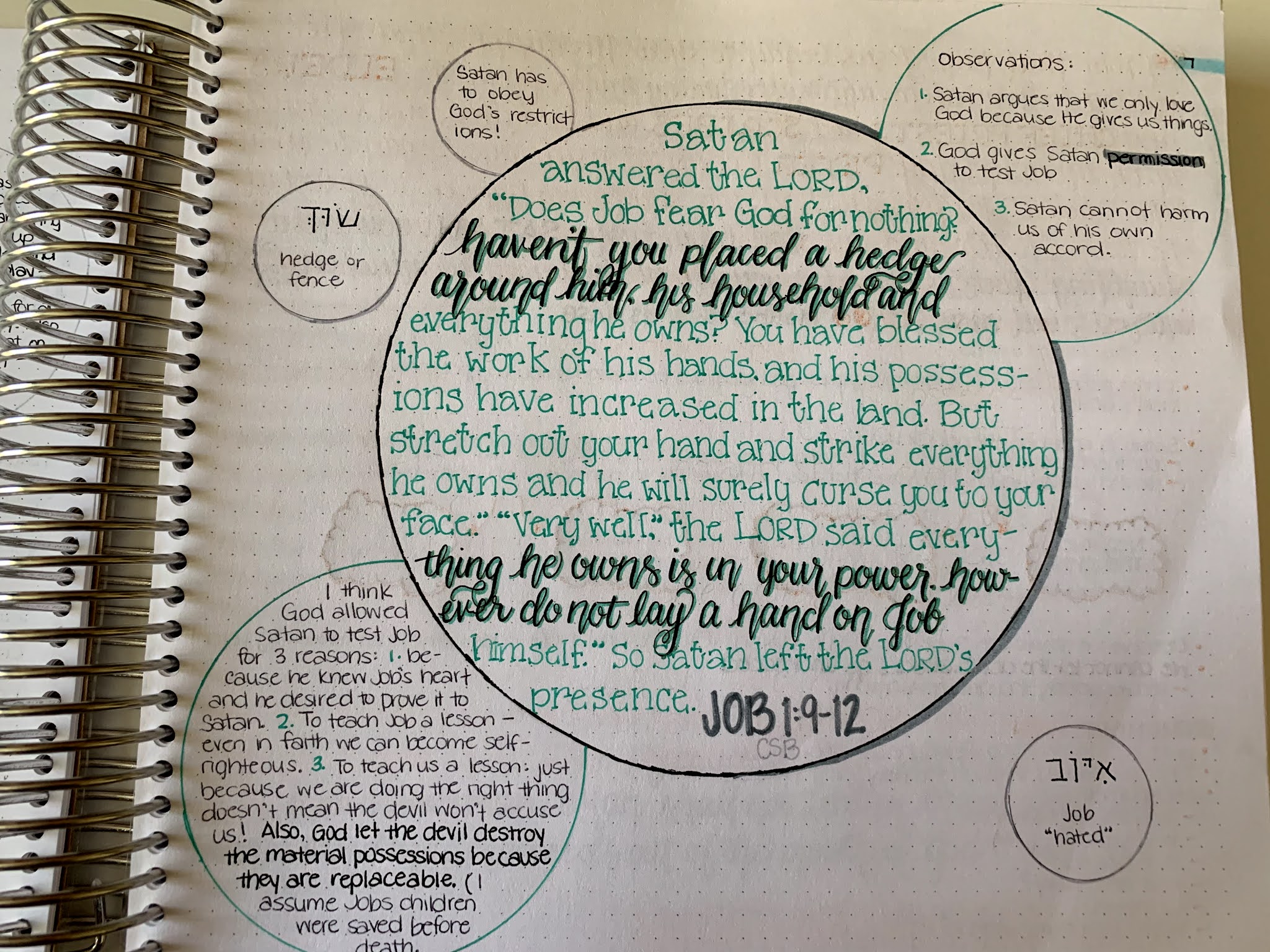
At the beginning of Job, Satan goes before God. Based on the context that "Satan" means adversary in Hebrew,[3] it is is implied that Satan frequently uses this time to complain about or accuse mankind. Instead of waiting for Satan to call out a particular person, God offers Job as an exemplary human. Satan is not convinced, arguing that Job only loves God because God has made Job successful. God then allows Satan to take Job's possessions and good fortune.Why Did God Allow This?
The major question is why did God allow Satan to test Job? I think there are a few reasons for this, all of which apply to us today:First, people often think they know everything until they are proven wrong. Satan had his mind made up about Job and the only thing that would prove him wrong was seeing it for himself. God already knew Job's heart and knew how everything would play out, but Satan did not.
Second, to prove to the sons of God who were also present. When Satan appears before God, the sons of God are also present. There are many intrepretations of who that refers to, but like Satan, these are limited beings who do not know the outcome of the test. If they were within earshot, some might have agreed with Satan, so God had to prove to them, as well, that there are faithful humans.
Third, to teach Job a lesson. (Sidenote, did you know "Job" means hated in Hebrew?[4]) Job was a bit self-righteous and in the end, though he never wavers in faith, God does have to chastise him. Sometimes we need to be reminded to have humility, because no matter how great our faith, we still fall short.
And fourth, to teach us a lesson. The book of Job answers the ultimate queston of why bad things happen to good people. Just like we discuss Job's trials and come to knew understandings about how suffering relates to our relationship with God, Job and his friends did the same thing. In the end, they learned about their own flawwed thinking because of Job's situation. Sometimes, we are the friend learning from our friend's misfortune and sometimes we are the friend going through the misfortune.
Who Does Satan Accuse?
Since we're discussing strategy, a great question is who does Satan accuse. God presents Job as perfect because he has perfect integrity, fears God, and turns away from evil. I seems that these are therefore the principles Satan tries to accuse us of not having. Also, an important observation is that if we do possess all three of these qualities, it is likely Satan wants to prove we don't really have all of these characteristics.Matthew 16:21-23 Satan Speaks Through Peter
In this passage, Christ attributes the words spoken by Peter as being from Satan. Christ identifies these words as a stumbling block and says the reason is because they put man's desires over God's desires. Satan uses us to express seemingly innocent thoughts that are actually contrary to God; though he can also use us to express thoughts that are obviously contrary to God as well. The major theme in this passage is putting self interest above God.Peter loved Christ and did not want to see Him die—this is a human inclination and very natural. Many of us would have likely expressed the same sentiments had we been in Peter's shoes. However, it wasn't what God wanted. As a small child, I used to pray/wish the world never ended—that was self interest and self preservation, but it also serves Satan. Our selfish desires always serve Satan. In my case, if the world never ends, Satan is never punished for his deeds and is allow to continue ruling over our world. In Peter's case, if Christ never died, there would be no salvation.
It is important for us to identify our thoughts and discern whether they are of God or not, as well as, identify the speech of those around us. As yourself:
- Why should I say this? (or why did they say it?)
- Is it selfish?
- Is it helpful?
- Is it necessary?
- Is it kind?
Matthew 4:1-11: Satan Tempts Jesus
Right before Christ starts His ministry, Satan comes to tempt Him. Christ fends off three attempts by Satan, each of which show Satan's tactics and the only way to respond.[4]Temptations #1: Weakness
The first thing Satan does is attack Christ's weakness. After fasting for 40 days, it is not surprising that Christ would be hungry. Satan challenges Him to turn stones into bread. In this, Satan is both questioning His ability and tempting Christ to give in to the flesh's desires. Similarly, Satan will come to us when we are weak and tempt us to take something the flesh desires even if it's not appropriate.Christ responds by quoting Deuteronomy 8:3.
Temptation #2: Promises
The second thing Satan does is attack the promise of God. Satan tries to get Christ to prove God is who He says He is. Satan wants us to believe we have the responsibility of answering for God or proving His existance, when that onus is on the Holy Spirit. Christ did not need to put Himself in harms way to prove God is God because both He and Satan already know exactly who God is. The same is true for us.Once again, Christ responds by quoting scripture. This time He quotes Deuteronomy 6:16
Temptation #3: Desires
The final thing Satan does is attack a desire. Satan promises Christ rulership from the price of submiting to him instead of God. Like with Eve in the Garden, Satan is offering something already given. Christ is the Son of God, King of Kings and Lord of Lords. The kingdoms Satan was offering to Him were already His. The catch in these situtations is not if you will have the desires of your heart by how you go about trying to get them. Satan's way, usually the easy way or a short cut, is temporary and comes at a high cost. However if we keep the faith and do it God's way, we get lasting results.Christ respons by quoting scripture again, and quotes Deuteronomy 6:13.
The fact that Christ's only response to Satan is to quote scripture should remind us of the importance of knowing God's Word and clinging to it.
Conclusion
These verses focused on the strategies Satan uses to trip us up and helped me reflect on ways to prepare myself for his attacks.References & Footnotes
- "June Scripture Writing Plan". The Reffled Mango; visited October 4, 2020
- "Alphabetical list of Fruits". Fruits Info; visited October 16, 2020
- Strong's H347. Job". Blue Letter Bible; visited October 17, 2020
- I am aware that this passage is not included in the original list. I just felt it was relevant to the study and decided to slide it in.
Subscribe to:
Posts (Atom)


PSALMS to God is a podcast, YouTube channel, and blog that aims to serve the LORD in every aspect of life. Whether it's a Bible Study, topics relating to Christianity and Life, the beauty of culture, or poetry, God is at the center of all things here.