Showing posts with label Food. Show all posts

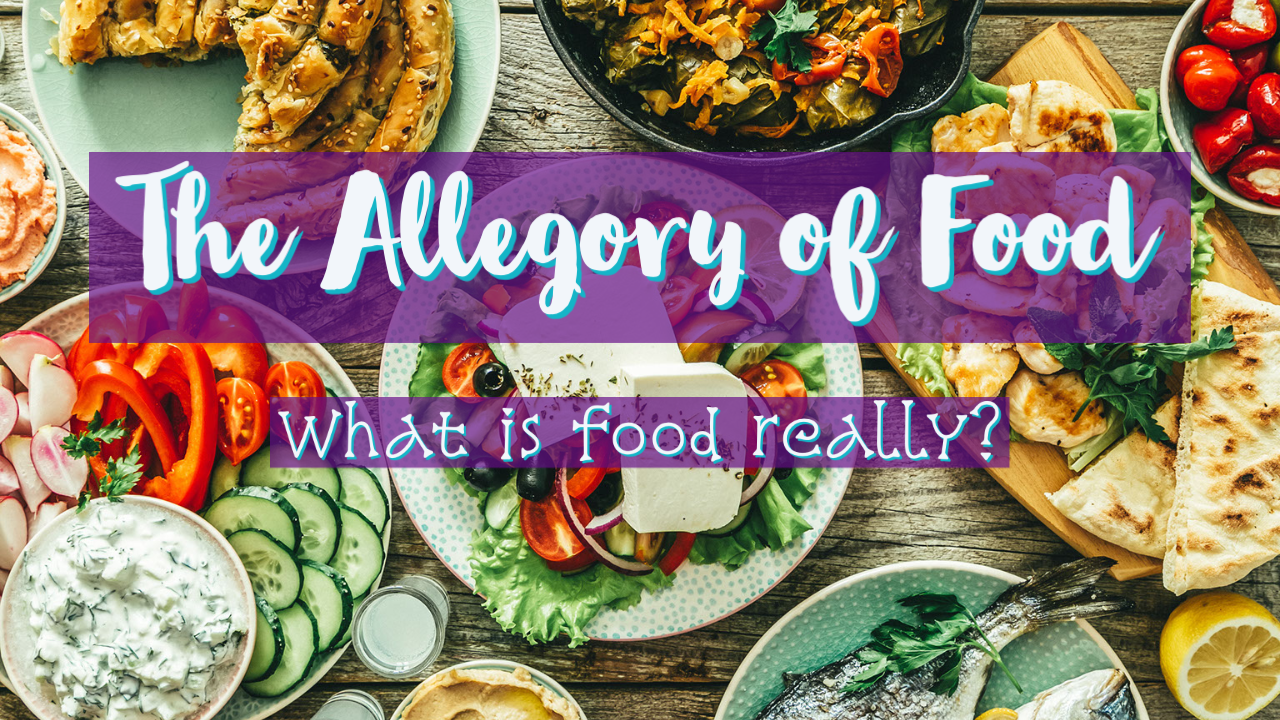
The Allegory of Food

From the fall of man to the last supper, food is at the center of so many crucial moments in the Bible. The more I read the word, however, the more I see that food serves as a stand in for something mcuh more important and our connection to food is heavily correlated to this more important object.

Major Events Centered on Food

The Fall of Man

Most people concerate on disobedience and pride when discussing the fall, but I've always found it fascinating that the test of man's obedience was a fruit. We don't know what type of fruit they eat—thanks to Paradise Lost most people are convinced it was an apple, despite there being no evidence for this. Let's say it was an apple, though, for argument's sake. Can you imagine throwing away paradise over an apple? Of all the fruits that exist in the world—and they had access to all the fruits—an apple is pretty basic. Now, of course I would say that because I've tasted one before and can easily compare it to other fruits. Nonetheless, Adam and Eve were given everything good to eat freely by God. Imagine standing in the grocery store and the manager says you can have anything you want in the store for the rest of your life as long as you don't take [insert a single item]. What item would it take for you to walk away from the deal? Where would you lose your self control? (I'm thinking I'd lose it at salt... How would I season all the food without salt!?)

Food seems like such a minor offense for us to be condemned over. This is probably why most pastors focus on obedience and pride, rather than the notion that our condmened existence is a consequence of eating the wrong fruit. Yet, there's quite the profound correlation between today and what happened then. The popular phrase "you are what you eat" is scarily true. Countless studies have proven that many of the health issues in the United States stem from poor diet. The standard American diet (aptly dubbed SAD) puts you at risk for obesity, diabetes, high blood pressure, high cholesterol, and so much more. People with these underlying conditions are more likely to experience severe COVID or death if infected with COVID-19. It follows (and studies have proven) that diet affects your life span. Also, what you eat provides your body with certain nutrients that help you function. Side effects of not consuming the proper balance of nutrients include fatigue, lethargy, moodiness, and more.

We were not created to consume certain foods!

Manna

In Exodus 16, we learn that while the Israelites were in the wilderness God provided them with a mysterious food called "manna." Manna was perfectly crafted by the Father to provide for their dietary needs and rained from the heavens faithfully everyday (except Sabbath).
And the house of Israel named the bread manna, and it was like coriander seed, white, and its taste was like wafers with honey. Exodus 16:31 NASB
The provision of manna took away the need and worry of foraging for food in the wilderness. Today, much of the Middle East is desert. I'm not sure exactly what the terrain between Egypt and Israel was during Moses' era, but even if it were rich with clean animals and bountiful with plants, it would have been a lot of work to hunt and forage. In my hometown, there used to be a blueberry farm—rows and rows of blueberry bushes kept by one man who used to sell the berries. When he died, no one took over the farm. In a year the weeds were so high it was hard to distinguish the blueberry bushes. Within two years it was a mess of weeds and baby pine trees, and by the third year it had been reclaimed by the forest. No doubt, there may still be blueberries buried in there somewhere, but the bushes are now competing for nutrients with the other plants now growing there and there are no longer neat pathways for one to get to the berries. Plus, some of the bushes likely died, making the quantity of berries drastically smalleer. Add in the fact that local wildlife no has free access to the berries and you can bet that it would be pretty hard to get a significant harvest in it's current state. The same concept would apply in any fertile wilderness.

Similarly, when humans raise cattle and other livestock for food, it may be messy, but it's fairly simple to corral the animals to slaughter. In the wild, one needs to first find the animal and then spear it from a distance as the animals wouldn't be tame enough for you to approach it. For a small family, perhaps this wouldn't be so bad, but for the entire nation of Israel plus the mixed multitude... How many wild animals would you have to find and kill to feed everyone?

The manna was a curcial gift from God that allowed Israel to continue even when they were in a position where they should starve.

Feeding the Multitude

There are multiple times in the New Testament that Jesus feed a multitude with a scant amount of food. I don't know what size the loaves of bread or the fish he carried were, but as someone who has eaten a whole large pizza by myself, I agree that it is miracluous to feed that many people with such a small quantity of food. Now I've heard pastors try to downplay the miracle by suggesting other people added to the meal, but regardless of how the miracle played out, the fact remains that a large group of people were brought together and able to join together from a small and finite quantity of food.

Example Prayer

In the example pray Christ gives us in Matthew 6, He says: "Give us this day our daily bread." Why do you think this was included?

The Last Supper

The final encounter Messiah has with His disciple is the last supper. We know that the early church often ate together and this likely stemed from Christ's example.

What is Food?

Food isn't just food though. Food is the Word of God!
But he answered and said, It is written, Man shall not live by bread alone, but by every word that proceedeth out of the mouth of God. Matthew 4:4 KJV
And Jesus said unto them, I am the bread of life: he that cometh to me shall never hunger; and he that believeth on me shall never thirst. John 6:35 KJV
Reflect back on the events mentioned above and substitute Messiah or the Word of God for food.

Rejecting God

In the garden, the forbidden fruit becomes a false god. The abundant fruits available to Adam and Eve are the true God. You could also think of the forbidden fruit as a forbidden word (it is after all from the Tree of Knowledge), and the other fruits as the pure Word of God. By choosing the forbidden fruit, Adam and Eve choose a false god, a false narative, a false doctrine. In the same way, we pollute our bodies by eating foods not meant for the body, we pollute our minds by consuming words not meant for our soul. Our corrupted bodies is what leads to death, but it is our corrupted minds that cause the trouble of sin.

Salvation

Romans 5:8 tells us that even as sinners who may not have comprehended the gift, Christ died for us. The Word was made flesh (John 1:14) and dwealt with us even though we didn't earn it. This same Word, dubbed the Bread of Life, is what saved us from our sin. If sinlessness was the garden or will be paradise, could we not think of sin as the wilderness? In the wilderness (sin) we need saving (the Bread of Life). This is exactly what the Father demonstrated in Exodus 16 by giving the Israelites manna (bread) while in the wilderness (lost). His promise to them did not end when they created the golden calf or because they complained; He provided this salvation free of charge for whoever would accept it.

Spreading the Word

When Christ feeds so many people with only a few loaves of bread and a couple fish, the food is the Word of God. Although God is infinte, the words written in the Bible are finite. At first, God selected the Israelites to be the keepers of the message—a limited number of people—but after Christ's death and resurrection, the same message was preached everywhere. In short, there is enough of gospel to feed the entire world. What's more, is that although God gave us a finite story, it can be multiplied without being changed. For example, most of Messiah's parables are related to agriculture and farming because that is how his audience could relate. Today, we can relate the exact same message using new parables more applicable to our audience. In this way, the one message is multiplied to educate thousands of cultures the same way the one meal was multiplied to feed thousands of people.

Our Daily Bread

In the example prayer of Matthew 6, Yeshua/Jesus prays "Give us this day our daily bread." We see evidence of God literally giving daily "bread" in the Exodus when manna rained from the heavens everyday (except Sabbath) for 40 years while Israel wandered in the desert. We also see men of God, like Daniel, who understand that the daily "bread" needed is not physical food but spiritual food. These men pray and communicate with God multiple times a day. When we pray this prayer, truly we are asking for daily wisdom from God, daily surrender to His Will, and daily understanding of His Word!

Unity

All of the holy days declared by God included a feast. In the New Testament, we see that every time the disciples get together, there is breaking of bread (re: food). The Bible correlates oneness of the body, celebration, and food. It makes sense that the food is the Word of God. Only when we follow His Word can we acheive unity and peace.

Events Indirectly Related to Food

Eating the Scroll

Both Ezekiel and John are given scrolls to eat while receiving a prophecy from the Most High (Ezekeiel 2-3; Revelation 10:9-10). In both cases, the scroll is described as having a sweet, honey-like taste, and, although described in different ways, bitterness is the end result for both men. Ezekiel leaves feeling bitter, while John has bitterness in his stomach. It makes sense that the Word of God is sweet—the Gospel literally means "good news"—but it also makes sense that it is bitter. The bitterness comes from the reality that there are in fact consequences for not following God, and that we have all fallen short. Every prophet who approached the throne of God was immediately embarassed by their own sinfulness, as we would be if we were to be in His presence today. On top of that, the sweetness that is unconditional forgiveness also applies to our enemies. The same way Stephen was forgiven of his sins, Paul was forgiven for stoning Stephen. There is a bitterness in knowing you must forgive others to receive your own forgiveness. There is also a bitterness in knowing that despite the free gift, not everyone will accept it. As such there are horrible times ahead and those who have accepted the gift will have to endure to the end.

Fasting

Fasting is the process of denying yourself food. I find it such an interesting concept when thinking about the fact that much of the Bible is talking about the importance of "daily bread." Yet, science has shown that fasting is actually good for your body. It gives the digestive system time to heal and rest. Is this true of the Word too? Might there be times where we need to simply reflect on all that we've been given instead of plowing ahead?

Lunchtime Childhood Trauma

This #TestimonyTuesday I wanted to share an experience I had as a child that has deeply shaped my views as a teenager and an adult. Sometimes God swoops in Himself to make a miracle happen, but sometimes, He calls on us to do the foot work. We go through experiences help us learn and to become better people, so we be ready when He calls. This testimony may not have ended with a tidy fix for the issue as a whole, but it did lead me to join the fight.

Footnotes

  1. A recent example: CNN
  2. Learn more about how you can help end hunger: 10 Charities That Fight Hunger

You Are What You Eat: Romans 14

Eating Herbs/Vegetables vs. Eating 'All Things'
2For one believeth that he may eat all things: another, who is weak, eateth herbs. 3Let not him that eateth despise him that eateth not; and let not him which eateth not judge him that eateth: for God hath received him. Romans 14:2-3 KJV

Introduction

Photocredit: Unsplash.com/Stefan Vladimirov
I started the You Are What You Eat Series a long time ago and for some reason, I never finished it. I believe I became tied up with life, probably the podcast, and other ideas. Eventually I forgot I had even started the series. However, I still feel like this is an important topic so I'm picking up where I left off and continuing. If you only recently began following the blog, I'd advise you start from the beginning of the series with "You Are What You Eat: Introduction".

Romans 14:2-3 is the second verse that comes up in defense of eating unclean meat when talking about the dietary law post-Crucifixion that I actually understand why people are confused. This verse explicitly says someone who is weak (in the faith) only eats herbs, implying that the strong in faith eat meat. Unlike the verse we mentioned before in 1 Timothy, there doesn't seem to be a qualifier on meat because it explicitly says "all things." So, why does Isaiah 66 condemn the man eating pork in the end times? Why does Acts 15 tell us we can't eat blood?

Breaking Down the Scenario

We already spoke about the concept of "all" things in previous posts. I can't eat poison or metal; I can only eat things that are edible. As with the other verses we've studied, we should also keep in perspective that Romans was written by Paul, who was Jewish. "Edible" would have referred to clean meats only in his mind. Nonetheless, let's look at the whole scenario and put it in context.

The scenario presented is that there are two men eating somewhere. The one who is strong in faith eats everything on the menu. The one who is weak in faith only eats herbs, re: vegetables. Think about this: the contrast of all things is herbs, not clean meat. If Paul was saying it was ok to eat unclean meat, why would he compare it to vegetarianism? We do not have a juxtaposition of unclean meats (such as pork or shellfish) and clean meats (such as chicken or beef), which are also not herbs/vegetables. So, wthy does the weak in faith believe he cannot eat the chicken on the menu?

In an episode of his radio broadcast,[19] Pastor Doug Batchelor concludes that Paul was referencing foods sacrificed to idols. Of course that muddies the water with Acts 15, which clearly forbids eating food sacrificed to idols. If we bring in 1 Corithians 8 and 1 Corinthians 10 as well, we can get a clearer view of what the actual problem is.

The Gentiles whom Paul wrote to lived an experience completely different from the Jewish Christians. To make a modern parallel, a Jewish follower of Christ interacting in Judea is like a Baptist interacting with a Methodist or Pentacostal. Fundamentally, they believe the same things and use the same scriptures for reference. The differences between them are so small that its possible for them to not even notice. In contrast, a Gentile convert interacting in Rome is like the same Baptist interacting with a Muslim or Hindu. The differences in belief will become apparent much more quickly.

One of these diffrences concerns meet sacrificed to a deity. During this time period, all meat was sacrificed to some deity before being consumed. In Israel, this deity was YHWH, but in Rome it could have been any one of their gods or goddesses. When this food was presented to a Gentile Christian, it presented a conundrum. Someone who was born in paganism may see the meat and instantly be reminded of ritual cermonies to pagan deities—associations cannot be removed overnight. Yet others knew they had not only had they not participated in the ritual, but the god who'd "received" the sacrifice wasn't real. Those who struggled with separating from the their previous lives, abstained from the meat all together (the way a recovering alcoholic may abstain from all alcoholic drinks).

In both 1 Corinthians and the passage in Romans 14, Paul is addressing the disparity between those who can and cannot detach themselves from the pagan lifestyle. In a perfect world, no one would be concerned with who the meat was sacrificed to because everyone would know there is only one God and would understand that there need not be anymore sacrifices anyway. However, since we do not live in a perfect world, Paul must advise on how to hand this matter. The advice given is to act in love and avoid being a stumbling block. New Christians (and even pagans), who saw a person eating meats sacrificed to idols may become confused and believe it is a sign of worship for the false deity. When offered meats sacrificed to idols, the strong Christian was to decline the meat not because the meat was actually tainted, but to ease the conscience of the weaker believers around him/her.[2][3] This also set the Christians apart from pagans by showcasing their dedication to YHWH.

Conclusion

In this passage Paul is not speaking of clean versus unclean. Paul is speaking of (clean) meat vesus not eating meat at all.

Up Next: Acts 15

The next post in this series will tackle Acts 15. There is already a post in the Bible Study section on Acts 15, though it is not specific to the clean vs. unclean meats discussion.[6]

References

  1. Pastor Doug Batchelor. "How does Romans 14 fit with biblical direction to avoid unclean meat?". Amazing Facts; visited 2017 and September 12, 2020
  2. What does the Bible say about eating food/meat that has been sacrificed to idols?". GotQuestions.org; visisted September 12, 2020
  3. Tom Martincic. "Romans 14: Who is the weak brother?". EliYah; visited September 12, 2020
  4. Pastor Joe Crews. "Hogs And Other Hazards". Amazing Facts; visited September 12, 2020
  5. United Church of God. "". Beyond Today. January 31, 2011
  6. Ree Hughes. Acts 15: Disagreements in the Church". PSALMS to God. July 1, 2020

Would You Rather?: Famine vs. Plagues

Would you rather is a fun game to play, particularly when getting to know someone. A person is asked to choose betwen two things of equal desiring—making it hard to decide and opening dialouge as to why the person chooses the option they choose. Recently I stumbled accross several versions of "Would You Rather?: Bible Edition" and found the questions quite intriguing. I've decided to answer one every Sabbath. Let me know your answer to today's "Would You Rather?" in the comment section.

Would you rather live through a famine and live through the 10 Plagues of Egypt?

Answer: the 10 Plagues of Egypt

Backstory

Famine

There are several famines mentioned in the Bible. We see them as early as Abraham's lifetime and they continue even until today. Israel experiences a few famines as a nation as well. Two of the worst famines (in my opinion) that occured in Israel's history are the one that lead them to Egypt[1] and the one that occured during the siege on Jerusalem in 70ad. The former lasted for 7 years and was eased by God's revelation through Joseph to the Pharaoh of Egypt. The latter was much shorter but so extreme that people resorted to cannibalism.[3]

The 10 Plagues

When God delivered Israel from Egypt, He did so by striking the land of Egypt with 10 plagues.[2] The plagues were as follows: water to blood, frogs, lice, flies, disease on the livestock, boils, hail, locusts, darkness, death of the first born.

Rationale

I know you're thinking, "why on earth would you pick the plaques!?" Hear me out...

As mentioned earlier, several famines occured during Biblical times. My thought process stems form the famine that brought the Israelites to Egypt in the first place (I feel like it's the one that would come to people's mind first, especially juxtaposed to the plagues of Egypt). It lasted 7 whole years—that is a long time to have a food scarcity. Thanks to God's revelation through Joseph, Egypt was able to stockpile food, but they still had to ration it to make sure it lasted the 7 years. Best case, that's 7 years of dieting; worst case, there's riots and cannibalism...
And there was no bread in all the land; for the famine was very sore, so that the land of Egypt and all the land of Canaan fainted by reason of the famine. Genesis 47:13 KJV

The Bible doesn't tell us how long the plagues took, but the key here is that God's people only suffered the first three plagues (turning the water to blood, frogs, lice). After the first 3 plagues, the Israelites were simply spectators, watching God reveal His glory. There were at least 7 days between the water and the frogs, though it doesn't say when the plague on the water stopped. Between each of the other interactions Pharaoh has with Moses, he requests the plagues to end and Moses does so. With this in mind, each of these would last for a relatively short period of time. The worst of the three mentioned, in my opinion, is the water to blood. It would be like a famine during that time because you couldn't get water to drink, cook with, wash with, etc. The frogs would be more of a nuisance than anything else and hair grease will protect your scalp from the lice.
And I will sever in that day the land of Goshen, in which my people dwell, that no swarms of flies shall be there; to the end thou mayest know that I am the Lord in the midst of the earth. Exodus 8:22 KJV

Most importantly, this show of power was done to remind Israel who their God is and what He can do, whereas famines are usually punishment. To me living through the plagues as a child of God, is akin to living through the great tribulation at the end of days. It's a badge of honor that comes with a great reward: the promised land (or a respected seat in God's kingdom).

Which would you rather do?

References and Footnotes

  1. Genesis 41
  2. Exodus 7-11
  3. Larry Holzwarth. "Episodes of Cannibalism throughout History". History Collection; September 5, 2020
  4. I found many versions of "Whould You Rather?: Scripture Edition"; this question was found in a version made by Megan of Church Leaders

How God Stopped Me From Being A Thief

Last week I had this crazy idea and was planning to take matters into my own hands. God showed Himself without me even asking and brought me my heart's desire: a mango so I could plant a mango tree. 😂 It was a beautiful reminder that He hears everything and cares about the littlest things. What has He done for you lately?

Cacao vs. Cocoa

Can I just be the first to say that cacao and cocoa have too many of the same letters in almost the same place to be different words. When you add in the fact that they're almost the same thing, it's like having identical twins named Alex and Alix—no one can figure out the difference! Supposedly one is good for you, and the other may or may not be good for you (this is what I hear most often)? They both have something to do with chocolate, though, and I think everyone will agree that chocolate is pretty awesome—ok, so my soror who is allergic to chocolate might not agree, but I think it's awesome. I had to know the differences! So, let's talk about cacao and cocoa.

Difference Between Cacao and Cocoa

Photocredit: Unspalsh.com/NordWood Themes
Native to South America, cacao trees produce cacao beans which are used to make cocoa and chocolate.[1] The word originates from South American tribes, such as the Aztecs, who referred to the plant as such.[2] Merriam-Webster's Dictionary lists cacao as the second definition for cocoa, but the primary definition is that cocoa is a powdered form of the cacao bean.[3] The main difference is that cocoa is a more processed form of cacao.

You could essentially think of cacao and cocoa as dark chocolate and milk chocolate, respectively. Cocoa powder is made almost identically to cacao powder, including using cacao beans to make it. The difference is that cocoa is heated to really high temperatures during the process. This slightly changes the flavor and the molecular structure of the resulting powder. Because most people prefer sweetness over bitterness, some companies opt to add something to sweeten the powder into the mix.[4]

Health food and organic companies heavily prefer the term cacao, and it's been alleged that some products may not use cacao based upon the previously mentioned definitions.[5] However, most sources suggest that the true difference is the process in which the bean is turned to powder.

Health Benefits

All right, so once you know the difference between cacao and cocoa, the question should be "Why should I consume either?" I know you've heard there are benefits to chocolate—I remind myself of this all the time when I'm stuffing my face with it. Well, the high heat used in the process of creating cocoa powder lessens the potency of it, but there are definitely health benefits to consuming cacao (or cocoa).[8]
  • Cacao is high in flavonids, calcium, iron, magnesium, and phenylethylamine (which basically elevates your mood!)[6][7]
  • Cacao is high in antioxidants (like fruit!). Antioxidants are linked to health benefits such as lowering blood pressure, improving cholesterol, decreasing inflammation, maintaining proper blood sugar levels (note, you'll want to make sure you're getting cacao or chocolate that doesn't have a lot of sugar added to it to get that last benefit).[9]
  • Cacao might lower your risk of stroke or heart attack.[9]
  • Cacao helps with your brain; that's right eating chocolate can help your mental perfromance! (Now I have an excuse for the chocolate stash I have at my desk)[9]
  • You've probably all heard that chocolate produces endorphins which make you happy. That may not be exactly what happens, as there are several possibilities of how cacao influences our mood, but the end result is that, yes, cacao improves your mood.[9] So, scientifically speaking, it is very appropriate for me to eat chocolate during that time of the month.
  • Earlier in the list I said it could regulate blood sugar levels. You know what that means, sources say it can actually help relieve the symptoms of Type 2 Diabetes.[9] I have to point out that the studies are not 100%, so if you have diabetes or are at risk of diabetes, I would definitely consult a dietitian or doctor who believes in natural remedies before adding this to you daily food routine—I would also suggest sweet potatoes. Regardless, you want to be careful that you're eating pure cacao (probably in moderation) and not mainstream chocolate which has been heavily sweetened and would likely make diabetes more likely or worse.
  • Cacao might be help you lose weight (or maintain your weight). Who would have thought, right? Studies showed that people who ate cacao regularly actually had lower BMIs than those who did not. BMIs have their own problems, but as a skinny person who frequently consumes chocolate, I could definitely see how this might be valid. Note, the study was likely performed with dark chocolate, which has more cacao and less additives. White chocolate and milk chocolate do not have the same benefits.[9]
  • Cacao might reduce asthma. Early studies on animals show the potential for cacao to unrestrict air passages.[9]

Most grocery stores have cacao powder, cacao nibs, and dark chocolate that is devoid of the additives that reduce the aforementioned benefits. You can use it in smoothies, breakfast bowls, homemade granola/trail mix, and so much more!

Allergen Risks

As I said at the beginning of the post, I actually have a sorority sister who is allergic to chocolate. So if you find that eating cacao isn't sitting well with you, you might have an allergy. (Don't worry, God knew you would have that allergy so there are plenty of other delicious foods that have the same benefits and properties!) Caffeine is usually found within chocolate as well, so if you have caffeine sensitivity you'll want to watch out for that as well. Common symptoms can be found in this Medical News Today article.

The History of Cacao

I had fun checking out the history of cacao. Here are a few articles if you're interested:

References

  1. Cacao". Merriam-Webster; visited March 2019
  2. Douglas Harper. "Cacao". Online Etymology Dictionary; visited March 2019
  3. "Cocoa. Merriam-Webster; visited March 2019
  4. Michelle Pellizzon. "Cacao vs. Cocoa". Thrive Market. April 8, 2016
  5. Marsha McCulloch, MS, RD. "Cacao vs Cocoa: What's the Difference?". Healthline. September 10, 2018
  6. Francesca Menato. "The Benefits Of Cacao Powder is Trending – Here's Why". Women's Health. March 29, 2018
  7. "The Health Benefits of Cacao". Nature's Path. October 11, 2016
  8. Rafael Franco, Ainhoa Oñatibia-Astibia, and Eva Martínez-Pinilla. "Health Benefits of Methylxanthines in Cacao and Chocolate". Nutrients. 2013
  9. Elise Mandl, BSc, APD. "11 Health and Nutrition Benefits of Cocoa Powder". Healthline. August 9, 2018
  10. Jon Johnson. "Chocolate allergy vs. chocolate sensitivity." Medical News Today. June 5, 2017

Generosity

God calls us to be generous and not be greedy. We are not to take everything for ourselves, but meant to give freely to those in need. #LoveYourNeighbor

Season 1 Episode F


19“When you reap the harvest in your field, and you forget a sheaf in the field, do not go back to get it. It is to be left for the resident alien, the fatherless, and the widow, so that the Lord your God may bless you in all the work of your hands. 20When you knock down the fruit from your olive tree, do not go over the branches again. What remains will be for the resident alien, the fatherless, and the widow. 21When you gather the grapes of your vineyard, do not glean what is left. What remains will be for the resident alien, the fatherless, and the widow. Deuteronomy 24:19-21 CSB
00:01:31 Hey guys! Welcome back to the PSALMS to God podcast.

So when I was 14, my parents decided that I should get a job, and of course at 14 there aren't that many options for a job, but I managed to get a job at a fast-food restaurant. And it was quite possibly the worst job I've ever had in my entire life. People are rude. People are really rude. If you're a fast food employee, know that I sympathize with you, and I promise if I ever come in your store I will not be rude to you, no matter what happens. You know, when I first started there I had no idea what I was doing. I had never had a job before—I was 14—and they gave me no training. They just kind of threw me up there and when things didn't come out right, whether it was my fault or what it was the people in the back’s fault or whether it was actually the customer’s fault because they didn't order whatever they thought they ordered, most of the time I got cussed out—and when I say that, I mean there were customers that would come in and just curse you out. Never mind the fact that I was a 14-year-old child, and I've always look young for my age, so I probably looked about 10. I don't really know how people can get it in their spirit to cuss out a child, but they did.
00:03:03 And I hated that job, but I had plans for that money when I got my first paycheck. I was like, “when I get this paycheck, I'm going to buy all the stuff that my mom said I could not buy,” and you know my parents were saying that I didn't need that I just wanted. And I was going to buy everything that I wanted. So the day came that I got that paycheck. And y’all, that pay check was scarce! If my memory serves me correct I got about $20, and that $20 probably wouldn't have even covered the gas that it took my mom and dad to get me to work for those two weeks. I mean I don't even know if I could have bought one thing that I wanted with that. Most of it probably went to food. I was a big fan of buying food—I'm still a big fan of buying food—so I probably spent the money on food.
00:04:06 But I was so upset. I didn't understand. You know, I was good at math, so when I calculated out how many hours I worked verses the hourly rate that I was supposed to make, $20 was not the number I was coming up with. Of course, this is the moment that I started to understand taxes like you know America was founded on, you know, the whole slogan “taxation without representation”[1]—and yet children can’t vote but we[2] still get taxed! You know, I'm not going to—that’s not what this episode is about though. We’re not going off into that tangent.
00:04:41 What I want to talk about is the feeling that I had when I realized how much money the government was taking out of my check, to the feeling that I have now the government is still taking money out of my check, and to what is taught in the Bible about how we are supposed to be providing for those who are less fortunate than us—and the connection of those things.
00:05:05 So like I said, at 14 I was livid. I did not understand and I was not happy about it. At 30, I don’t look at my actual pay stub. I looked at it at the very beginning when I first worked there just to make sure everything was right and it looks reasonable. Now I do not look at it I just look at what actually goes into my account, because if I stop and think about how much money the government is taking I probably will still feel some type of way. But the fact of the matter is the Bible teaches us that we're not supposed to take every single drop of our labor, the fruit of our labor, and take it for ourselves.
00:05:46 So in the Bible, it specifically mentions fruit vines, olive trees—things that would have been very common to the people of Israel at this time. This was an agrarian society, so pretty much all of their wealth and all of their livelihood would have came from the crops and the things that they were growing. Today we live in a different type of society where the fruit of our labor is actually monetary most of the time. And so what God was saying in the passages that I read at the very beginning of the episode from Deuteronomy 24 the last couple of verses, is that the people were not supposed to pick every single fruit off of the bush. They were supposed to leave some behind. And after they had gleaned it—I don't know how many of my listeners are actually farmers or have had like a garden even like a little tiny, you know, kitchen garden or something like that—a lot of times when you pick things you might pick every single ripe thing on the bush but things may come back later and there may be a second harvest or maybe you just get one more fruit that you missed or something like that.
00:07:05 They weren't supposed to go back and claim that. All of that was supposed to be left for those who didn't have anything, and if you follow through the Old Testament, any time they mention the widows, the fatherless, the strangers or the foreigners, they're always talking about the people who were the poorest in society. People who have less opportunity. The people who are not necessarily afforded rights the way that other people were; they were supposed to be protected and taken care of. And one of those ways was by leaving this food so they could come and get it. And when they would come to get this food there was no expectation that they would pay the owner of the field for it. It was just it was just known that you know after the harvest, whatever was left would be for those people.[3]
00:08:05 So for instance, the second job that I ever had, it was also in Food Services but it was not at a fast food place. It was at a waterpark, and one of the things I learned at that place was that at the end of the day we were supposed to throw away all of the food that was left over. So if we had leftover hamburgers or leftover hot dogs or whatever, we were supposed to throw it away; we weren't supposed to save it and like reheat it and serve it the next day. That was against some sort of DHEC rule or violation. Now, in that same city, just down the street—like maybe like a block down the street—was a place where most of the homeless, the poor, there were also some unsavory characters—those people live very, very close to where I worked. And so, you know, sometimes they did venture that far up, sometimes the didn't, but we were also not allowed to give the food to them, which makes no sense to me. It didn't make sense to me then; it doesn't make sense to me now. But it would have made so much more sense: we have this leftover food, we can't sell it, nobody wanted it, we are not allowed to serve it the next day, why can't we just give it to the homeless people who have no food? That makes so much more sense than throwing away perfectly good food.
00:009:37
NeONBRAND
And one of the reasons that I wanted to bring up this topic is because this is near and dear to my heart on a two-fold spectrum. So obviously because God commands us to take care of the poor, and so we're supposed to be providing some sort of services with quote-unquote our leftovers. But also because this is also what my research focused on when I was doing my PhD. So my research was more so from a technological standpoint of how to monitor and present information on food waste, but it was about food waste none-the-less. And about how America wastes 40% of the food that we cultivate.[4] That's a lot of—that's almost almost half! Almost half of the food that we produce in America gets thrown away, and it's for reasons like this. There are also things about how grocery stores operate the fact that they have these massive bins of apples, oranges, and celery, or whatever produce that you're buying. All of that is there just so that we feel like we chose the fruit that we want, or we chose the the produce that we want. And when you have less stuff in there, we are less likely to buy, because we feel like it's picked over and we don't have options, blah blah blah blah blah. In reality they're buying way more than they can sell because at no point do they only want two oranges in the bin. Even though you're only going to buy two oranges, you're not going to buy the two oranges that are there, you want to be able to choose which oranges you buy. So they buy excess, more than they know that they're going to sell, so that even went that last customer comes in, there's something for them to choose from.
00:11:33 The problem is produce doesn't last forever. So that means that at the end of the week, a lot of this food has gone to the bad. I know me personally, I've gone in the grocery stores on multiple occasions and pulled up—ou—you know like a piece of fruit that has mold on it, and I'm like, “That's gross! Like it's already molded”—now I don’t want any of it. This is part of the reason why, because they're overstocking, but then they have to throw away food. And it's mind-boggling because there are people who are starving. Obviously, you know there are countries that are having this problem—whole countries. I know like Venezuela had a food shortage problem—I think they still have a food shortage problem.[5] Meanwhile in America, we're wasting 40% of our food.
00:12:23 But then right here in America, we have people who are struggling to have food. I think it's somewhere on the order of—oh the number is escaping me. I will post it in the transcripts if you're curious, but it's something like 1 in 6 Americans have what's called food uncertainty, meaning they don't know where their next meal is coming from. And that is one too many. So you know, it should be 0 in 6, is what I mean.
00:12:59 There is a lot of trouble with getting food to people who need food because everybody needs food, and so I just think it's interesting because it's not something we really don't talk about in the church. And it's a problem that should be talked about in the church, not only because it's a humanitarian issue, but also because it's commanded of us in the Bible to take care of these people and to make sure that they have what is necessary.
00:13:30 And one of the reasons I wanted to bring it up in this particular time, in this particular moment, also you know as we inch closer and closer to 2020 and election season, something to keep in mind is that, like I said, we have a duty and a responsibility as Christians to take care of the less fortunate and those who do not have. But also to remember that when you don't have basic necessities, particularly when you're talking about food, when we are talking about shelter, things like that that. That is what drives people to desperation; that is why people wake up and do crazy things—whether it's they’re committing violent acts or crimes or whether it's that they decide to go sell drugs or something super reckless. When you wake up and you can't feed your children, you can't feed your family, and you feel like you have no other option, that's when you do desperate things—and it makes sense, because you're trying to get your basic necessities.
00:14:45 So if we as people who can spare that one, you know, as the Bible says, the one or two olives that are left on the tree, if you have just anything to spare. If you can leave that behind for those people, and you know they're gathering a little bit from me, a little bit from you, a little bit from over there, then it eases that tension. It eases that need to go off the deep end and do something drastic to get those necessities, because we're actually providing for them. And so as a society, we are responsible for each other. And so I would just urge you, and myself, that as you go through your life and you go through your day-to-day life, don't necessarily focus on what you want and how hard it is for you to get what you want, because there are other people who have even less. There's always somebody that has less than you[6] And we have a duty to not let ourselves get caught up in the capitalist, consumerist ideology that is pedaled to us in our society today.
00:16:05 I definitely, you know, as I was getting ready to do this podcast and as I sat down and thought about it, I am blessed beyond what I should be blessed with. There is nothing that I could ask more for. Everything that I could need, I have, and that is exactly the lesson my parents wanted me to learn when they made me get that job, that very first job. They wanted me to understand the importance of want versus need. Yeah sure I want a house with a pool—a private pool—that would be really nice down here in South Florida. I can't afford that, but I don't need that, you know. There are lots of things that I see that would be nice to have just to have. I love to just be able to jet off on vacation all the time, I can't do that. But I have all of the necessities; I can pay my rent, I have a place, I have a roof over my head, my refrigerator is stocked, and I know where my next meal is coming from. And that is something to be thankful for. Everybody doesn't have that. And when I think about that, I realize that I owe it to myself to not forget that, and one of the ways that helps me not to forget that is just like God said: is to make sure that I'm giving back to other people. So whether that's financially, whether that's with your time, whether that's just by stopping and being nice to somebody, just trying to make their day better, whatever you have left in you, make sure you can give it to somebody else to help them.
00:18:02 OK so that ended up being a little bit longer than I intended or expected, but it's a topic that's near and dear to my heart and so I wanted to say all that I had to say. I hope that you will think about it throughout the week and that you will pay it forward. So the transcript for this particular episode will be on the website at www.psalmstogod.com/generosity. Thank you guys for listening and for tuning in. Don't forget to like and subscribe. Follow of me on social media, whatever floats your boat. I can't wait to talk to you guys again. See you next time.

Footnotes and References

  1. I meant “No taxatation without representation” was the slogan, taxation wihtout representation was the problem, but y’all understood what I meant, I hope. (No Taxation without Representation)
  2. Clearly I’m not a child anymore; I don’t know why I said we instead of they but that’s what I said.
  3. This is evident in the story of Ruth, who secured food for her and her mother-in-law from the fields of Boaz
  4. Dana Gunders. Wasted: How america is losing up to 40 percent of its food from farm to fork to landfill". Natural Resources Defense Council Issue Paper, IP: 12-06-B. August 2012
  5. "Venezuela crisis: How the political situation escalated". BBC. January 24, 2019
  6. OK, so at some point yes there is one person where no one has less than them; but this is not just in reference to tangible objects and when you start counting the intangible and mixing it in, you’re comparing apples to oranges, then it gets complicated.

You Are What You Eat: Isaiah 66

Isaiah 66 is pretty simple to understand. Once you accept it, you realize unclean meats will be unclean at the end of the world, so they must be unclean now too.
Isaiah 66:3, 17
3He that killeth an ox is as if he slew a man;
he that sacrificeth a lamb, as if he cut off a dog's neck;
he that offereth an oblation, as if he offered swine's blood;
he that burneth incense, as if he blessed an idol.
Yea, they have chosen their own ways,
and their soul delighteth in their abominations.
17They that sanctify themselves, and purify themselves in the gardens
behind one tree in the midst,
eating swine's flesh, and the abomination, and the mouse,
shall be consumed together, saith the Lord.Isaiah 66:3,17 KJV

Introduction

Before you jump into Isaiah 66, take a minute to read Isaiah 65 and remember that someone divided to the book into chapters thousands of years after Isaiah wrote these words. Starting in Isaiah 65:17, God is detailing to Isaiah what it will be like when His creation is made new, re: after the end of this world. In Isaiah 66, God is basically telling us why He had to create a new Heaven and a new Earth. We get further evidence that this is talking about the end times in Isaiah 66:15-16—"[He] will come with fire" (Daniel 7:9).

Isaiah 66:3

In the third verse, God tells us about people who are going through the motions. These are the people who say they are His but have no relationship with Him. They do things that they think will please God, such as give offerings, but because their heart is in the wrong place, the acts are still an abomination. To show this, God juxtaposes the actions He previously commanded with actions He has condemned. In this He reiterates the uncleanness of swine, otherwise known as pigs (or pork).

Isaiah 66:17

In Isaiah 66:17, God makes His stance on the offense of eating unclean animals more clear by telling us that those eating unclean food will be consumed in the coming fire. These people are the ones who appear to be holy (sanctifying themselves) but are doing unholy things (eating unclean meat). In short, God is referencing hyprocrites, but the manner in which He calls them out, is to specify the particular sin of consuming unclean flesh.

Why These Verses Are Important

Photocredit: Unsplash.com/Annie Spratt
As I've been saying throughout the series, the Bible cannot contradict itself. It is the same Spirit from God inspiring both Isaiah and Paul to write, therefore their teachings must exist in harmony. Isaiah makes it very clear that in the end, God still sees the things He called unclean in Leviticus as unclean. Isaiah could have easily used lustfulness or covetousness to make the point of disobeying God or allowing sin to fester in the shadows while outwardly portraying godliness. However, he specifically uses unclean meats. If eating pork was an abomination and will be an abomination, doesn't it make sense that it is an abomination?

Up Next: Romans 14

Ok, now that I've inserted this tidbit about Isaiah 66 so it makes sense when I say the Bible can't contradict itself, we can keep moving through verses. The next verse I think we should talk about is Romans 14.

Food is Life

I'm excited to announce, the PSALMS to God podcast is finally here. Find out why I chose a bread metaphor, how that relates to my obsession with food, and what that's got to do with...well, anything.

Season 1 Episode 0


1Then was Jesus led up of the Spirit into the wilderness to be tempted of the devil. 2And when he had fasted forty days and forty nights, he was afterward an hungred. 3And when the tempter came to him, he said, If thou be the Son of God, command that these stones be made bread. 4But he answered and said, It is written, Man shall not live by bread alone, but by every word that proceedeth out of the mouth of God.Matthew 4:1-4 KJV

00:01:09Hey guys, welcome to the PSALMS to God podcast! I'm so excited. So I've been trying to launch this podcast for almost two years now. I know that's a long time to be trying to do something. I have had so many ideas... They never really seemed to work out; I couldn't figure out how to get them to flow together. To be honest, when I came up with this idea, I had zero time, but I knew God was telling me to do a podcast, and I knew He had a reason for telling me to do it.
00:01:43I think it took me those years to really just get in tune with what is was He was trying to show me. The biggest thing I learned during those two years was that even though I felt like I was doing all of these different things, they weren't actually different. So, at the time, I had three separate blogs because I thought I was talking about three separate ideas. I didn't think that they needed to be on the same blog, because I thought they needed to be in separated spaces because different people would be interested in the different topics.
00:02:15But as I was trying to figure out how to structure this podcast, and how to make it accessible, how to link it back to a blog, I realized that no matter how unrelated these topics seemed, God is always at the center of the those topics, because He's at the center of my life—or at least I'm trying to make sure He's the center of my life. (I can't claim to be perfect at that just yet.)
00:02:39Anyway, in the midst of that revelation, PSALMS to God was born. If you've already been to the website, then you already know that PSALMS to God is actually an acronym. It means Praising, Seeking, Appreciating, Loving, Magnifying and Surrendering to God. And that's exactly what the intention of this podcast has always been from the moment I had this idea. I want to praise, seek, appreciate, love, magnify, and surrender to God—no matter what the topic is. So don't be surprised if you start to see some of my other favorite topics pop up on the podcast, whether it be poetry or food, or culturally significant topics. They all are intertwined into the concept of placing God at the center of my life, so they'll probably all pop up on the podcast at some point in time.
00:03:32
Now, in the beginning of this podcast, I started with a quote from Matthew 4:1-4. This is a very, very important verse for everyone, but for me personally, because I am always hungry. Y'all, I'm always hungry, like always! Anyone who knows me personally, knows this to be true. It's so bad that my dad has made the statement that he would rather pay all of my living expenses (except my grocery bill), than to just pay my grocery bill. That's saying something; I just... I eat way, way too much.
00:04:12Because I know that I'm always hungry, my life is basically structured around the fact that I'm always hungry. If you go to my job, I have a snack drawer. When I pack lunch for work, I pack with the expectation that I will probably eat my lunch before lunch and still be hungry at lunch. So, I pack extra food; I pack extra snacks. If you see me at the store, or at church, or I don't know—where ever, the bowling alley, the mall, it doesn't matter—usually, I have snacks in my purse. I have snacks at home. Sometimes I have snacks in my room because I wake up in the middle of the night hungry.
00:04:52When I plan my budget, food is the first thing in my mind for the budget, it's the most important thing. I basically budget with the intention that I should be able to spend however much money I want to on food without thinking about it, and everything else should just fit in somewhere.[1] That's kind of crazy, right? That's really crazy, actually. But the reason I'm like that about food is because I'm a picky eater and I think it's important for us to be mindful of what we eat.
00:05:26
Photocredit: Unsplash.com/Anna Pelzer
The Bible talks about our bodies being the temple,[2] and you want to take care of the Temple. If you go back and look at the Biblical description of the Temple, you can see how important it was, that it was holy; and of course, you want to treat your body in a similar fashion. Which means you want to be buying the best food to get the best nourishment and the best fuel for your body, so you can run at your optimal best. So this is why I put the most emphasis on food when it comes to me budgeting. Of course, that doesn't mean I should be hungry all the time or eating all the time, but I just wanted to throw out there why I focus on it so heavily when it comes to budgeting.
00:06:11But physical food is actually immaterial. I know, I was just talking about how I'm always hungry and how food is so important, how did I get to this point? Well, Jesus is showing us this. He's been fasting for 40 days! Y'all, I can't even imagine fasting for 40 minutes,[3] so I know He was hungry! And now, here comes the devil, trying to get Him to turn these stones into bread so that He can eat. Y'all, it's Jesus—of course He can turn the stones in to bread and eat if he wants to, He's Jesus. But, Jesus knew—and He actually goes all the way back to the Old Testament and quotes Moses—He quotes Deuteronomy 8:3 when He's saying "man shall not live by bread alone, but by every word that proceedth out of the mouth of God." Jesus is reminding us that it's the spiritual food and the spiritual nourishment that we provide to our body that is the most important thing.
00:07:09So, this habit that I have of structuring my life to accommodate the fact that I'm always hungry physically, should be replicated in my spiritual life; and that's even more important. I should be making sure that I always have spiritual food on hand. I should be always ready with something spiritual—whether I'm starving, and I want a complete feast, or whether I just need a nice simple meal, or if I just need a little snack, just a little taste to have something for the moment; I should have that type of arsenal for my spiritual life, too. I really wanted to imitate this concept in the podcast. I've been trying to balance my life, so that I'm making this kind of structure in my life as well—that I'm, reading the Bible daily; that when I'm in these moods or moments that I know I should be praying that I stop and I get the right scripture or I get a moment of prayer or something to realign me in tune with God. And you know, maybe I would call that a snack or something to put me back on track. Sometimes, I need more and I need to be in the Word a little bit longer, to savor it and to wrap my head around things and let God speak to me. Then of course, there are times when I need to spend a long time just reading and researching and digging and understanding what it is that God has out there for us.
00:08:42I had this idea to kind of mirror how I'm trying to balance my personal life into this podcast, and so I would arrange the different episodes as what I like to call, crumbs, slices, and loaves. The reason I went with that is kind of a bread metaphor, because the Bible is always talking about bread—breaking bread together,[4] as well as, the bread of life.[5] In John 6:35, Jesus tells us He is the Bread of Life, that when we consume the spiritual bread we never hunger. That's because that spiritual bread—which is Him, which is the Word of God—it leads us to salvation and to eternal life. So, if I do this right, I won't be going around saying I'm always hungry, but in the same sense, I should always be hungry for the Word.
00:09:35I liked this whole theme of bread, like I said, because it's also about breaking bread together and I want to be able to break bread with you guys. So, sometimes on this podcast, we'll just sit for the little crumb. We'll do something short and sweet; we'll get a verse, we'll just meditate on how that applies to life—maybe have some short thoughts on it. Other times I will dig in a little bit deeper. I had this idea—I found my old high school yearbooks and I was looking at the superlatives for the senior class. Which, I thought that was really interesting to think about how or favorite biblical heroes would have been seen in a superlative light. I want to go into some information on those people and how their lives relates to today through the superlatives—I know that sounds crazy but just stay tuned and you'll see that I'm not crazy.[6] I think it's going to be really cool actually. I just want to bring their stories into modern day conception and let us see a bit more about them, and maybe try to see them in us and us in them. So, that will be what I'm calling our slices of bread. And then once a month or so, I think we should have a deep feast. I'll bring in a friend and we'll have a conversation about a topic. We'll just try to dig really deep into that topic. This season I want to talk about the fruits of the spirit. I think they're really important to defining our faith and defining who we see God as and the character of God. So for those episodes, each episode will focus on a particular fruit of the spirit.
00:11:17Because I anticipate a lot of information being discussed in some of these episodes, and because I always want to hear your feed back, I'll post transcripts with references and maybe even some footnotes with after thoughts I had after filming the episode on the blog. You can always find the latest episodes under the podcast section of the website, but I'll give a direct link at the beginning and end of each podcast as well.
00:11:44I hope that you are as excited as I am. I hope you'll join me. Don't forget to subscribe to get automatic updates and I can not wait to talk to you again. In the mean time, visit the blog and view this episode at www.psalmstogod.com/foodislife.

Footnotes and References

  1. A more accurate overview of how I budget for groceries is this: Typically, I don't pay attention to prices in the store, I just decided what I want. Over time, I have analyzed my average grocery bill, and I a lot about $50 more to what I expect to spend. After setting that, then I determine how much I can afford in rent, cable, lights, etc.
  2. 1 Corinthians 6:19–20
  3. This is definitely an exaggeration. I've done 4, 24-hour fasts (but it's probably accurate to say I began struggling about an hour into the fast).
  4. Acts 20:7
  5. John 6:35
  6. At least, I hope!

You Are What You Eat: 1 Timothy 4:1-7

Another famous passage people use to justify eating clean meats is 1 Timothy 4:1-7. At first glance it seems to do just that, but once you add context to is that interpretation falls apart. So, let's add some context.
Abstaining from Meats is False Doctrine?
1Now the Spirit speaketh expressly, that in the latter times some shall depart from the faith, giving heed to seducing spirits, and doctrines of devils; 2Speaking lies in hypocrisy; having their conscience seared with a hot iron; 3Forbidding to marry, and commanding to abstain from meats, which God hath created to be received with thanksgiving of them which believe and know the truth. 4For every creature of God is good, and nothing to be refused, if it be received with thanksgiving: 5For it is sanctified by the word of God and prayer. 6If thou put the brethren in remembrance of these things, thou shalt be a good minister of Jesus Christ, nourished up in the words of faith and of good doctrine, whereunto thou hast attained. 7But refuse profane and old wives' fables, and exercise thyself rather unto godliness. 1 Timothy 4:1-7 KJV

Introduction

1 Timothy 4:1-7 is one—of two—of the only arguments for eating unclean foods that ever made the slightest bit of sense to me. It's a fairly convincing passage because, here, Paul is telling Timothy about some of the false doctrines that will appear in the end of days, and one such doctrine is abstaining from meats. Paul goes on to say that "every creature of God is good and not to be refused." Sounds not only like permission to eat whatever we want but a warning to be wary of those suggesting otherwise! However, as with all passages in the Bible, you have to put these words into context, and once you do, he's not giving us permission to eat unclean meat.

Putting the Passage into Context

The main difficulty of understanding what is written in the Bible stems from people assigning their interpretation based upon modern times and their own personal culture. However, the Bible was written thousands of years ago. Both the language and the culture of the people writing and reading the text was different from our own. To show how quickly phrases, words, and references can change, I have two examples:

When I was in middle school, I met a elderly lady from Alaska. After she described the scenery to me, I remarked that it sounded "cool." She immediately began to agree and explain the chilliness of the weather, but I meant "cool" as in hip, awesome, or interesting. Fast forward about 10 years and my younger cousin was going on about how much she loved the song "As Long As You Love Me." I agreed that I liked the song, but when she started singing it, she wasn't singing the song I was thinking of—she was referencing the more current hit by Justin Bieber and I was referencing the 90's hit by the Backstreet Boys.

My point: Biblical passages have to be put into the context of the people writing them and the time period in which they wrote. Since there's also a language change, studying the original text is helpful as well. At some point, I plan to take a class on Hebrew and Greek to help me when I study the word.

Biblical Context

Another important point of context for each passage is what other passages in the Bible say about the topic. Malachi 3:6 tells us that God does not change, which means if He didn't like it when Moses was writing it, He doesn't like it now. One example where God appears to change is when He grants Noah permission to eat flesh. Prior to this, everyone was vegetarian (or at least they were supposed to be vegetarian). Did God change His mind about killing animals for the purpose of food? No. In Isaiah 1:11 God says He hates the sacrifices and gets no pleasure from the blood. Remember, back then, people didn't go to the grocery store or the local burger place to get meat for their meals. The way they got meat was by first sacrificing an animal to God; it was the meat from this sacrifice that they ate (Exodus 12:1-10). If God didn't like needless sacrifices of the animals He created, do you think He delights in us killing the same animals in the name of gluttony? God simply allowed additional sources of nourishment because of the need that arose from flooding the planet. A secondary theory is that this a part of what he used to diminish the length of our life in punishment of the events preceding the flood.[12] We'll get into that in a different post.

In short, Paul's teachings cannot contradict the teachings of God; if they do, then Paul would be a false prophet.

What is Meat?

You may not think much of it, but I think it's important to define meat. Like the mix up I experienced with the lady from Alaska, words have a tendency to change, even if only in connotation, over time. Meat is one of those words. During the time the Bible was first translated to English, meat was used to describe any food substance. Even today, you can see the evidence of this if you look up "meat" in a dictionary. Merriam-Webster lists the top definition of meat as food or the edible part of something.[1]

We think of meat as the flesh of an animal: chicken, turkey, beef, pork, etc. Evidence of the Bible using "meat" to mean food as opposed to flesh can be seen in Genesis 1:29 and Leviticus 2:1. In these verses meat has nothing to do with flesh. This tells us that we need to be careful when interpreting the word "meat" in the Bible.

The word translated to "meat" in 1 Timothy 1:3 is βρωμάτων, which actually means "food of any kind."[3][4] So, the command Paul is referencing isn't specifically tied to flesh. Now, as we continue into verse 4, Paul references creatures (κτίσμα[5][6]), which indicates a focus on flesh. There are fewer restrictions on non-flesh foods so while the false doctrine might require unnecessary fasting of all foods, the real issue Paul is addressing is specific to the flesh.

Thanksgiving

Photocredit: Unsplash.com/Mantra Media
Once we establish that Paul is in fact addressing an issue related to flesh, it still seems like the passage is giving the OK to eat anything, right? Especially if that's what you've been taught your whole life and that's what you want it to mean. However, the clauses at the end of verse 3 and verse 4 add meaning that is often over looked. Notice that both verses reference "thanksgiving."

In 1 Timothy 1:3-4, Paul makes it clear that he isn't actually talking about any food, he's talking about the food that was created to be received with thanksgiving. What did God create to be received with thanksgiving? Herbs and fruit from plants bearing seeds (Genesis 1:29; 3:18) and clean meats (Leviticus 11).
Remember when I mentioned that the original Greek word is βρωμάτων? Strong's Exhaustive Concordance gives us the following definition of the word: "From the base of bibrosko; food (literally or figuratively), especially (ceremonially) articles allowed or forbidden by the Jewish law -- meat, victuals." In contrast, the word for unclean is ἀκάθαρτος[7]—though it does not ever seem to have been used in reference to food. ἀκάθαρτος is the word used in Acts 10:14,28, which we previously discussed.[7][8] The word in Timothy 4:3 is referring to ceremonial meat—that which was allowed by Jewish law (sacrifices to God, which are no longer necessary now that Jesus has given the ultimate sacrifice) and that which was forbidden by Jewish law (sacrifices to idols or things handled by pagans/Gentiles). The original is not specifying unclean meats.

Who is Speaking? Who is Being Spoken To?

Another thing we should consider is the point of view of the author and reader of the text. If you are speaking to an American and use the phrase "boot," he or she will assume you're talking about footwear. However, if you are talking to someone from Great Britain, he or she will assume you're referencing the trunk of your car.[10] Same language, different context.

The author of 1 Timothy is Paul, and although he is known for preaching Christ to the Gentiles, he was born a Jew. The recipient of the letter was Timothy, who was the son of a Greek man and a Jewish woman (Acts 16:1). Both men would have been well versed in the Jewish customs; specifically clean and unclean meat.

Assume I go out of town for a while and ask you to stay at my home to watch my cat. Before I leave, I tell you to make yourself at home and feel free to eat or drink anything you find in my home. Are you going to drink bleach or try to eat my cat's food? Of course not, you will know automatically that I'm giving you permission to eat the things we both agree are edible. Paul and Timothy would have the understanding that clean meats are food, but unclean meats would not have been considered βρωμάτων in their minds.

The Actual Command

From a modern perspective it seems really odd that someone would be forbidding us to eat clean meats. The debate within the church is on unclean meat, not clean meat; even among Seventh Day Adventists who promote vegetarian and vegan lifestyles it is clear that clean meats are still OK for us to eat.[9] So what is Paul talking about? As with most Biblical passages, there is a meaning that is specific to the time Paul was writing it, but there is also a meaning specific to today.

In Paul's Day

There was actually a few ways clean meat could become unclean according to Jewish tradition. The one I think bears the most relevance is that of meat sacrificed to idols.

In 1 Corinthians 8, another letter by Paul, the discussion of meat is around meat offered to an idol. In this passage, Paul is reminding believers that we know idols are not real. In Acts 15, once again we see a council of believers discussing the issue of eating meat offered to idols, and here, forbidding it. Paul and Timothy, as well as many other apostles, were teaching in societies that were not based on Godly worship. The people they were ministering to were not just Jews who trusted in Christ, but Greeks and Romans who had been worshiping pagan gods before. Their daily practices and marketplaces would have been abundant in meat sacrificed to idols because that is what was considered normal.

Back in South Carolina, where anything goes when it comes to food, it is very difficult to find Kosher food. Almost everything is cooked in fatback (pork) and since people do not care about the dietary laws, they don't think about mixing the utensils, surfaces, pots, etc. that come into contact with clean and unclean meats. This makes it hard for me to eat when I go home. I fully understand the plight of the people Timothy was ministering to. Their families and friends would likely continue to serve meat that had been sacrificed to idols and the marketplace would have contained meat to purchase that had been sacrificed to idols. Their question to Timothy would have been if it was OK to still eat that meat.

Today

Forbidding to marry, and commanding to abstain from meats... 1 Timothy 1:3 KJV
Are you familiar with Lent? Many Denominations participate in this fast from Ash Wednesday until Easter, but it was started by the Catholic Church. When Lent first began it was actually a fast from flesh, though today people typically fast from anything they choose. Today, some Catholics still observe fasting from flesh on Fridays during the Lent season.[2][11] The Catholic Church also forbids their priests from marrying...

Up Next: Isaiah 66

We established earlier that each passage must fit within the context of the Bible. If our interpretation of a verse contradicts something else in the Bible, we have to go back and reassess our interpretation because something isn't right. If any of the verses I've been sharing with you actually mean you can eat unclean meats like pork, we have a problem with Isaiah 66. So next time, let's look at Isaiah 66.

References

  1. "Meat". Merriam-Webster Dictionary; visited September 15, 2017
  2. "US Bishops Pastoral Statement on Penance and Abstinence". United States Conference of Catholic Bishops. 1983
  3. "Interlinear Bible 1 Timothy 4:3". Bible Hub; visited December 29, 2018
  4. "1033. bróma". Strong's Concordance via BibleHub.com; visited December 29, 2018
  5. "Interlinear Bible 1 Timothy 4:4". Bible Hub; visited December 29, 2018
  6. "2938. ktisma". Strong's Concordance via BibleHub.com; visited December 29, 2018
  7. 169. akathartos". Strong's Concordance via BibleHub.com; visited December 29, 2018
  8. Ree Hughes. "You Are What You Eat: Acts 10". PSALMS to God. December 16, 2018
  9. Dr. Mark A. McCleary. "Meat on Adventist Church Property". Adventist Today. October 20, 2015
  10. "boot". English Oxford Living Dictionaries; visited December 29, 2018
  11. "Lent". Encyclopædia Britannica. March 22, 2018
  12. Bodie Hodge. "Why Did People Start to Have Shorter Lives After the Flood?". Answers in Genesis. July 16, 2010

DON'T MISS

Book Review,Food,Testimony
© 2022 all rights reserved
made with by templateszoo