
Showing posts with label Temple. Show all posts

SOAP Method | Study the Word

I wasn't always a freestyler when it comes to studying the Word. In the begining it can be hard to figure out how to study the Word (or even what to study). There are a ton of mnemonic devices to help you study the Bible. I plan to do a video summarizing 5 of them, but I also wanted to show you examples of them in use. The five mnemonics I will be covering are:
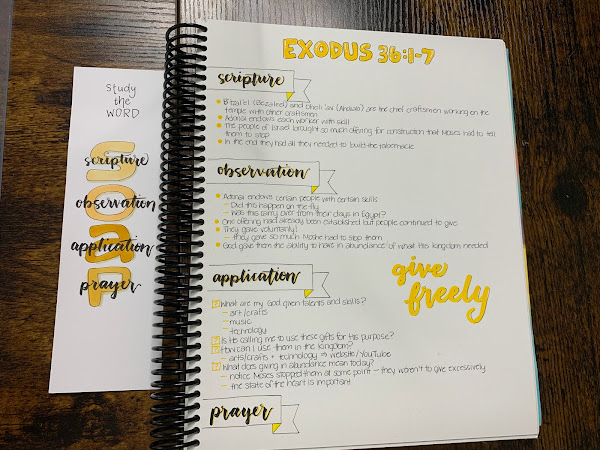
  1. S.O.A.P.
  2. F.E.A.S.T.
  3. R.E.A.P.
  4. H.O.P.E.
  5. E.A.S.Y.

The S.O.A.P. Method

S.O.A.P. stands for scripture, observation, application, and prayer. I may be biased because this was the method I used as a newbie to Bible Study, but I think it's the most popular of all the methods. Although I have one nitpick about this method—I believe you should start with prayer (which I'll discuss later)—it's a great way to start out studying. Below, I'm going to take you through Exodus 36:1-7 using this method.

Scripture

The first thing you want to do is read the scripture. If it's a shorter scripture, I like to write it out. For longer passages, I have a "special"[1] Bible I write in, which I may use to underline, circle and otherwise call attention to the parts that sick out to me. Neither of these are required, though. The more you study, the more you'll find what works for you.
1“Now Bezalel, Oholiab, and every skillful person in whom the Lord has put skill and understanding to know how to perform all the work in the construction of the sanctuary, shall perform in accordance with everything that the Lord has commanded.”

2Then Moses called Bezalel, Oholiab, and every skillful person in whom the Lord had put skill, everyone whose heart stirred him, to come to the work to perform it. 3They received from Moses every contribution which the sons of Israel had brought to perform the work in the construction of the sanctuary. And they still continued bringing to him voluntary offerings every morning. 4And all the skillful people who were performing all the work of the sanctuary came, each from the work which they were performing, 5and they said to Moses, “The people are bringing much more than enough for the construction work which the Lord commanded us to perform.” 6So Moses issued a command, and circulated a proclamation throughout the camp, saying, “No man or woman is to perform work any longer for the contributions of the sanctuary.” So the people were restrained from bringing any more. 7For the material they had was sufficient and more than enough for all the work, to perform it. Exodus 36:1-7

Observation

Observations can be made mentally or recorded, depending on your style. If you record them, you can write out sentences and paragraphs, map from the written out verse, or use a bulleted list—whatever works for you; don't be afraid to try out different methods. Below is a bulleted list of observations I made while reading this passage:
  • The Lord gave certain people specific talents for use in building the sanctuary.
    • Did He give them talents on the fly?
    • Or did people have the talent before, either something they picked up in Egypt, or had always possessed?
  • They had already taken up one collection/offering, but people still came back to give more.
  • Giving was voluntary.
  • They gave so much Moses had to stop them!
  • God gave to them in such a manner that they were able to give enough for the sanctuary and still have more left to give.

Application

Applications take us from in the passage to our present day life. How does this passage speak to me, what does it say about our current society, etc. During this step we can come up with pracitcal ways to improve oursleves and our community based on what we have observed. For me, this usually starts with questions. Below is what my thought process looked like for Exodus 36 applications.
  • What are my God given talents and skills?
  • Am I using them for His kingdom? Is He calling me to use them for His Kingdom?
  • What does giving in abundance mean today?
    • Moses stopped the people from giving at some point, so there was a clear boundary at which point it became "excessive" giving
    • Moses stopped them when they had enough for what God needed
    • So, we should give freely with an open heart, but be mindful of God's voice or messenger telling us when we have given enough.

Prayer

The final step is prayer. Personally, I believe this hsould be the first step in a Bible Study, and to be honest, I get annoyed when I attend Bible Studies that wait to pray until the end. There are four ways to incorporate prayer into a Bible study:
  1. Pray before the study
  2. Pray after the study
  3. Pray before and after the study
  4. Pray randomly throughout the study
While there is no Bible verse that instructs on this, I would strongly sugggest method #3. The reason I prefer this method is based on John 14:26, 1 Corinthians 2:14, and 1 John 2:27. The Holy Spirit interprets the Word for us and opens our spiritual eyes. To understand the Word we need to put away flesh and read in the Spirit, which for me means inviting the Holy Spirit in before I start studying. Then at the end of the study I ask the Spirit to help me implement what I've learned in my life and to continue working on me in the areas in which I struggle. Some people feel like diving in and then asking the Holy Spirit to sort out the wrestling between Spirit and flesh afterward. I concede that there's nothing inherently wrong with that method but if I had to only have one prayer during my study I would pray before the study. Nonetheless, as you study and grow your relationship with God you will find what works for you, and who knows, you might be a method #4 person and pray midway through the study. As long as you're studying and leaning on Him for understanding, I'm proud of you!

References and Footnotes

  1. I say special because it's the only one I write in; there isn't acutally anything special about it.

Isaiah 2: Judgment of Israel

Isaiah 2 continues the pronouncement of judgement on Israel, but now, Isaiah is concerned with the "last days" or the end times, not just a period of captivity. Some of the events mentioned in Isaiah 2 are repeated in Revelation, confirming an expected fulfillment near the very end of time. Isaiah gives us sings to look for by describe the attitude of the people when all of this is set to take place.

Ezra 5&6: Darius' Decree

During the reconstruction of the Temple, the Israelites face adversity but they don't give up. Eventually Darius I reinstitute the command to rebuild the Temple.

Introduction

During the reconstruction of the Temple, the Israelites face adversity but they don't give up. The Israelites don't immediately stop building the Temple. Instead they continued their work such that the king has to send people to investigate. This is a classic case of the question is your duty to your country or to God. Our duty is first to God. If was the king or president mandates goes against what God has said, we are to follow God. The Jews were fully aware of why they had been taken into captivity so they understood the importance of rebuilding the Temple and sticking to God's plan.
Top

Darius

When Darius takes over the Persian throne, he discovers the decree Cyrus had given the Jews. This decree not only gave them permission to build the Temple, but called for the king's treasury to fund it. The idea the a Persian king would command the Jews to rebuild the Temple, let alone fund it, used to be doubted by scholars. However evidence has since proven this to be a possibility, as the Persians funded many extra-religious buildings.[1] This proclamation moves Darius to reissue this decree and made it so that the Israelites could rebuild their Temple. From Ezra 4 we see that construction restarted on the Temple during Darius' 2nd year, and in Ezra 6 we are told they completed the Temple in his 6th year. However, since they actually began reconstruction during Cyrus' reign, we can't estimate the length of time they actually spent working the Temple.

Once the Temple was complete, the Israelites had great sacrifices for the dedication and hosted Passover. Now that they had experienced punishment for disobeying God, they were committed to following His law.
Top

How Big Was It?

Photocredit: Unsplash.com/Rob Bye
The dimensions given of the Temple in Cyrus' decree do not match those of Solomon's Temple. Some people cite this as a contradiction, however, we aren't being told about the old Temple, we're being told about the new Temple. Perhaps they wanted to upgrade the original Temple. It is possible that where they may not have been able to add gold and silver, they could add space. Although we don't think about it much today, land is a vary valuable commodity. It could also be a copyist error. Another important the to remember is that since one king halted the construction and Darius took over the decree, Darius could have changed these Dimensions based on how much he was willing to provide financially.
Top

References

  1. Holman Bible Publishers. Holman KJV Study Bible, pg. 803-806. 2014

Ezra 7&8: Introducing Ezra

Despite the book being named after Ezra, we aren't introduced to him until chapter 7.

Introduction

Despite the book being named after Ezra, we aren't introduced to him until chapter 7 and he is only present in the last four chapters of the book. Ezra was a dedicated priest who lived during the time of Artaxerxes I.
Top

Ezra

Ezra is a descendant of Aaron's son Eleazar and a scribe of the law. The establishes him as a member of the tribe of Levi and a priest. Notably, he is also descended from Zadok, who is discussed frequently in Kings and Chronicles.

Although we generally assume priests (preachers, ministers, etc.) have a closer relationship with God than the average person, this isn't actually true. In our time, this is evidenced by the number of priest and preachers committing heinous acts such as child molestation. However, during biblical times, this wasn't true either. The books of Kings and Chronicles frame the state of Israel based on the king, not the priests. Om the Books of Law, we are told that the priesthood represented the firstborn of Israel. They were supposed to be set apart and keep the law so that they could enter the holy place and touch the holy objects. Of course, if we look at Bible history, they firstborn usually turns out to be a disappointment—Cain, Esau, Reuben, etc. Unlike the corrupt priests, Ezra set his heart to follow God's law.
Top

Artaxerxes I

Photocredit: Wikipedia/ Guillaume Rouille
Ezra returns to Jerusalem during the 5th month and during Artaxerxes' 7th year. Following the Israelite calendar, this would have been around August. More importantly, based on the historical record of Artaxerxes' reign, the year this occurred would have been 457 bc. The date is important because Ezra's return to Jerusalem with a letter from Artaxerxes marks one four decrees given in the books of Ezra and Nehemiah to rebuild the Jerusalem. Daniel 9:25 tells us that the command to restore and rebuild Jerusalem marks the beginning of the 70 weeks prophecy. I'll go into more detail about the prophecy in the post on Daniel 9, but it's important to notice these decrees and establish their dates as we read. This is one of the reasons it takes several readings (and not necessarily in the same order) to understand Bible as a whole.

The letter Ezra is given from Artaxerxes proclaimed that the Israelites were free to return to Jerusalem. Ezra is sent to "inquire of Judah and Jerusalem according to the law of God," which means he was to make sure the Israelites were upholding the law of God. Artaxerxes specifies that the law of God was in Ezra's hand, proving that he was proclaiming Israel free to worship the God of Abraham, not a Persian god. This decree allows Judah to establish the law of God in their land, which is a step toward autonomy. Cyrus and Darius had allowed them to rebuild the city, but now Artaxerxes was giving them the command to restore the law of God. Near the end of his letter, Artaxerxes even establishes a possible death sentence on those within Judah who do not uphold the law of God. Ezra 7:26 shows Artaxerxes validating the law of God, and thus giving Judah some level of independence to carry out God's law.

Artaxerxes even proclaims that money for the Jews to purchase what they need for sacrifices was to be given to Ezra. Artaxerxes tells the treasures to do whatever Ezra asks so that the Israelites can do whatever they need for the Temple. Ezra tells the Israelites that they are blessed the Lord has moved the king's heart in such a manner.
Top

Points of Interest

Ezra gives us a record of the exact weight of precious metals brought to the Temple. If you wanted, you could convert these weights to modern units and establish the modern value of the metals based upon their current prices. This could then be compared to the cost of the original Temple. I am not providing that here, because I don't think that was the point of the telling us this information. Solomon's Temple was grandiose and magnificent; the reaction of those who had witnessed it's splendor to the new Temple confirms that the second Temple was not as magnificent. The point of informing us that the king handed over treasures for building the Temple is to show God's hand in the matter. It is evident that God had appointed this time for the Israelites to be freed from captivity. God wanted His nation reestablished, so He moved this king of Persia to do so. This also parallels the wealth Israel is given by Egypt when they leave.

An interesting point that comes from the presentation of these treasures is the completeness of the Temple. Most scholars claim that the Darius of the Bible is Darius I, thus by the beginning of Artaxerxes' reign, the Temple should have been complete. It is possible that despite having a completed Temple there was much room for improvement, and this why Artaxerxes supplied them with riches for the Temple. Others will argue that this works in favor of counting Darius II as the Darius of the Bible. However the dates to not line up to support Darius II as the Darius of the Bible.[1] Therefore, we must assume Artaxerxes was merely improving a finished Temple.

One thing that stands out to me, is that the author refers to himself as "me" or "I" in the book. It's not often that we see a first person account of anything in the Bible. We can learn a lot from this, specifically that the author was at one point captive and returned with the other Israelites. The person returns with the chief men of the cities, but when they gather together, none of the men are non-priests from the tribe of Levi, so he sends for them. Thus we know the author had a desire for fairness. Once representatives from the non-priest families of the tribe of Levi are present, the author declares a fast. This fast is because he was ashamed to ask the king for soldiers to protect them on the journey; instead they look to God to defeat their enemies. This is a major hint that despite speaking of Ezra in the third person elsewhere in the book, this "I" should be associated to him. It was Ezra who received the decree and given permission to get what he needed. It stands to reason that it would have been Ezra that was in the position to ask for a band of soldiers from the king as well.
Top

References

  1. John Oakes. "Is the Darius who built the temple after Artaxerxes in Ezra 4 Darius I or Darius II?". Evidence for Christianity. November 29, 2015
  2. Brad Beaman. "Bible Timeline, Persian Kings Period". Brad Beaman: My Free Space. November 1, 2007

Ezra 3&4: Reconstruction of the Temple

The Israelites start rebuilding the Temple, are blocked by enemies but resume the task.

Introduction

As one could expect, there were bumps along the way with rebuilding the Temple. Cyrus gave the order for the Israelites to rebuild, but there were many people ready to stand in their way. We may experience similar ups and downs in our own lives. The devil is persistent, but if we keep following God's way, we will come out triumphant, just as the Israelites did.
Top

Priorities

The first thing the Israelites do is rebuild the altar; it takes them 7 months to get the altar back up and operational. Once the altar was in place, they all gathered in Jerusalem to bring offerings to God. This took priority because the act of giving to God and communing with God was more important that a building. People today are often obsessed with the building itself, ascribing folklore and superstitions about what can and can't happen in the building. We should remember that tending to His business and His Will should always take precedence over a building.
Top

Celebrating

Photocredit: Unsplash.com/Nathan McBride
The Feast of Tabernacles was also celebrated, while everyone was gathered. The returning Israelites dutifully followed the law of Moses regarding sacrifices, even though they had not rebuilt the Temple. Considering the fact that mankind and the Israelites had worshipped God without a Temple for thousands of years before Solomon, it was a safe assumption that the altar should be rebuilt first.
Top

The Temple

Like before, they bring wood for the Temple from Tyre. The construction began in the 2nd year of their return, much sooner in comparison to the Exodus. This eagerness, however, was quickly silenced by their enemies. Judah's enemies first offered to help build the Temple; this was an effort to take ownership of the Temple and be able to control Judah.[1] Thus, when the Israelites refused their help, these enemies took to petitioning the king. Although these enemies had claimed to be seeking God, their reaction seems a bit extreme. Nonetheless, we should also take note that this is likely the response we will receive if we act as though the Body of Christ is too exclusive for certain people. While we must be cautious of those trying to undermine God's Glory, we also have to be mindful of how we treat people. Turning away someone who is truly seeking God could not only ruin their relationship with God, but cause problems for us too. Because of the Israelites' snub, the enemies tried to make it more difficult for Judah.

After Artaxerxes takes the throne, an exchange occurs between Artaxerxes and the enemies, in which the enemies described the rebelliousness of the city of Jerusalem. They warned the king that warning that if it were completely rebuilt, it would disrupt the Israelites from paying tribute. Upon hearing this, Artaxerxes commanded that the city not be rebuilt. After Artaxerxes put a halt to the reconstruction process, work on the Temple didn't resume until the 2nd year of Darius. Matthew Henry suggests that the king referred to as Artaxerxes is the same as Ahasuerus (mentioned in verse 6) and Cambyses, the ruler who followed Cyrus.[2] Others suggest that Ahaserus referred to Cambyses while Artaxerxes refers to Smerdis, a king who reigned briefly between Cambyses and Darius I.[3] Others believe that the text from Ezra 4:6-23 is parenthetical, to show that throughout the Persian reign, there kings of Persia received letters from people complaining about the Jews.[1] All three solutions explain the timeline given in Ezra 4. I would lean toward the Ahasuerus being Cambyses and Artaxerxes referring to Smerdis. The Persian kings often had dual names, so it stands to reason that these could have been their other names. However, Ahasuerus is thought to be Xerxes I and is the king Esther marries. The question, however, is whether Ahasuerus in Esther is the same Ahasuerus. There were 2 Darius' and 4 Artaxerxes in the Persian empire, so the possibility exists.

We are told that upon completion, the returnees who had seen the original temple wept, but those who had not shouted for joy. Together, they made a great noise that could be heard, by could not be distinguished as joyous or sorrowful from a distance. Solomon's Temple had been grand and central to their identity. This new Temple, while nice, was no where near as ornate and magnificent as the original. This probably felt very personal to those who had seen the first Temple; they may have thought their culture had been devalued.

References

  1. Holman Bible Publishers. Holman KJV Bible Study, pg 799-803. 2014
  2. Matthew Henry. "Ezra 4 Commentary". via Bible Study Tools; visited March 2017
  3. Eric Lyons. "Kingly Chronology in the Book of Ezra". Apologetics Press. 2005

2 Chronicles 1-7: Solomon Builds the Temple

The most important event in Israel, is the building of the temple. Chronicles focuses on this heavily, with most of 1 Chronicles discussing David's preparation and the first 7 chapters of 2 Chronicles discussing Solomon actually building the temple.

Introduction

Photocredit: FreeImages.com/Tatyana Khramtsova
The most important event in Israel, is the building of the temple. Chronicles focuses on this heavily, with most of 1 Chronicles discussing David's preparation and the first 7 chapters of 2 Chronicles discussing Solomon actually building the temple.
Top

Solomon Placed In Charge

2 Chronicles begins with Solomon taking over David's throne. Solomon continues to generate wealth for the Temple by initiating trade with Egypt and neighboring nations. This acquire great wealth for Israel and with it, he purchases chariots and horses, which were sure to strengthen Israel's army. God promised that Solomon would have a peaceful reign, but some of that could be because he purchased so many chariots. Neighboring countries would then know he was too powerful to be attacked. Likely God told Solomon to make these purchases, though there is also a chance that Solomon did not trust God's promise of peace and bought them just in case.
Top

Great Wisdom

We are blessed with the story of Solomon asking God for wisdom, which is also given in 1 Kings 4. God told Solomon he could ask for anything he wanted, and Solomon requested wisdom! How many of us can say we would ask the for the same if put in this situation. Matthew 21:22 tells us anything we ask of in prayer will be given to us, provided we come to prayer in faith. I'll be the first to admit that sometimes what I pray for is entirely selfish: good health for myself, help graduating from graduate school, etc. The conversation between Solomon and God reminds us that we should pray for wisdom. God had already promised us an abundant life (John 10:10), so why do ask for such things. What we truly need is the wisdom to discern right from wrong, righteous from unrighteous. God was so please that this is what Solomon asked for that he gave Solomon riches and honor in addition to wisdom. When we ask for the right things, everything else follows.
Top

Huram of Tyre

Solomon making a deal with Huram, the king of Tyre. King Huram sends wood and even employs some of his own men to do the work of cutting the wood at Solomon's request. When we are doing God's Will and ask nicely, things fall into place.

King Huram also sends a craftsman, also named Huram to help build things for the Temple. This Huram, though from Tyre, was born of an Israelite father and has ties to Dan. Whether one was considered an Israelite or not is often discussed as a matter of parentage, but those who converted to the God's law were also considered part of the Israelites. Thus, the fact that Huram's father was an Israelite, and depending on Huram's customs and attitudes, he may have even been seen as Israelite.
Top

Construction

Solomon began building the Temple on the second day of the second month during his 4th year in power. Considering the fact that he had the wood shipped from Tyre, which would have taken much longer back then than it would today, this is a pretty quick start to carrying out God's instructions. 2 Chronicles 3 gives us the dimensions of the Temple and is basically a blueprint. We are given intricate details about the gold used to overlay the walls, posts, and beams, as well as, the design of cherubims in the Temple. It was a masterpiece of great splendor. Solomon was determined that nothing but the finest was for God. We should remember that in our every day life. We may not be able to afford gold, but when we give to God, we should give the best that's in our ability to give.
Top

Furniture

2 Chronicles 4 recounts the items Solomon had made for the Temple and the craftsmanship of Huram, who came from Tyre to create these things. Solomon had an abundance of tables, lavars, basins, and candlesticks made to adorn the house and to be used in praising God. He was not stingy nor did he skimp on materials when it came to God. That's a major theme in the description of the Temple.
Top

Relating to Today

In the New Testament we are told that our bodies are the Temple of God. They are just as intricately designed and valuable. We should be sure to treat them well and take care of them. Solomon took great care to create the Temple and we should be sure to take great care in maintaining our personal temples.
Top

Dedication

Once Solomon gets everything in the Temple, he prepares for the dedication of the ark. During this time, the ark of the covenant was brought from the city of David (Zion) inside the Temple. Consequently, this is the last time the ark of the covenant is seen.

The dedication of the Temple takes place during a feast in the seventh month; this feast is likely the feast of Tabernacles, which would have required all the men of Israel to come to the Temple anyway. This ensured a large crowd for the dedication. At the dedication, the Levites which David assigned to musicianship praise God with music and song. There is a grand showing of people and praise. As the people praise God, He enters the Temple and appears as a cloud.

Solomon addresses the crowd with a brief synopsis of how he came to be the one to build the Temple; this includes a reminder that God foretold the coming of the Temple. Following the address, Solomon submits to prayer. This prayer is done publicly, proving that public prayer is sometimes acceptable. As with most prayers, He starts by praising God, invokes the covenant, then asks that God hear the prayers of Israel. Solomon's prayer is long and covers many scenarios. One such case is that of foreigners or strangers who seek out God. Solomon prays that they too will be heard.

God confirms that He has heard Solomon's prayer by consuming the burnt offering at the Temple with fire from Heaven. His glory fills the Temple and the priests are unable to enter. When the people of Israel see this, they humble themselves before God.

In gratitude, Solomon offers burnt sacrifices to God and they keep the feast for 7 days. On the 8th day they have a solemn assembly and the next day Solomon allows everyone to go home. On that final day, everyone is happy that God has blessed Israel and her kings. We are told that this day is the 23rd of 7th month, which means the feasts started on the 15th day, confirming this feast as the Feast of Tabernacles.

That night, God comes to Solomon and answers Solomon's prayer. He promises to hear Israel's pleas and establish Solomon as king, under the provision that they keep the law. If at any time they were to break the law and go astray, He would "pluck them up by the roots" from the land (which is exactly what eventually happened).
Top

References

1 Chronicles 27-29: The Last Days of David

The last few chapters of 1 Chronicles summarize David's legacy. Although the chapters are centered on David's rule as king, it is obvious that the main focus is on pricelessness of God.

Introduction

The last few chapters of 1 Chronicles summarize David's legacy. We are given a method to estimate the cost of materials used to construct the Temple, as well as, an example prayer to God. Although the chapters are centered on David's rule as king, it is obvious that the main focus is on pricelessness of God.
Top

Divisions of the State

In the previous chapters, we were given divisions related to the Temple and the service of God, but 1 Chronicles 27 outlines divisions dedicated to serving the nation and the king. We are told about the army, the princes of each tribe, and the overseers of the nations wealth.

CaptainTribal Affiliation
JashobeamJudah
Dodai
BenaiahLevi
Asahel
Shamhuth
Ira
HelezEphraim
Sibbecai
AbiezerBenjamin
Maharai
BenaiahEphraim
Heldai
The army was divided into 12 units of 24,000 men with one unit serving per month during times of peace. Would assume from the number 12 that each division represented a different tribe, but when the captains of the units are listed this doesn't seem to be the case. Only some of the captains are identified by tribal affiliation and we see two captains from the Tribe of Ephraim. Likely each unit consisted of a mix of tribes and the captains were merely the best of all the army. This method would help unify the nation of evade the possibility of tribes turning on each other. If the units were organized by tribe, it would be much easier for a civil war to break out. Of course, we know that eventually the nation splits in half anyway.

Just as we have governors of states today, back then each tribe had a ruler. These leaders were important and influential among their tribe, and likely acted as liaisons between the tribes and the king. Despite 1 Chronicles 27 only naming one person per tribe, several passages of the Bible is indicates that there could be more the one prince of a tribe. Perhaps there existed a ranking among princes that elevated only one to ruler—a succession line, basically. The Tribe of Manasseh, which was split across the Jordan, is the only tribe to have 2 leaders, because each half of the tribe had their own a leader.

The last set of divisions given in 1 Chronicles 27, involve the men who oversaw the riches of the king and nation. These men were in charge of the treasuries, vineyards, herds, army, etc. It is here that we find Joab listed as the general of the army. His name had been noticeably absent when discussing matters of the army previously. Joab's murderous habits likely demoted his status, causing the chronicler to give him less focus. Interestingly the man over the camels was an Ishmaelite. This is further proof that strangers were brought into the fold of Israel. Those who made themselves loyal to God were apparently joined into the nation. Another set of familiar names found in this list is that of Ahithophel, who turns on David during Absalom's rebellion, and Hushai, who spies for David during the same time period.
Top

Appointing Solomon King

In 1 Chronicles 28, David makes a public showing of declaring Solomon heir to throne and giving him detailed instructions on building the Temple. This action was likely for the people, and to ensure there was no confusion or rebellion against the throne. Although we are not told when during David's rule this occurs, it seems likely that it occurs after Absalom's rebellion. In 1 Chronicles 29, Solomon is officially made king. Interestingly it says he was made king for the second time. This furthers the idea that first time was during Absalom's rebellion, which was done in haste, and this time was probably more formal and deliberate.[1]

David presents Solomon with gold and riches for the Temple's construction and encourages him to be strong. Much emphasis is placed on the fact that God will see Solomon through the task. At first I wasn't sure why Solomon would need a pep talk about building a Temple. In my mind this was an easy task compared to Moses, or Joshua, or David. After deeper thought, it started to make sense.

People are often weary of change and the Temple would be a major change for Israel. Once it was constructed, there would be a centralized location for sacrifices to God. With that, people would have to travel to fulfill their duties. This would be an inconvenience, and may have been a contributing factor to the decline of Israel's relationship with God. When Solomon began construction, I imagine there would have been a fair amount of pushback from the people. David didn't want hesitancy form the nation to effect Solomon's ability to complete the task.
Top

David and the Magnificence of the Temple

Photocredit: Unsplash.com/JJ Jordan
The chronicler's focus on David's legacy are his exact contribution to the Temple. This reiterates how important it was that the Temple be built and how instrumental David was in its construction, despite not being the one to actually build it. David contributes 3,000 talents of gold and 7,000 talents of silver. This is equivalent to 226,194.28lbs of gold and 527,786.66lbs of silver.[2] Today, gold is worth $39,776.87 per kilogram and silver is worth $579.68 per kilogram.[3][4] By doing a little math, we see that David essentially contributed $4,081,106,843.94 worth of gold and $138,775,393.14 worth of silver.

That's enough to place the Temple at #4 on the list of today's most expensive buildings of the world.[5] However, that wasn't everything that went into the Temple! The people also donate gold, silver, brass, and iron to the Temple. The most important part about the giving of the people, isn't the price associated with it however, it's the fact that they gave willingly. David didn't issue a donate or die decree or scare the people into giving; they truly wanted to please God and gave of their own free will.

Nonetheless, a considerable amount of wealth is added to the Temple due to this. The people gave 5,000 talents and 10,000 drams of gold, 10,000 talents of silver, 18,000 talents of brass, and 100,000 talents of iron. A dram is approximately 1lb[6], making the amount of gold donated about 386,990.47lbs, which is worth $6,982,269,470.17. The people donated 753,980.93lbs of silver, which is worth $198,250,558.25. The average price of brass today is $1.16 per pound;[7] the Israelites donated 1,357,165.67lbs of brass, which is worth $1,574,312.20. Iron costs $0.02 for .1kg if buying in bulk or $7.20 for .1kg.[8] Since the Israelites donated 7,539,809.37lbs of iron, I'm going to use the bulk price to estimate its worth at $684,000.00. In total, the people donated $7,182,778,340.62 to the construction of the Temple! If we add the people 7.18 billion to David's donation, we can estimate the cost of the temple to be about 11.4 billion dollars! This would rank it at #2 on the list of today's most expensive buildings of the world, and remember, this total doesn't include anything Solomon added.
Top

Sacrifices

After pulling together that much wealth, the Israelites decide to offer sacrifices to God in celebration; this includes 1000 bulls, 1000 rams, and 1000 lambs. Reading this makes me understand the passage where God says He hates animal sacrifice (Isaiah 1:11). How sad is it that this many animals had to die to express gratitude and repentance? Although God mandated feasts and outlined sacrifices, you should note that God doesn't command them to sacrifice 3,000 animals at this point. This is something the Israelites did on their own. God didn't desire animals to die, however, there death was necessary to atone for our sins before Jesus' sacrifice. Over time, the Israelites confused this with God delighting in the sacrifice of blood.
Top

Prayer

When David ends his reign and transfers power to Solomon, he does so by praying to God. This prayer one of the many examples given of how we should pray to God. David exalts and praises God, then attests to God's mercy. He asks God to help Solomon keep the commandments. Even then, they knew that it is impossible to keep the commandments without God's help!
Top

References

  1. Holman Bible Publishers. Holman KJV Study Bible, pg. 729. 2014
  2. "Talents (Biblical Hebrew) to Pound Conversion". Unit Conversion; visited March 2017
  3. "Gold Prices Today Per Ounce & Gold Chart Historical". APMEX; visited March 2017
  4. "Silver Prices". APMEX; visited March 2017
  5. Alice Young. "The 10 Most Expensive Buildings in the World". Constructing Global. June 10, 2016
  6. "Dram". Bible Hub; visited March 2017
  7. "Brass - US Scrap Prices". Recycle In Me; visited March 2017
  8. "Iron Element Facts". Chemicool. October 6, 2012

1 Chronicles 23-26: Levite Duties

Not only did David gather materials for building the Temple, he began preparing the Levites for the shift that they would experience regarding worship.

Introduction

The next few chapters of 1 Chronicles is devoted to the duties of the priesthood. Not only did David gather materials for building the Temple, he began preparing the Levites for the shift that they would experience regarding worship. Once the Temple was set in Jerusalem, the Israelites would have a specific place of worship and enemies would have a specific location to attack. This would have a major effect on how the Levites were to carry out their duties. David sets up offices and divisions to carry out musical praise, guard duty, and more.
Top

Number of Levites

Perhaps to remind the audience of who the Levites were, 1 Chronicles 23 gives the genealogy of the Levites, starting with Levi and his sons. Following the descendants Merari, Kohath, and Gershon, we are reminded of important Levites, as well as, introduced to Levites that are given duties by David. Much of the genealogy can be found in Numbers and Exodus.

David's illegal census allowed the number of Levites present in Israel to be counted, and we are told there were 38,000 men. Of these men, 24,000 were to perform the general work for God's House. 6,000 men were made officers and judges. 4,000 were assigned to be porters or guards, while another 4,000 were assigned to be musicians. Musicians were required to perform daily before the Ark.

Aaron's Sons

Aaron had 4 sons, but 2 of them died for committing sin in the holy place (of all places!). Thus, the priestly lineage spanned only from the two living sons: Eleazar and Ithamar. The legitimacy of these two lines led to the establishment of two high priests, Zadok and Ahimelech, because they both had rightful claim to the title.

We are told that Eleazar had more chief men in his lineage, and Ithamar only had half of that number. Due to this imbalance, David assigned lots and shifts at the tabernacle with size in consideration. The priests were assigned shifts to take up their duties at the Temple, based on the lots they were given.
Top

Musicians

Photocredit: Unsplash.com/Mariusz Prusaczyk
Many Levites were assigned to provide music for the Lord in praise. There are three families specifically placed in charge of the music: those of Asaph, Heman, and Jeduthun. One family plays the harp (or something similar—it's generally referred to as a psaltry)[1], another family plays the cymbals, and the final family plays the trumpet. This number of men assigned to this task is very large and shows the importance of music in worship.
Top

Porters (Gatekeepers)

Chapter 26 gives details on the divisions of the porters or gatekeepers. These men were responsible for protecting the holy objects and kept guard at the gates leading to the Temple. Assignments were given by casting lots for which division would guard which gate. Most of the people assigned to guard the fate were from the Levite tribes of Merari and Kohath.
Top

Other Duties

The Gershonites, on the other hand, were assigned to keep watch over the treasury. Another group of Levites was also assigned to administering the law and presiding as judges over the people.
Top

References

  1. "Psaltery". BibleStudyTools.com; visited February 2017

1 Chronicles 22: David Prepares Solomon to Build the Temple

David does what he can to insure his son is well prepared to take up the mantle and build the Temple. This is a lesson for parents everywhere.

Introduction

David doesn't let God's decision that he would not be the one to build the Temple deflect his dedication to the task. Instead, David does what he can to insure his son is well prepared to take up the mantle and build the Temple. This is a lesson for parents everywhere.
Top

David's Actions

David collects wood, iron, and brass, so that the materials will be ready when Solomon takes the throne. Many of these materials are garnered from his military conquests. Clearly David didn't want anything hindering or delaying Solomon's ability to construct the Temple. This proves that David didn't just want to be the person who built God a home, but he wanted God to have a home. Many of us would have went our own way after learning that the honor wouldn't fall on us, but David continued working toward God's Will.

Not only does David stockpile these materials, he leaves instructions to Solomon and explains to the duty his son has to carry out the construction of the Temple. David also instructed the princes of the nation to cooperate with Solomon when the time came; he wasn't leaving anything to change! God promised to give Solomon rest from Israel's enemies so that his reign would be peaceful, unlike David's. This would make Solomon a man of peace and free up more men to build the Temple.
Top

The Lesson

Photocredit:Unsplash.com/Liane Metzler
There are many blessings that take generations to be realized. For instance, Harriet Tubman saved some slaves, but she could save them all. Sometimes we make decisions that do not effect us, but will effect our children. As we grow old, we can chose to take on life insurance or not, and if we choose not to, we can put our children in debt.

David knew that building a home for God was important and that his son would be called to carry out the duty. David could have taken the spoils of war he won and done anything he wanted to with the wealth. However, David knew that this would leave his son scrambling before the Lord. In doing this, he wouldn't just be cheating his son, he would be cheating God. We have a responsibility to our youth to prepare them for the call God has for them. Sometimes this mean monetarily, but sometimes it just means educating and preparing them for a relationship with God.
Top

References

1 Chronicles 17: The Temple

But the word of the Lord came to me, saying, Thou hast shed blood abundantly, and hast made great wars: thou shalt not build an house unto my name, because thou hast shed much blood upon the earth in my sight.1 Chronicles 22:8 KJV

God tells David he isn't to build the Ark, but we don't find out why until a few chapters later.

Introduction

David wanted to build the Temple, but God stopped him. God told the prophet Nathan that David wasn't going to be the one to create his home and many people wonder why. 1 Chronicles 17 and 2 Samuel 7 discuss David's desire to build the Temple and God's response.
Top

A Theory

One group theorizes that Solomon was chosen because of his wisdom. They believe that Solomon constructed a hidden room in the Temple, with the help of his Egyptian bride, to conceal the Ark. Although no mention of the Ark is made from the time it enters the first Temple onward, they believe it is still in Jerusalem in this hidden space.[1] Egypt is known for their expertise in hiding things; in fact new chambers may have been recently discovered in one of the pyramids just last year.[2][3] If the Egyptians were involved with the process it seems likely that a hidden room is possible. Of course, God could have given Solomon this knowledge directly if He wanted to, why include the Egyptians?

If this theory proves true, it seems to me that the plan was carried out by Solomon without inspiration from God. Kings were not to marry foreign women and God would have possessed the knowledge to to create a secret chamber. It seems odd that God would send Solomon to the Egyptians to carry out such a task. Of course, it is also possible that the Egyptian princess was meant to help and Solomon decided to make her his wife on his own. It is one of the Bible's many mysteries.
Top

The Bible Speaks

But the word of the Lord came to me, saying, Thou hast shed blood abundantly, and hast made great wars: thou shalt not build an house unto my name, because thou hast shed much blood upon the earth in my sight.1 Chronicles 22:8 KJV
While the theory mentioned above is impressive, the Bible actually tells us why David wasn't allowed to build the Ark in 1 Chronicles 22. David may have had great faith, but David was a man of war who killed many people; David was violent. God shows that is His preference that we be wise and peaceful over violent when he tasks Solomon with building the Temple instead.
Top

References

  1. Edoardo Recanati. "The Ark of the Covenant". Israelhai.org; visited February 2017
  2. Adam Boult . "Scientists discover two mysterious ‘chambers’ in the Great Pyramid of Giza". The Telegraph. October 18, 2016
  3. Owen Jarus. "Chambers Hidden in Great Pyramid? Scientists Cast Doubt". Live Science. October 17, 2016

2 Kings 16&17: The Northern Kingdom Captured

The fall of the northern kingdom to Assyria, and the dependency of the southern kingdom on the same Assyria is covered in 2 Kings 16 and 17. The struggles of both kingdoms are direct results of their abandoning of the covenant they made with God.

Introduction

The fall of the northern kingdom to Assyria, and the dependency of the southern kingdom on the same Assyria is covered in 2 Kings 16 and 17. The struggles of both kingdoms are direct results of their abandoning of the covenant they made with God. Kings Ahaz and Hoshea of Judah and Israel respectively mark a tragic low in the history of the Israelites.
Top

Ahaz

Ahaz becomes king of Judah during the 17th year of Pekah. Ahaz begins his reign at 20 years old. He reigns for 16 years. Unlike many of Judah's kings, Ahaz does not follow God's word and is a sinful king. He even commits the crime of child sacrifice. Without God's support, Ahaz looses major battles with both Syria and Israel. The Syrians are able to take over the city of Elath. 2 Kings 16:6 gives us the first mentioning of the word Jew, which is the name given to the Israelites living in the southern kingdom of Judah (later Judea).
Top

Pact with Assyria

When Ahaz is in danger of losing to Syria and Israel, he sends wealth from the Temple to the king of Assyria to buy their alliance. Interestingly, when these kings use foreign aid, they always pay with God's money instead of calling on God. The king of Assyria obliges and defeats Judah's enemies. While meeting with the king of Assyria in Damascus, Ahaz takes a liking to a pagan altar and requests the priests to mimic it back home. God always makes it clear that we are to be set apart from the world, so you can bet He didn't want His altar to be like the pagan one.
Top

Defiling the Temple

Ahaz places this pagan altar in the house of God and moves God's altar, giving reverence to the pagan Assyrian god. Ahaz also removed the Sabbath canopy and closed the kings entry because the king of Assyria did not like them. While my study Bible suggests it is unknown why he was offended by these two things, I think it is quite obvious. Both are reminders who the true king of Judah is. The Sabbath is a reminder of who created the Earth (Exodus 20:10-11) and who delivered the Israelites from Egypt (Deuteronomy 5:14-15). The king's entry was a reminder that God appointed David's lineage, including Ahaz, to be king. The king of Assyria wanted that power and reverence for himself.
Top

Interesting Thought

I find it interesting that on the verge of the northern kingdom being taken captive by Assyria, the king of the southern kingdom was essentially selling his soul to the Assyrians. When people who don't have faith become fearful, they will do anything to preserve their own well being. While Jehoshaphat had been adamant that the Israelites of the north were the same people as those of the south and thus was determined to fight with them, Ahaz completely abandoned his brothers in the north. Ahaz even abandons God because he thinks Assyria is a better option. This may have worked in his favor in the short term, but long term, God is always the best option.
Top

Hoshea

Hoshea becomes king of Israel during Ahaz's 12th year. Evidenced by his coup, he is an evil king, though he is not considered as bad as the other kings. His rule lasts for 9 years.

During Shalmaneser's reign as king of Assyria, Hoshea bows to him, becoming his servant and giving him presents. Just as Ahaz was buying his time as a "free" king, Hoshea was doing the same. It was the illusion of keeping the throne as opposed to outright defeat that inspired kings to take this option.

At some point, Hoshea rebels against this tradition, however. Shalmaneser decides that Hoshea is conspiring against him when Hoshea sends messengers to Egypt as though to form an alliance and does not send tribute to Assyria. This is the reason Assyria attacks Israel. After he defeats Israel, Shalmaneser binds Hoshea in prison.

The siege Shalmaneser unleashes on Israel lasts 3 years. At the end of the siege, the king of Assyria takes the people of Israel into Assyria fulfilling God's curse to displace the Israelites. These 10 tribes are never truly recovered; they assimilated into the Gentile population. God gave the Israelites plenty of warnings and sent his prophets to testify to Israel, but the Israelites continued to do evil and would not repent. When the northern kingdom crumbles, all that is left is the tribe of Judah.

Shalmaneser of the Bible is likely Shalmanese V, the son of Tiglath-pileser III.[1]
Top

Samaria

Photocredit: By Deror_avi, via Wikimedia Commons
The king of Assyria replaces the Israelites with his own people in the city of Samaria. These are the people who will eventually become known as the Samaritans. Initially they do not fear God, but He send lions to attack them. When they report this to the king, he allows one of the priests to return and teach the new inhabitants the ways of the Lord. The Samaritans didn't give up their gods, though they claimed to fear God; instead they created a blended religion just like Israel had before. Archeologists have found a Samaritan Pentateuch (the first 5 books of the Bible, which deal with the law).[2] Scholars believe it to be authentic.[3] This book was likely created with the help of the priest sent to teach them the ways of God.
Top

References

  1. Editors of the Encyclopædia Britannica. "Shalmaneser V: King of Assyria and Babylon". Encyclopædia Britannica. July 20, 1998
  2. Ben Outhwaite. "Samaritan Pentateuch (MS Add.1846)". University of Cambridge Digital Libray; visited February 2017
  3. "Samaritan Pentateuch". Wikipedia; visited February 2017

2 Kings 11-15: Four Good Kings in Judah

Beginning with Jehoash, Judah experiences a period of revival with 3 God-fearing kings. Although the effects are not permanent, these rulers give us a positive glimpse of David's dynasty, and prove that given the right leader, a nation can always return to God.

Introduction

Beginning with Jehoash, Judah experiences a period of revival with 3 God-fearing kings. Although the effects are not permanent, these rulers give us a positive glimpse of David's dynasty, and prove that given the right leader, a nation can always return to God.
Top

Jehoash

Judah is often represented by the lion
Photocredit: FreeImages.com/Chad Littlejohn
2 Kings 11 focuses mostly on the destructive Queen Athaliah, but we are also introduced to her successor, Jehoash. Hidden away by his aunt to escape Athaliah's massacre of Ahaziah's sons, Jehoash grows up in the Temple under protection. The priest does not wait until Jehoash is a full grown man (at least not by our standards today) to reveal Jehoash as king. Instead, Jehoash is crowned king at 7 years old with the support of several military leaders. Children were seen as adults as much younger ages back then, and the priest probably assumed that God's rightful heir needed to be on the throne as soon as possible.
Top

Reign

Johash's reign begins during the 7th year of Jehu king of the Northern kingdom. Because Jehoash was crowned at 7 years old, we also know that he was born the year Jehu took the throne. Following the ways of God, Jehoash reigns for 40 years—like David and Solomon. Johash does right by God but he doesn't rid Judah of pagan altars or illegal altars for God.
Top

Repairing the Temple

Jehoash orders that the priests take the money they've collected to repair the Temple, but after 23 years of ruling, the Temple still wasn't repaired. It seems only natural that Jehoash would have special regard for the Temple given that he was brought up there. He does not let this stop his vision, but continues the effort to repair the Temple. The priests are told they can't receive any more money until the repairs are completed. They come up with a public method of collecting the money to make sure the task is carried out properly. The priests kept the money from the trespass and sin offerings.
Top

Pressure From Syria

Hazael, king of Syria attacks Gath and subsequently determines to attack Jerusalem. Caving to pressure, Jehoash gives Hazael all of the treasures that had been dedicated to God. This is a low point in Jehosah's reign. Instead of clinging to faith and trusting God, he gives away holy objects. When we are cornered by the world, we are not to give up anything that belongs to God. We are to prepare for battle and trust that God will fight for us.
Top

Death

Jehoash is killed by his servants, and his son Amaziah takes over his reign.
Top

Amaziah

Amaziah, the son of Jehoash, was also a good king, though not as good as David. He takes the throne at 25 years old and reigns for 29 years. When he takes the throne, he takes revenge on the servants who killed his father and kills them. He does not kill their children however, because the law states that we are not to such a thing.

Amaziah starts a war with the northern kingdom of Israel, which turns out disastrous for Judah. The king at Samaria shared a name with Jehoash of Judah, so it can be difficult to keep them straight. Jehoash of Samaria does not want to be involved in the war, but does what he feels is necessary for his people. Jehoash raids the Temple and breaks the wall. The failure of God's people often leads to the destruction of His temple. Similarly, when we fail today, we defile ourselves and destroy the new temples of our bodies.

Amaziah does not die in the war and actually outlived Jehoash of the northern kingdom by 15 years. He was killed in Lachish by people who conspired against him. Azariah takes over as king after his father is killed.
Top

Azariah

Azariah tops the previous record of longest reigning king, reigning 52 years. His reign begins when he is just 16 years old and Jeroboam II had been ruling Israel for 27 years. Azariah follows in his father's footsteps and was a good king. Although he follows God, he does not remove the high places or altars from the kingdom. Azariah's downfall is not told in 2 Kings, but we know something changes his course of behavior because we are told that God curses the king with leprosy. His crimes are listed in 2 Chronicles 26. After being cursed with leprosy, his son Jotham takes over as king.
Top

Jotham

Jotham becomes king of Judah during the 2nd year of Pekah and is 25 years old when he begins his reign. His reign lasts for 16 years (this figure does not include co-regency).[1] Jotham walks in the way of the Lord, but again, does not remove the altars. He adds an addition to the Temple. During Jotham's reign both Syria and Israel began attacking Israel. After his death, his son Ahaz takes the throne.

References

  1. Holman Bible Publishers. Holman KJV Study Bible, pg. 658. 2014

1 Kings 5-8: Solomon's Temple

Discussing the grand Temple of Solomon along with the differences between the account given in 1 Kings versus 2 Chronicles.

Introduction

1 Kings 5-8 tell us of the marvelous construction Solomon did in Jerusalem, including the Temple and his own home. The passages go into great detail about the finial look of the structure, though it is still hard to visualize. This information is also given in 2 Chronicles, however the information given in 2 Chronicles doesn't always seem to match that given in 1 Kings. Below is a section discussing some of these differences.
Top

Hiram of Tyre

1 Kings 5 introduces us to Hiram, the king of Tyre. Hiram had been a great supporter of David and was eager to show his support for Solomon. When Hiram reaches out to Solomon, Solomon expresses his desire to build a house for the Lord (the Temple). David had promised to create a house for God in 1 Samuel 7:27, but was unable to carry out this mission because of the many wars he had to fight. Now that there was peace, Solomon could carry out the task.

Solomon seeks the help of Hiram because his land, though located in Lebanon, possessed the cedar and fir trees that Solomon needed for constructing the Temple. In exchange for these trees, Solomon would provide the king (and his family) with food. It is unclear if Tyre was experiencing a food shortage, but food is a necessity and in a society where food only came by hard labor, it would have been a grand payment. In addition to providing food for Hiram, Solomon sent his own men to labor in the forests. Later in 1 Kings 9:11-14, we learn that Solomon also gives Hiram 20 Israelite cities, but Hiram is not satisfied with these cities. The wood is shipped to Jerusalem via rafts in the sea, since Tyre is a city located on the Mediterranean Sea.[1] It is interesting to note that the city of Tyre still exists today!
Top

Paid in Food

1 Kings 5:11 tells us that each year of construction, Solomon sent 20,000 measures of wheat and 20,000 measures of pure oil. In 2 Chronicles 2:10, we learn that an additional 20,000 measures of barely and wine were also given. It appears, the author of Kings did not provide a complete list of food payments to Hiram, but merely enough to show the reader that something was paid. Some people incorrectly consider this a contradiction, however, 1 Kings 5:11 doesn't state that the list is exhaustive. Since 1 Kings 5:11 doesn't claim to be an exhaustive list of what was given to the king, it doesn't conflict with 2 Chronicles 2:10. Furthermore, the goods given in 1 Kings 5:11 are for Hiram's household while those given in 2 Chronicles 2:10 are given to the servants.

Top

Men Sent to Work

Solomon drafts a group of 30,000 men to be sent to Lebanon to Hiram (as promised). He sent 10,000 men a month and these men would stay for in Lebanon for 1 month then return home for 2 months. Adoniram was in charge of these men. In total, Solomon sent 70,000 men to carry the lumber and 80,000 to chop the lumber. 3,300 men were placed in charge of overseeing the work. This was a large scale operation that took planning and organization.

This is another set of numbers that seems to differ from those in 2 Chronicles 2. 2 Chronicles 2:17-18 tells us there were 153,600 foreigners in Israel, of which Solomon took 70,000 to carry the wood and 80,000 to chop the wood. This matches what we are told 1 Kings 5:15-16. However, when we come to the total number of Israelites placed in charge of overseeing the work, we get a different number. 1 Kings 5:16 says that 3,300 were sent as overseers, but 2 Chronicles 2:18 says 3,600 were sent to oversee the work.

Scholars suggest the following to explain the difference in totals. Throughout 1 Kings and 2 Chronicles, we are told of "higher" positions of oversight that existed within the construction of the Temple. In 1 Kings 9:23, we are told there are 550 officers, presumably these 550 are higher ranked than the 3,300 men sent to oversee the foreign workers. Think of a corporate structure where you have a CEO (Solomon, the king), Vice Presidents (the 550), managers or supervisors (the 3,300), and workers the (the foreign workers). In total that would give 3,850 Israelite men working on the project. Similarly, in 2 Chronicles 8:10, the number of officers given is 250. When 250 is added to the 3,600 overseers, we still get 3,850 Israelites working on the Temple. The difference here is not actually in how many people were present but who was considered a "chief officer" versus simply an officer. Apparently the authors of Kings and Chronicles disagreed on that matter. The division is presumed to use to officer to refer to military personnel and overseer to refer to industrial personnel.[2]
Top

Two Hirams

There are actually 2 Hirams mentioned during the construction of the Temple. One is the King of Tyre, while the other is a half Israelite, also from Tyre, who is a skilled craftsman. The text doesn't explicitly tell us they are not the same people, however, their descriptions implicitly confirm that they cannot be the same person. For instance, Hiram who is half Israelite is unlikely to be king of Tyre, considering it is his father who was an Israelite. Unless he took the throne by force, it seems unlikely that he would have inherited the kingdom. Furthermore, the King of Tyre is never described as having any talent as a craftsman. It seems odd that a king would possess a skill considered to be a peasant trade.

Both men contribute to the building of the Temple, but their methods are distinct. King Hiram allows Solomon to purchase the wood from his land to be used for construction. The other Hiram handles the crafting of the wood once it arrives in Jerusalem. This Hiram was responsible for the ornate artistry of the Temple.

The name Hiram also appears as Huram, and Hirom in the Bible. All 3 names are considered equivalent. There is also a passage in which it appears as Huram-abi. Hiram means most noble, while abi means father. Many speculations exist as to the meaning of Huram-abi but no consensus has been reached.[3]
Top

Free Masonry

Interestingly, as I began to research Hiram to confirm that there were in fact 2 Hirams, I discovered the fact that Hiram plays a role in masonry.[4] Many churches and pastors denounce Free Masonry. While I don't know enough on the subject to comment one way or the other, I thought it was interesting to see that they have incorporated this into their fraternal order. While it may seem soothing to some, as I often say, the devil can quote scripture too! Remember just because people claim something has ties to the Bible, doesn't mean it actually does!
Top

Building the Temple

Imagery of the Temple based on the Biblical description
Photocredit: source unknown
Solomon began construction of the Temple in the 480th year after the Exodus in the month of Zif (part of April and May in our calendar). This timeline allows us to approximate the beginning of construction to 966bc. This was the 4th year of Solomon's reign, which means he didn't waste any time carrying out this mission. In comparison, after the twin towers of the World Trade Center were destroyed it took the US 5 years to break ground on the One World Trade Center that replaced them, and another 7 to complete it. Solomon did all of this without the aid of modern technology. This shows that when God wants something done, He makes a way. The US's hold up was likely political, whereas Solomon's only hold up was physical. God respected Solomon's desire to carry out an order God had given so He paved the way for Solomon to fulfill this desire. God states that as long as Solomon keeps the statutes of the law, He will bless Solomon.

We are given great detail about the Temple. The given size was 60 cubits long, 20 cubits wide, and 30 cubits tall (90' x 30' x 45'). A porch or covered hall was also added; it was 20 cubits by 10 cubits (30' x 15'). Narrow windows were installed. These would not have had glass like our windows today, but would have provided ventilation for sacrifices given on the altar. Like the Tabernacle, there are two rooms that make up the main part of the Temple. Solomon also includes chambers around the walls of the Temple.

Solomon has the cedar carved with knops and flowers—this was likely the handiwork of Hiram the craftsman. The Temple was overlaid in gold such that nothing was visible that wasn't gold. This is a testament to Israel's wealth. Solomon also had 2 cherubs made from olive trees; each was 10 cubits (15') high and their wings were 5 cubits (7.5') wide. The wings spanned the wall where they were placed. They too were overlaid in gold. Palm trees, cherubim, and flowers were carved on the walls inside and out. The doors to the holy place were made of olive trees, then covered with gold, while the inner court was made of stone with cedar beams. So much detail is given it's actually hard to picture.

The Temple was completed in the month of Bul (October/November) in Solomon's 11th year. The month called Bul is also known as Marcheshvan.[5]
Top

The Grandeur of Modern Churches

My dad often makes note of churches that don't match the community. Where we live there are often elaborate churches with grand windows and costly brick, but the houses around the church are falling apart. Although we are clearly told of the elaborate and grand beauty of Solomon's temple, we are also told that Solomon's palace was marked with grandeur as well. There was a reason the Israelites didn't build the Temple before Solomon came. God knows what we can and can't afford; He also makes a way when we don't see one. When we see the number of people that came together to build the Temple, it's on the order of a mega church and all of Israel was to come there to worship. However, today, we have churches that only service 10-20 people. I do not think God meant for these to be so extravagant the community suffers. In fact, we hear no mentioning of building a physical church when the apostles when to the churches of the gentiles.
Top

The Court and Around the Temple

Solomon creates two brass pillars, which he names; the right pillar is named Jachin and the left is named Boaz. Together these names mean "He established in strength."[6] The pillars were quite ornate. The sat in front of the sanctuary of the Temple.[7]

Solomon also includes a "molten sea" in his new palace. It was made of brass and likely something like a basin or tub for people to wash up in. It sat on top of 12 brass oxen. This basin was 10 cubits wide and 5 cubits tall, approximately 15' wide and 7.5' feet tall. This gives us a circumference of roughly 47'. The Bible tells us the circumference is 30 cubits which is a rounded figure since 10π is about 31.4 cubits (which is 47'). If we continue reading the text, we see that the rim of the basin was a handbreath or 4" thick. Scholars suggest that the measurement of the circumference refers to the inner circumference while the diameter refers to the outer edges. If we use this assumption we see the following:
10 cubits=15 feet=180 inches
inner diameter=>180 inches - 2 handbreaths (one on each side)
=180 inches - 2*4 inches
=172 inches
circumference=>172 inches*π
=540.35 inches
=45.03 feet
=30 cubits

The amount of brass used for the area outside of the Temple was so great it was could not be measured.
Top

Solomon's House

Solomon spent 13 years building his own home (a stark contrast to the 7 years he took for the Temple). It prompts me to wonder at the reason and motive. There are two possibilities, one shows Solomon to be wise and righteous, but the other speaks to mankind's greed and vanity. It is possible that Solomon was hurried at set forth more energy at building the Temple because he felt it was urgent to build the Lord's home. Solomon hired many Israelites and employed many slaves to accomplish this, but we aren't told how many of them he kept for the building of his own home. Perhaps he was simply sluggish in building it because it wasn't as important. The other possibility is that Solomon took more time planning and adding grandeur to his own house. The Bible shows that God is pleased with the Tabernacle, so I'm apt to believe Solomon didn't cut any corners.

Solomon's home is also made of the cedar wood, but instead of overlaying it with gold, Solomon uses brass. To me, this is a signal that he recognizes his inferiority to God. Solomon makes an additional house for his wife, Pharaoh's daughter. Likely she expected lavish accommodations and he was happy to provide them.
Top

"Contradictions" with 2 Chronicles

There are many suggested contradictions between the account given in 1 Kings and that given in 2 Chronicles. I have mentioned some in the text above, but I would like to address a few others here.
Top

Hiram

Was Hiram from the tribe of Napthali or Dan? 1 Kings 7:14 tells us that Hiram was of the tribe Napthali, but 2 Chronicles 2:14 tells us Hiram's mother is from the tribe of Dan. Some scholars suggest that his mother's first husband was from the tribe of Napthali (she is a widow). This seems like an unlikely answer however, because we are told Hiram's father is from Tyre, which means the man of Napthali would not be his father.

Since Hiram's father was a gentile, Hiram wouldn't have belonged to any tribe. The tribal information must refer to his mother. Tribal inheritance was passed from the father to his children, but when a woman married, she married into the tribe of her husband. Thus Hiram's mother was probably born into the tribe of Dan; "a daughter of Dan" refers to her blood lineage of being a Danite. 1 Kings is giving us the tribe she married into. This is supported by most scholars.[8]
Top

Porch Measurements

Many people cite the height of the porch as problematic: 1 Kings 6:2 tells us that the hall or porch created was 30 cubits tall, but 2 Chronicles 3:4 tells us it was 120 cubits high. This is a great different in height! Once again, however, if you read carefully, you will see that 1 Kings 6:2 is describing the height of the house of the Lord, where 2 Chronicles 3:4 is discussing the height of the porch before the Temple. These heights could very will be different.

I agree that it seems odd for the Temple to be 30 cubits (45') tall with a porch attached that is 120 cubits (180'), however it isn't impossible. Nonetheless, many still try to explain the "discrepancy." Some people believe it is a copyist error. Historian Josephus maintained that the height was actually 120 cubits. 120 cubits is 180', while 30 cubits is only 45'.[2]
Top

Height of the Pillars

1 Kings tells us the height of the pillars placed in front of the Temple were 18 cubits tall and Jeremiah 52:21 confirms this measurement. 2 Chronicles 3:16, however, says that the pillars were 35 cubits tall. Scholars take note of the language in 1 Kings verses 2 Chronicles. 1 Kings makes it explicit that the height given is the eight of each pillar, whereas 2 Chronicles does not. Margin notes for 2 Chronicles suggest that the height given is the sum of the two pillars. Scholars assert that the pillars were cast as one pillar then cut in half. Each pillar would have been 17.5 cubits (or 18 cubits to the nearest cubit).
Top

Basin Capacity

1 Kings 7:26 says the basin created held 2,000 baths, while 2 Chronicles 4:5 claims it held 3,000 baths. A "bath" was a unity similar to our liters or gallons today. Scholars suggest that 2,000 refers to the typical amount of water contained in the basin, but 3,000 refers to how much it can old to the brim.[2]
Top

Solomon's Prayer and God's Approval

When the temple is complete, Solomon sends for the elders and the heads of the tribes to bring the ark into the Temple. The priests place the ark in its proper place and when the priests leave, a cloud fills the holy place indicating the presence of God. God had already promised Solomon that He would uphold His covenant with David as long as Solomon obeyed Him. God's presence in the Temple proved that God was pleased with Solomon's work.

Continuing his relationship with the Lord, Solomon offers a prayer to God. He admits his wonder at God dwelling in the Temple, since no place could ever contain Him. Solomon asks that when the people of Israel mess up and turn to the Temple to call on God, He will answer. Solomon even prays for strangers who venture into Israel seeking God. Solomon's heart was filled with love in these requests; he didn't seek retribution on these people or wish that they suffer, instead he prayed that God would still hear their requests and help them back to righteousness. This is the spirit of God and the spirit of the law that we should be keeping.

At the close of Solomon's prayer, he reminds the people to follow the statutes, then they offer sacrifices to God. To dedicate the Temple, they offer 22,000 oxen and 120,00 sheep. The people feast and rejoice for 8 days.
Top

References

  1. "Tyre, Lebanon". Google Maps; visited January 2017
  2. William MacDonald. Believer's Bible Commentary, pg. 468. 1995
  3. "Huram-abi". Abarim Publications; visited January 2017
  4. Stephen Dafoe. "Hiram". Masonic Dictionary. 2008
  5. "Bul". Bible Study Tools; visited January 2017
  6. Holman Bible Publishers. Holman KJV Study Bible, pg. 591. 2014
  7. "Jachin and Boaz". Jewish Virtual Library; visited January 2017
  8. "1 Kings 7:14 Commentary". Bible Hub; visited January 2017

DON'T MISS

Book Review,Food,Testimony
© 2022 all rights reserved
made with by templateszoo