Showing posts with label Peter. Show all posts

Dealing With The Devil (Part 2)

Introduction

This is a continuation of a study I'm doing on "Dealing with the Devil," based on a 30 day scripture plan I found by The Ruffled Mango.[1] In this post, I'm covering days 5 through 9—we're going to look at the parable of the Sower, the betrayal by Judas, Peter denying Christ, and Ananias and Sapphira's lies.

Mark 4:2-4: The Parabale of the Sower (pt. 1)

The Israelites lived in a agrarian society, so analogies to farming or taking care of livestock was the perfect way to explain things to them, and Christ utilizes this in most of His parables. In this case, He speaks of a sower (or farmer) who is sowing (planting) seeds. Plants, vines, and fruit have a long history in the Word—Matthew 7:15-20; John 15; Romans 6:21-22; Ephesians 5:8-10; Colossians 1:10; James 3:17-18; Galatians 5:22-23. From these passages we know this is related to our behavior.

Note that "seeds fallen to the way side" are seeds separated from the group. In the previous post, we determined that fellowship between Christians is crucial to our walk with Christ and warding off the devil. Another important understanding of "seeds fallen to the way side" is that these seeds are not where they are supposed to be and that makes them vulnerable. If they were in the garden (the proper place), there would likely be a fence and scarecrow protecting them from being devoured before even sprouting.

Mark 4:13-15: The Parabale of the Sower (pt. 2)

Later in the chapter, Christ explains the parable for us, so we don't have to do any guess work about what He means. He identifies the seeds as the Word and the fowl of the air as Satan. Essentially Christ is saying that when you sow the Word in an unprotected place, Satan will swoop in and steal that information before it can take root.

When I read these verses, I focused more on the applicaiton to protecting self than the question of if I sow seeds in the wrong place. The major concern that struck me was "what if I'm on the path?" Have you ever had a Bible Study or discussion about the Word and you dismissed it? Or maybe you read a few verses and by the time you got to the end you forgot what you've read? I felt like these were examples of me not being in the right place to cultivate the Word.

So, I asked my self, how do we create an envirnoment in our minds that ensures we aren't "on the path"? The following is what I came up with:
  • Be mindful of what we allow to take up space in our mind
  • Pray for retention of the Word
  • Be intentional when reading the Word
  • Be intentional when listening to the Word

Luke 22:2-4: Judas Betrays Christ

I knew Judas betrayed Christ, everyone knows that. However, I never noticed that the Bible tells us Satan entered Judas. There were three main ideas that I dwelt on after reading Luke 22:2-4.

What Does it Mean to be Possessed?

Hollywood has given us very interesting ideas of possession, albiet some passages in the Bible do warn of depravity due to possession. However, in each of the last three passages discussed in the post, you'll see evidence of Satan wielding control over someone and it doesn't look like a madman. Sometimes, people give the devil full access of their mind and body for lengthy periods of time, but in these cases it appears to be a single bad decision.

In cartoons, there's always the scene where an angel of God is on one shoulder telling the character to do right, while the devil is egging the character on to do wrong from the other shoulder. In real life, God gives us free will and each second of the day we are presented with choices. When we start choosing to listen to the devil more that God's Spirit, we are giving the devil control of our life. This is how he gains a foothold and is able to manipulate our actions.

Choose Your Friends Carefully

The passage starts off talking about Jesus' enemies, but that's not who Satan enters. Satan goes for the someone close to Jesus, someone in His inner circle. People in our inner circle see us at our best and our worst; they know our flaws and weaknesses. They know exactly the kind of information Satan needs to exploit us.

This is one reason he targets those close to us, but another reason is that they have our trust. We usually trust those closest to us to give us good advice, to keep us safe, and not to put us in compromising situations. This means we are more likely to go along with them. There are people I know that I would never travel with because even though I like them well enough, I have no idea what they will get into. My closest friends, however, I trust to share my values and not put me in an uncomfortable position. Because of this, I'm more likely to go on a trip with one of the latter over the former. So, Satan knows to get to me, he too has to come through the latter.

The saying "choose your friends carefully" rings true here. We want to surround ourselves with people who have our back, but more importantly, we want to surround ourselves with God-fearing men and women who are actively fighting off Satan's attacks.

Don't Let Satan Use You

Speaking of God-fearing men and women, we have to be that for our friends. Just like Satan used Judas, he can use us against our friends. When we find ourselves plotting for someone's downfall, that's an indicator that Satan is putting thoughts in our head. It's one thing to think someone should go to jail for a crime, but when we wish bad on people our of jealousy or spite, there's a problem. When we aren't happy for our friends' success or we're ready to tell their business to people we know don't like them, there's a problem. If we find ourselves in these situations or feeling like this, we need to take it to God immediately, because likely, Satan is in our head.

Luke 22:31-32: Satan Wants Peter

Satan didn't just go for one person in Jesus' inner circle. He also wanted to take Peter away from the faith. I see Peter's experience more like a Job experience, in the sense that Christ knew Peter had the faith to maintain their relationship.

Four things stood out to me in this passage: Christ already knew the devil's plan, Christ warns Peter about said plan, Christ prays for Peter's faith, and Christ aknowledges that He and Peter will be separated for a time.

God Knows All

God is omniscient; He knows all of His creations better than they know themselves. Since Satan is one of God's creations, this is true for him too. Satan can't outsmart God or catch Him off guard. This means He knows exactly which one of His children Satan is plotting against and exactly what test Satan will put before them.

God Warns Us

Because God knows what's coming, He often sends us a warning to help us avoid Satan's traps. There are at least three examples of this that come to mind: God warns Cain that sin is lurking before Cain kills his brother (Genesis 4:6-7); Christ sublty tips Judas off to His knowledge of the betrayal, which is in time for Judas to take a different course of action (Matthew 26:21-24); and Christ warns Peter that Satan is trying to get to him (Luke 22:31-32).

God Wants us to Succeed

Christ prays for Peter, telling us that He wanted Peter to win against Satan. What's interesting is that of all the things He could have prayed for, He prayed for Peter's faith. This tells us that the main factor in successfully defending against Satan's attacks is our faith.

God Knows We Aren't Perfect

Christ makes a point to note that Peter will be "returning" to Him. While this could be literal, since they get separated in the commotion, I have a feeling it's spiritual. Peter goes on to deny Christ three times, which is also a way of separating himself from Christ in it's own right. In doing so he's distancing himself from Christ, the way we may distance ourselves from Christ to fit in or enjoy things of the world. There's a real danger that we will put so much distance between ourselves and Christ that we won't be able to find our way back.

Yet, Christ knew Peter would regret His denials and find His way back. Christ didn't have to reveal any of this information to Peter, but by doing so, and by giving Peter a specific task to complete upon his return, Christ exemplifies His forgiving nature and love. When Peter fails, he isn't just left with the feeling that Christ is saya "I told you so." The last thing Christ said about the incident was "when you come back to Me." This means we can return and we will be forgiven!

Acts 5:1-4: Ananias and Sapphira Lie to the Holy Spirit

The final passage for today covers the fate of a couple that lies to the Apostles about a property they sold. They withold part of the proceeds they receive for an unknown reason, choosing to lie about the amount they sold it for. Interestingly, I think they very well have simply said, "We sold our property for x and we're giving you half"—or whatever portion they gave. The deeper issue here is that everyone else was giving everything they had, and this couple was not ready or willing to do the same. Regardless of the reason, we know that God loves a cheerful giver (2 Corintians 9:7), so it would be better to give what you can with joy than to try to keep up with the joneses.

Like with Peter (from part 1) and Judas, Ananias and Sapphira let Satan guide their actions rather than God. These action (e.g., lying, greed, etc.) are easy to recognize as ungodly. When we have ideas that do not please Him, Satan has put them in our head and carrying out such an action is an offense to God himself, not just the person we hurt (or lie to in this case).

Conclusion

While the last verses focused more on Satan's stategies, these verses reminded me to watch myself. The main thing I took away from these verses was to watch myself and don't let Satan use me for his on purposes.

References

  1. "June Scripture Writing Plan". The Reffled Mango; visited October 4, 2020

Dealing with the Devil (Part 1)

Introduction

Recently, I started Scripture Journaling. Scripture Journaling is the process of writing out individual passages from the Bible to meditate on them, usually daily. I found a themed plan, entitled "Dealing with the Devil," by The Ruffled Mango.[1] I decided to start with this plan and share both my journal and my thoughts on the passages. I'm also chronicling the experience on my new YouTube channel. I hope you'll join me!

Genesis 3:1-5: The Serpent in the Garden

In the garden, when Satan makes his first appearance, he actually reveals a lot about his strategy:
  • He approaches Eve when she is alone
  • He twists God's words
  • He envokes FOMO (fear of missing out)
  • He offers Eve something she already has
  • He, likely, utilizes the fact that Eve added to God's Word

Alone

The only thing God said was not good before the fall, was that man be alone (Genesis 2:18). Satan captializes on the the fact that we are weaker and more vulnerable when we are alone. There are many passages in scripture reminding us not to forsake fellowshipping with our fellow believers (e.g., Hebrews 10:24-25) . When we isolate ourselves, we become vulnerable and Satan will leap at the chance to devour us.

Twisting Scripture

Satan manipulates us by taking scripture out of context and twisting it to fit his purpose. Often, he uses our weaknesses to make these incorrect interpretations of God's Word sound good. That is why it is important for us to know God's Word, inside and outside. By meditating on the Word and strengthing our relationship with God, we will be able to discern Satan's manipulations.

Fear of Missing Out

We always think we're missing something or that there's something better out there. Eve could eat from any tree in the garden except one, and that wasn't good enough. There are over 2,000 types of fruit in the world,[2] all of which would have been available in the garden. The odds that the fruit on the tree of knowledge was the best fruit in the garden would have been roughly 1 in 2000 or 0.5%, and just Satan convinced Eve that she was missing out by not being able to eat this fruit.

False Gifts

Satan lures Eve to eat the fruit by suggesting that in doing so she will become like God. The irony is that she is already like God. God created man and woman in His image, gave them dominion over the earth and the ability to create. Not only was Satan offering Eve something she already had, the ramification of his suggesiton almost cost her that very object. Once man ate from the Tree of Knowledge, we lost our dominion over earth (we gave it to Satan), we lost our ability to be good like God, and we were cast our of our palace (the garden). It is important for us to know that God has already made us heirs to the kingdom. As long as we follow Him, everything belongs to us anyway!

Adding to the Word

God told Adam and Eve not to eat the fruit, but when Eve talks to Satan, she says they're not even supposed to touch it! This is the beginning of a pattern with mankind (just look at everything Israel added to what God said). It's also a crack in God's perfect law for Satan to weasel into. Imagine this: Eve has convinced herself that part of God's rule is that they can't touch the tree, but she (or the serpent) is touching the tree and nothing bad has happened. This leads her to doubt anything bad will happen if she eats the fruit. However, it's based on faulty logic because God never said they couldn't touch the tree. We have to stick to the Word as written to avoid these types of situations (Deuteronomy 4:2; Revelation 22:18-19).

Job 1:6-12: Satan Accuses Job

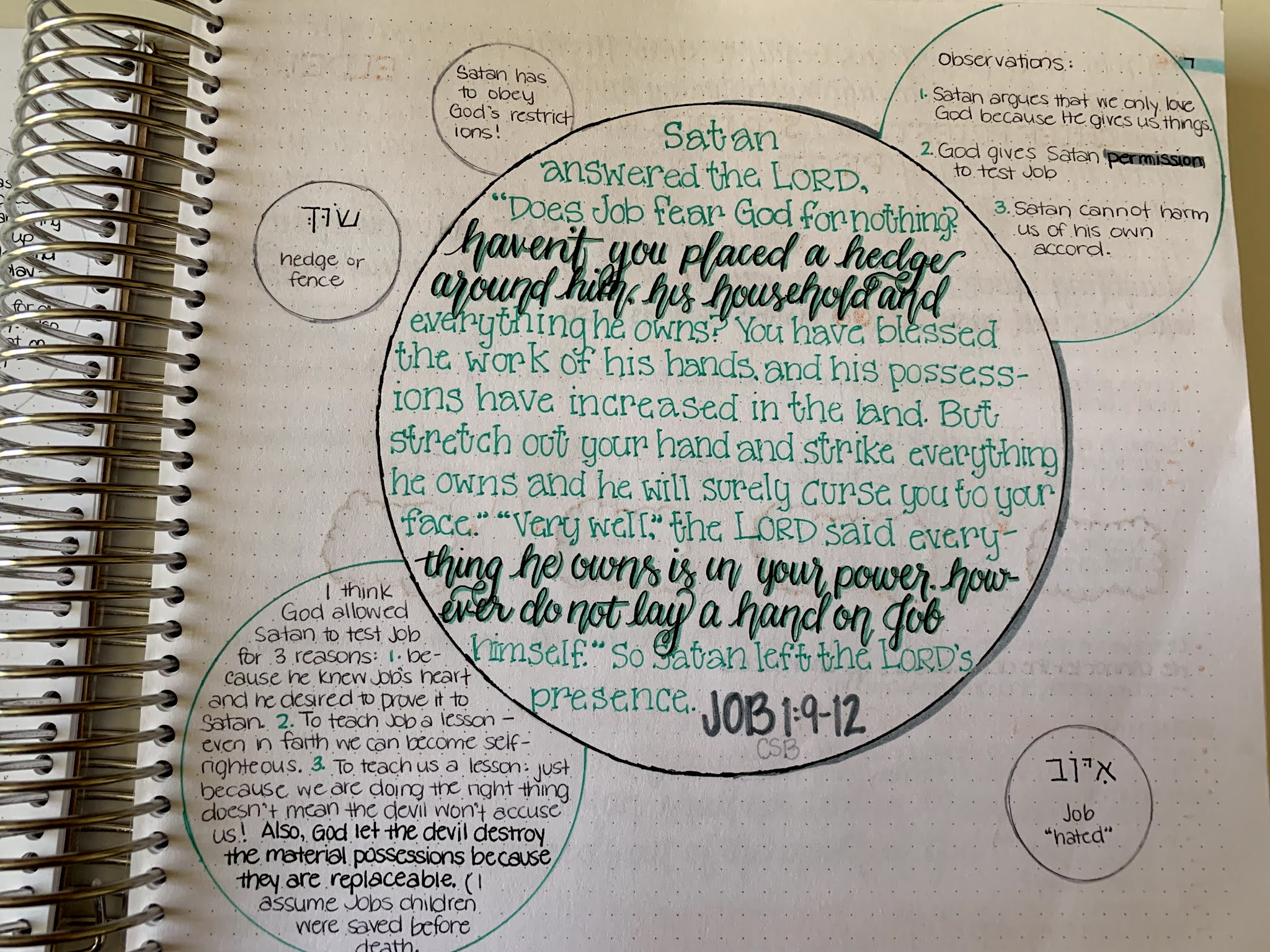
At the beginning of Job, Satan goes before God. Based on the context that "Satan" means adversary in Hebrew,[3] it is is implied that Satan frequently uses this time to complain about or accuse mankind. Instead of waiting for Satan to call out a particular person, God offers Job as an exemplary human. Satan is not convinced, arguing that Job only loves God because God has made Job successful. God then allows Satan to take Job's possessions and good fortune.

Why Did God Allow This?

The major question is why did God allow Satan to test Job? I think there are a few reasons for this, all of which apply to us today:

First, people often think they know everything until they are proven wrong. Satan had his mind made up about Job and the only thing that would prove him wrong was seeing it for himself. God already knew Job's heart and knew how everything would play out, but Satan did not.

Second, to prove to the sons of God who were also present. When Satan appears before God, the sons of God are also present. There are many intrepretations of who that refers to, but like Satan, these are limited beings who do not know the outcome of the test. If they were within earshot, some might have agreed with Satan, so God had to prove to them, as well, that there are faithful humans.

Third, to teach Job a lesson. (Sidenote, did you know "Job" means hated in Hebrew?[4]) Job was a bit self-righteous and in the end, though he never wavers in faith, God does have to chastise him. Sometimes we need to be reminded to have humility, because no matter how great our faith, we still fall short.

And fourth, to teach us a lesson. The book of Job answers the ultimate queston of why bad things happen to good people. Just like we discuss Job's trials and come to knew understandings about how suffering relates to our relationship with God, Job and his friends did the same thing. In the end, they learned about their own flawwed thinking because of Job's situation. Sometimes, we are the friend learning from our friend's misfortune and sometimes we are the friend going through the misfortune.

Who Does Satan Accuse?

Since we're discussing strategy, a great question is who does Satan accuse. God presents Job as perfect because he has perfect integrity, fears God, and turns away from evil. I seems that these are therefore the principles Satan tries to accuse us of not having. Also, an important observation is that if we do possess all three of these qualities, it is likely Satan wants to prove we don't really have all of these characteristics.

Matthew 16:21-23 Satan Speaks Through Peter

In this passage, Christ attributes the words spoken by Peter as being from Satan. Christ identifies these words as a stumbling block and says the reason is because they put man's desires over God's desires. Satan uses us to express seemingly innocent thoughts that are actually contrary to God; though he can also use us to express thoughts that are obviously contrary to God as well. The major theme in this passage is putting self interest above God.

Peter loved Christ and did not want to see Him die—this is a human inclination and very natural. Many of us would have likely expressed the same sentiments had we been in Peter's shoes. However, it wasn't what God wanted. As a small child, I used to pray/wish the world never ended—that was self interest and self preservation, but it also serves Satan. Our selfish desires always serve Satan. In my case, if the world never ends, Satan is never punished for his deeds and is allow to continue ruling over our world. In Peter's case, if Christ never died, there would be no salvation.

It is important for us to identify our thoughts and discern whether they are of God or not, as well as, identify the speech of those around us. As yourself:
  • Why should I say this? (or why did they say it?)
  • Is it selfish?
  • Is it helpful?
  • Is it necessary?
  • Is it kind?

Matthew 4:1-11: Satan Tempts Jesus

Right before Christ starts His ministry, Satan comes to tempt Him. Christ fends off three attempts by Satan, each of which show Satan's tactics and the only way to respond.[4]

Temptations #1: Weakness

The first thing Satan does is attack Christ's weakness. After fasting for 40 days, it is not surprising that Christ would be hungry. Satan challenges Him to turn stones into bread. In this, Satan is both questioning His ability and tempting Christ to give in to the flesh's desires. Similarly, Satan will come to us when we are weak and tempt us to take something the flesh desires even if it's not appropriate.

Christ responds by quoting Deuteronomy 8:3.

Temptation #2: Promises

The second thing Satan does is attack the promise of God. Satan tries to get Christ to prove God is who He says He is. Satan wants us to believe we have the responsibility of answering for God or proving His existance, when that onus is on the Holy Spirit. Christ did not need to put Himself in harms way to prove God is God because both He and Satan already know exactly who God is. The same is true for us.

Once again, Christ responds by quoting scripture. This time He quotes Deuteronomy 6:16

Temptation #3: Desires

The final thing Satan does is attack a desire. Satan promises Christ rulership from the price of submiting to him instead of God. Like with Eve in the Garden, Satan is offering something already given. Christ is the Son of God, King of Kings and Lord of Lords. The kingdoms Satan was offering to Him were already His. The catch in these situtations is not if you will have the desires of your heart by how you go about trying to get them. Satan's way, usually the easy way or a short cut, is temporary and comes at a high cost. However if we keep the faith and do it God's way, we get lasting results.

Christ respons by quoting scripture again, and quotes Deuteronomy 6:13.

The fact that Christ's only response to Satan is to quote scripture should remind us of the importance of knowing God's Word and clinging to it.

Conclusion

These verses focused on the strategies Satan uses to trip us up and helped me reflect on ways to prepare myself for his attacks.

References & Footnotes

  1. "June Scripture Writing Plan". The Reffled Mango; visited October 4, 2020
  2. "Alphabetical list of Fruits". Fruits Info; visited October 16, 2020
  3. Strong's H347. Job". Blue Letter Bible; visited October 17, 2020
  4. I am aware that this passage is not included in the original list. I just felt it was relevant to the study and decided to slide it in.

Pride, Morality, and Hope

Suddenly an angel of the Lord appeared, and a light shone in the cell. Striking Peter on the side, he woke him up and said, “Quick, get up!” And the chains fell off his wrists. Acts 12:7 CSB

A more in depth study of Acts 12 can be found here.

Herod Agrippa I
Herod Agrippa was the grandson of Herod the Great (the Herod that tried to have Christ killed as a baby). He actually followed Jewish customs and traditions, strengthening his bond between the Jews he ruled over. Because of this he despised Christians.[1] In the beginning of this chapter we learn that he's alread killed James, the brother of John, now he has his sights set on Peter. Herod's pride eventually leads to his demise. When people exalt Herod as a kind and he allows it, God strikes him dead.[2]

Peter
James is killed by Herod, but Peter is spared. Peter still had a job to do. One of things Peter's experience reminded me of was the moment in my childhood when I realized that morality and legality were two totally different things. There are things that are legal that aren't moral, and there are things that are illegal that are perfectly moral. We often get roped into an idea that because someone is a criminal according to the state/world they're a bad person, but that's not the case. Lots of great people spent time in prison—Peter, Paul, many civil rights leaders, etc.

Rhoda
Rhoda is thought to be a servant, hence why she answers the door. She is so shocked that Peter is at the door that she forgets to welcome him in! Many of us react like Rhoda to the blessings God has for us. When Rhoda tells the others, they don't believe her. The Church's reaction reminded me of when Christ said we could move mountains if we had faith the size of a mustard seed (Matthew 17:20). Verse 5 tells us they had been praying constantly, so why are they shocked that God rescued Peter?

References & Footnotes

  1. "Herod Agrippa I". Encylopædia Britannica. January 1, 2020
  2. When I read through this chapter, I couldn't help picturing Herod as Trump. After failing to maintain his prisioner, Herod jets off (to a vacation?) where he allows people to stroke his ego. Doesn't this sound like something Trump would do?

Acts 6-8 & 10-11: The Transition

A major transition happened in the course of Christianity after the stoning of Stephen--the Word began to be preached to the Gentiles! In this episode we cover: Acts 6-7: The Stoning of Stephen Acts 8: Philip Preaches to the Samaritans & an Ethiopian Acts 10-11: Preaching to the Gentiles We'll get back to the conversion of Paul in Acts 9 next week! Also, what exactly does it mean to be a Gentile?
Howbeit the most High dwelleth not in temples made with hands...Acts 7:48 KJV

The Stoning of Stephen

When they heard these things, they were cut to the heart, and they gnashed on him with their teeth.Acts 7:54 KJV
Stephen was one of the deacons chosen to assist the widows. He is devout man who performs many miracles within the community which enrages the Jews who don't follow Christ. Because of this, they accuse him of blasphemy—which was a very serious crime in Israelite society. When Stephen addresses the issue, he doesn't defend himself. Instead he gives a history of the Israelite nation, pointing out the similarities of his contemporaries to the forefathers who struggled with idolatry. This enrages them even more, so they kill him. Among the Jewish leaders who take part in this is Saul (later known as Paul)! Like Christ, Stephen's last words are a plea of forgiveness for those killing him.

Turning Point

This marks a major turning point in the history of Christianity. Before Stephen's murder, the gospel was only preached to the Jews. After his death, we see focus shift to spreading the gospel beyond the Israelites. This is important to remember as it often comes up in discussion about prophecy!

The Star of David?

42Then God turned, and gave them up to worship the host of heaven; as it is written in the book of the prophets, O ye house of Israel, have ye offered to me slain beasts and sacrifices by the space of forty years in the wilderness? 43Yea, ye took up the tabernacle of Moloch, and the star of your god Remphan, figures which ye made to worship them: and I will carry you away beyond Babylon.Acts 7:42-43 KJV
During Stephen's speech to the Jewish leaders, he quotes Amos 5:26, which mentions the star of a foreign god that Israel has made "their star." The star in reference is the star known today as the Star of David—the hexagram. This star actually represents idolatry.[6][7][8] It is interesting that Amos condemned them for it in the Old Testament, Stephen condemns them again in the New Testament, and today that star is on the flag of Israel...

Preaching to the Gentiles

What Does Gentile Actually Mean?

The dictionary definition of Gentile is non-Jew, and this is how most Christians define it. However, if you pay close attention to the Bible, this definition seems amiss. Throughout the text we see Biblical authors refer to Hamites (descendants of Ham) and Semites (descendants of Shem) by their tribe names—Ethiopian, Egyptian, Canaanite, Philistine, etc. We never see the Israelites refer to these people as Gentiles and in Genesis 10:5, we see the "isle of the Gentiles" reference a place where Japheth's descendants reside. Furthermore, the Jews have a particular dislike for the Gentiles that is unlike their "separate-ness" from others. The Israelites frequently intermarry with the tribes from Ham and non-Israelite Semites, and we see in Acts 8 that Philip has no problem speaking to the Ethiopian or the Samaritans. Yet Peter has to get a divine message from God to feel comfortable meeting with the Roman Cornelius, and it is only after Peter shares the gospel with these Gentiles (Romans) that the disciples get together to demand answers.

The Samaritans

Acts 8:1-24 covers Philip preaching to the Samaritans. There were already believers in Samaria, many who had already been Baptized—remember when Jesus spoke to the Samaritan woman at the well? However, the Samaritans had not received the Holy Spirit, so Peter and John were sent to show miracles and bring the Holy Spirit to them. We are told multitudes were saved there.

Among those multitudes was a sorcerer named Simon who converts. Despite believing, Simon still doesn't fully understand. He desires the abilities Peter and John have (giving the Holy Spirit). He proposes paying for the abilities and is promptly rebuked. Simon's desire to skip the work and jump straight to the power is more common than we think. While many of us would not suggest we "pay" for God's gifts, many do have a desire to skip the process of working and expect all the benefits of a full relationship with Christ. Christ Himself said some things can only be done with prayer and fasting, which means we have to grow in our relationship with Him to be able to perform certain miracles (Matthew 17:19-21).

The Ethiopian

Philip also preaches to a man from "Ethiopia." I put Ethiopia in quotation marks because it is important to remember that here Ethiopia does not reference the country we think of today but rather a broad region in Africa including Cush, Ethiopia, and Nubia. This man is already a believer in the God of Abraham, but he is unsure of how Christ fits into the picture. After asking Philip, he receives the gospel and requests Baptism.

Candace

Many think "candace" is a proper name in Acts 8:27, however it is actually a title similar to pharaoh.[2][3]

Eunuch

There's a bit of a debate over whether the term eunuch is always literal in the Bible. [5] At the very least it refers to a man who is celibate, though if taken literally, it also means he is celibate because he is disfigured. It was common during the ancient days for those who guarded queens (and concubines) to be emasculated so the king wouldn't have to worry about these guards sleeping with the women [*resists urge to go off on a rant about the sexism involved here*].[4]

Cornelius

Cornelius is a Roman soldier who is a man of God seeking truth. God visits him and sends him to Simon Peter. This is the interaction that requires a vision from God to both men (Cornelius and Simon Peter). When Peter visits Cornelius (and his household), the Holy Spirit falls on everyone in there, including the Gentiles. It is this event that prompts the disciples to convene and discuss whether the Gentiles are to be included in the gospel, ultimately understanding that God has included them in salvation.

Baptism

Baptism is featured heavily in in these chapters. There are a few things I noticed in these chapters that I wanted to point out. One of the issues I had trying to get baptized in our time is that people don't want to baptize you into the Body of Christ, but into their denomination. When I brought this up to the pastor who eventually baptized me, he made a point about that fact that just as God meant for babies to be born into a family, so He meant for babes in the faith to be born into a family. On the surface this sounds great, but if you read Acts 8, it's apparent that after baptizing the Ethiopian, Philip leaves. Similarly, it does not suggest that anyone stays permanently in Samaria after baptizing the Samaritans.

Another issue I take with the way some congregations/denominations handle baptism is the requirement of baptismal classes. Philip shares the gospel with the Ethiopian, who is baptized on the spot because he truly believes. While we aren't told how much time elapsed during the journey, it doesn't seem to be more than a few days at most and could very well have been a few hours for all we know!

References

  1. "Gentile". Merriam Webster; visited May 19, 2020
  2. Joshua J. Mark. "The Candaces of Meroe". Ancient History Encyclopedia. March 19, 2018
  3. Brent MacDonald. "the Bible and the Kingdom of Cush - so called "Ethiopia"". Not Just Another Book. 2014
  4. "Eunuch". Bible Study Tools; visited May 19, 2020
  5. Megan Sauter"Eunuchs in the Bible". Bible Archeology. January 21, 2020
  6. "Remphan". Bible Study Tools; visited May 19, 2020
  7. George Lujack. "Star of David or Star of Remphan?". Scripture Truth Ministries. March 21, 2018
  8. "In Acts 7:43, what are “the tabernacle of Moloch” and “the star of Remphan”?". Hermeneutics - Stack Exchange; visited May 19, 2020

You Are What You Eat: Acts 10

In Acts 10, Peter has a dream about eating unclean food. Some people use this to justify eating unclean meat, but in the Bible a dream is rarely what it seems. In every case where God gives people a vision, the vision is interpreted elsewhere in the text. Similarly, Peter's vision is explained later in the chapter. As it turns out, Peter was actually being told to accept Gentiles, not to consume unclean meats.
Kill and Eat?
12Wherein were all manner of fourfooted beasts of the earth, and wild beasts, and creeping things, and fowls of the air. 13And there came a voice to him, Rise, Peter; kill, and eat. 14But Peter said, Not so, Lord; for I have never eaten any thing that is common or unclean. 15And the voice spake unto him again the second time, What God hath cleansed, that call not thou common.Acts 10:12-16 KJV

Introduction

Photocredit: Unsplash.com/Christopher Carson
Acts 10:9-18 details a vision Peter is given from God. In this vision, Peter sees animals of all types, and a voice commands him to kill these animals to eat. When Peter receives these instructions, he protests. Peter says he has never eaten anything unclean, implying that he isn't about to start eating unclean animals now. Since God is the one commanding Peter to "rise and kill," many people take this as proof that we can eat unclean animals. However, if we really look at the passage, that isn't what's happening here.

The Punchline

After Peter experiences his vision, he has to think on it (Acts 10:19)—it isn't clear to him that God is giving him permission to eat unclean flesh! Eventually, Peter tells us what he has determined his dream means. In Acts 10:28 and Acts 11:5-18, it is explained that God gave this vision to Peter to prepare him for the inclusion of Gentiles in the movement. This makes sense because if you read prior to Peter's vision, you'll see that we are told about a Gentile, named Cornelius, who is sent by God to Peter. Cornelius receives his instructions in a vision as well. Prior to the dream's revelation, the Jews did not associate with Gentiles; Peter likely would not have received Cornelius without God revealing this message.

Other Examples of Beasts in Visions

If you remember back in Genesis, Joseph was an expert at interpreting dreams. Many of the dreams he interpreted weren't literal translations. The objects and animals in the seen in the dreams were usually metaphors or symbols for a larger picture. In Daniel 7, Daniel recounts a vision he was given from God that also includes beasts. These same beasts are repeated in the vision given to John and recorded in Revelation. If you compare Peter's dream with the visions given in Daniel and Revelation, you will notice continuity of symbolism in beasts or animals representing nations.

Moral of the Vision

Up until this point, the gospel was reserved for the Jews. The Jews didn't associate with Gentiles and essentially looked upon them the same way they looked at unclean animals such as pigs. Although God never told them to treat other people with such disdain (they weren't to yolk themselves with pagans, but strangers could be converted, at which point they became part of Israel), the Jews developed this tradition anyway. The development of unbiblical traditions was one of the main problems Jesus had with the Pharisees. He was constantly trying to get them back on target with God's word and to abandon man made traditions. Despite following Jesus during His ministry, Peter would have been raised in the Jews' tradition and been wary of Gentiles. So, when God sent Cornelius to Peter, He had to also send Peter a message to inform Peter that he should receive Cornelius with open arms. In the Old Testament, prophets like Isaiah talk about the time when the Gospel would be preached to the Gentiles, this is the beginning of the fulfillment of those prophecies.

Up Next: 1 Timothy 4:1-7

In the next post we'll look at 1 Timothy 4:1-7, another popular passage in the "can we eat unclean foods" debate.

References

  1. Jeffery Spitzer. "The Non-Jew in Jewish Law". My Jewish Learning; visited December 2018

DON'T MISS

Book Review,Food,Testimony
© 2022 all rights reserved
made with by templateszoo