Showing posts with label Romans. Show all posts

What Can Separate Us from the Love of God?

38For I am persuaded, that neither death, nor life, nor angels, nor principalities, nor powers, nor things present, nor things to come, 39Nor height, nor depth, nor any other creature, shall be able to separate us from the love of God, which is in Christ Jesus our Lord. Romans 8:38-39 KJV
Have you ever had moments where you feel like you can't face God? For me, it's usually when I'm angry. In those moments I feel like I've been cut off; it's a weird combination of shame and pride—shame that I'm displeasing my Father, and pride because I don't want to let go of whatever it is that displeases Him. It's comforting to know that even in those moments, we are not truly separated from God's love. As I've grown in my faith, I have repeated Romans 8:38-39 to myself when I feel this distance and that is what has pushed me away from sin and toward the Father.

Let's take a look at all the things Paul lists as not being able to separate us from the Father's love:

Death

The wages of sin are death (Romans 6:23). If we had to atone for our sins ourselves or through animal sacrifices, we would never earn eternal life. We all deserve death, but our Father has proven His love for us by providing a perfect sacrifice for us in His Son. The Messiah won the victory over death and now, if we accept Christ—His sacrifice and His teachings—we, too, are granted victory over death!

Life

When I first read life in the list, it threw me for a loop. Why would life separate us from the love of God? Almost instantly I realized this is a reference to temptation. We live in a fallen society; everything in life is temptation. Not only are the things of the world temptations against God's Word, but it's so easy to get distracted. There are days when I put all my time and energy in to things I need to survive (my job, fixing something at the house, chores, etc.) and when I finally get to sit down, I'm too tired to give the Father quality time. Sometimes days like this come back to back, stacking on top of each other. However, the Word says for every temptation He gives us a way out (1 Corinthians 10:13). Simple things like listening to gospel while I clean or praying while I work help me regain my focus on Him. He will not let us get lost in the distractions of life.

Angels

Presumably, Paul is referencing fallen angels here. Like Satan, the other fallen angels would love to see us turn away from the Father; but He has not given them power over us. Arguably, since angel means messenger, Paul could be referencing the message itself, but I believe he means fallen angels.

Principalities

We are subject to the powers that be. Whether you are a 5 year old who has to obey teachers and parents, or an adult who is bound to the laws of your government, there's ablways someone calling the shots. These people can easily require of us something we feel is displeasing to God. However, just as He appeared in the fiery furnace with Shadrach, Meshach, and Abednego, he will come to us as well.

Time

interestingly, Paul doesn't mention things past, which I think would be most people's concern. Of course the entire concept of baptism and salvation discusses things past. The real pressure is on now and the feature. Onve we have chosen to follow and obey the most High God, however, He will work out our future. Amazingly, we can make that choice at any moment, meaning our present state cannot stop us from expereincing the love of God.

Distance

When I first read this, I assumed Paul was referencing physical distance. The Israelites had feasts that required them to go to the Temple; not to mention sacrifices were to be done at the Temple. This is my mind, Paul was saying it doesn't matter where you go because God goest with you. Though now as I type, I see this less literally. He loves us when we are at or worst (valley or depth) and He loves us when we are at our best (hills or height).

Creatures

This was the one that made me scratch my head. If it could, how would an animal separate us from the love of God? I thouhgt of job in the beally of the some sea creature and then I thouhgt of Leviathan and Behemoth... Perhaps these are the creatures He means.

Luke vs. Paul: Abstaining from Meat Sacrificed to Idols

I have a list of difficult passages I've been working through and last Sabbath I added this topic after my Sabbath school class discussed Romans 14. Luke's conclusion on the issue of abstaining from meat sacrificed to idols seems to be the opposite of Pauls. In our society, these scriptures don't seem to have much relevance since our meat is usually factory farmed and not sacrificed to anyone. However, I think it's important to understand what we're reading so we can see how each passage fits in to the larger narrative. In addition, the underlying problem of bringing together people from different cultures is very real in our modern world. So, how do we harmonize these scriptures?

The Stances

Let's start by looking at each man's words on the topic. Luke, the author of Acts, mentions this issue in two places. Paul also mentions the issue twice.
28For it seemed good to the Holy Spirit and to us to lay upon you no greater burden than these essentials: 29that you abstain from things sacrificed to idols, from blood, from things strangled, and from acts of sexual immorality; if you keep yourselves free from such things, you will do well. Farewell. Acts 15:28-29 NASB
But regarding the Gentiles who have believed, we sent a letter, having decided that they should abstain from meat sacrificed to idols and from blood and what is strangled, and from sexual immorality. Acts 21:25 NASB
One person has faith that he may eat all things, but the one who is weak eats only vegetables. 3 The one who eats is not to regard with contempt the one who does not eat, and the one who does not eat is not to judge the one who eats, for God has accepted him. Romans 14:2-3 NASB
7However, not all people have this knowledge; but some, being accustomed to the idol until now, eat food as if it were sacrificed to an idol; and their conscience, being weak, is defiled. 8Now food will not bring us [c]close to God; we are neither [d]the worse if we do not eat, nor [e]the better if we do eat. 9But take care that this [f]freedom of yours does not somehow become a stumbling block to the weak. 10For if someone sees you, the one who has knowledge, dining in an idol’s temple, will his conscience, if he is weak, not be strengthened to eat things sacrificed to idols? 11For through your knowledge the one who is weak is ruined, the brother or sister for whose sake Christ died. 12And so, by sinning against the brothers and sisters and wounding their conscience when it is weak, you sin against Christ. 13Therefore, if food causes my brother to sin, I will never eat meat again, so that I will not cause my brother to sin. 1 Corinthians 8:7-13 NASB
It seems as though Luke has a hardline stance that the act is wrong, whereas Paul is saying the act in and of itself is not wrong, but we should be mindful of those around us.

Background

Let's step back into the time period of Luke and Paul for a second; it's impossible to understand these passages otherwise. In recent years, meat consumption has become a standard practice, something everyone does for every meal, but this hasn't always been the case. Meat was a luxury (and still is in some places). On top of that, there were no grocery stores or factory farms. Animals were not raised and slaughtered for mass consumption. In Paul and Luke's day, animals were kept to be sacrificed to gods. Just as the Israelites sacrificed a lamb on Passover (and then ate it), others were sacrificing animals to Roman gods. This meat could end up in the market for sale, or it could be the meat being served at your neighbor's house when you accepted a dinner invitation. Being unsure of the origin of the meat, many believers abstained from meat altogether (hence Paul referencing those who only ate vegetables).

The major issue in the church that both men were addressing was how to deal with Gentiles in the Israelite religion. Israel was supposed to be a Theocracy, with God as their king. The laws of God and the laws of the land were to be one and the same. Since everyone was to be worshiping the same God, their was never worry that the meat brought from your fellow Israelite was sacrificed to a pagan god. Roman however, was diverse, like the United States. In the cities of the Gentiles, you had people from different religions and cultures; you could never be sure what had been done to the meat sold in markets or served in people's homes.

Similarly, the mindset of the Jews and the Gentiles was different. Jews were simply accepting a deeper understanding of the religion/scriptures they had been taught from birth. Gentiles were unlearning the religion of their birth and learning something new. This changes how you approach things...

Modern Examples

I have two examples from my own personal life to illustrate how background can change the way you see things.

A friend of mine sent me a song by Lecrae. When I clicked play, I instantly recognized the beat. Lecrae's song samples from a Hip Hop song that has been sampled by many other artists. Instead of focusing on the lyrics of this particular song, my brain went to the lyrics of the song where I had first heard this beat. There is already a connection in my mind between the original song and that music. Not only did the lyrics of that song (which is not Christian) pop into my head, but memories associated with that song as well. It is impossible for me to worship and focus on God when listening to this song because my brain associates it with other things. My friend however, had never listened to non-Christian Hip Hop. They have never heard any of the songs that Lecrae is sampling from. They have no memories associated with that beat. They are able to listen and hear Lecrae's lyrics in peace.

Another friend introduced me to Erin Condren planners. I used her planners for 3 years before switching to a bullet jounral. It was during that time that I began keeping Sabbath. When I started using the planners, I didn't notice that they started the week on Monday, but as I got deeper in to my studies it bothered me. Like most people in the U.S., my brain was wired for Sunday being the end of the week: you work Monday through Friday, chores on Saturday, and rest on Sunday. Observing the Sabbath took a massive shift in mindset to see the week as Sunday through Friday, with Saturday as the day of rest. Now I start my week with chores, meal prep, and planning, but it's strange having that at the end of the week in your planner. I needed the visual of Sunday at the beginning of the week and Sabbath at the end to help me adjust my mindset.

Now, because of my experience, I could argue that no one should be listening to Lecrae and that no one should be using planners that start on Monday. This is the issue Paul and Luke are addressing. In my modern scenarios there is nothing inherently wrong with Lecrae's song or the planner; it is my experiences, my mindset, that affects the situation. There are many people who can listen to that Lecrae song and be moved by the Holy Spirit. There are many people who can use planners that start on Monday and still keep Sabbath. Paul's argument is the same: it's in the individual's mind.

Abstaining From Meat Sacrificed to Idols

While I can see clearly what Paul is suggesting when I bring it into a modern lens and inspect my personal life, it still gets muddy when I try to put it back in context with his time period.

Some ministries teach that Paul is expanding on Luke's instructions in Acts, essentially telling why they should abstain from the meats.[1] I question this interpretation for two main reasons. In Acts, Luke said absolutely to abstain from meats sacrificed from idols. While Paul does say that he would abstain to keep his brother from stumbling in 1 Corinthians, in Romans 14 Paul tells the one who does not eat not to judge the one who eats and vice versa. Putting Paul's writings together, I would say his stance is that it's OK to eat meat sacrificed to idols as long as it doesn't cause fellow believers to stumble. Luke on the other hand doesn't leave any room for eating this meat if no one objects...

My second concern is that the topics surrounding this issue actually seem to matter. Neither author is solely talking about meats sacrificed to idols. Luke also mentions consumption of blood, consumption of strangled animals, and sexual immorality. The command to abstain from blood is given all the way back in Genesis 9, right after the flood, before the establishment of Israel. Strangled meat refers to meat that had not been killed according to the custom, which typically meant blood was still inside that animal, pointing us back to the first issue of abstaining from blood. Sexual immorality is also spoken against in Genesis before the establishment of Israel, and is spoken against by Jesus/Yeshua/Messiah. Yes, all of these were part of pagan practices in Roman, but they were also forbidden during Noah's time, when there were no other people on the planet and thus, no pagan practices to conflict with God's ways. In Revelation 2:14,20, John comes back to the point of abstaining from meat sacrificed to idols and once again, God is condemning it.

In contrast, if you look at the modern examples I gave, you will never find passages where God condemned a specific type of music or planner.

Harmonizing

Honestly, I don't know the answer. This is one of those passages I will have to keep studying. Comment below how you view this passage and how you harmonize them.

References

  1. "What does the Bible say about eating food/meat that has been sacrificed to idols?". GotQuestions.org; visited June 2021

Dealing With The Devil (Part 3)

Introduction

This is a continuation of a study I'm doing on "Dealing with the Devil," based on a 30 day scripture plan I found by The Ruffled Mango.[1] In this post, I'm covering days 10 through 14—we're going to look at:
  • Acts 13:8-12
  • Romans 16:19-20
  • 1 Corinthians 5:1-5
  • 2 Corinthians 2:10-11
  • 2 Corinthians 11:12-15

Acts 13:8-12: Elymas Tries To Sway the Proconsul

Satan uses Elymas, a sorcerer, tried to sway the proconsul (a man of power[2]) from the faith and it ended up backfiring on him! In this passage, we learn that Satan uses trickery and deceit to accomplish things, but we also learn that when we stand up to him, God uses those moments to bring believers to His side instead.

Romans 16:19-20: Simple Concerning Evil

Despite their obedience, Paul chides the people on being "wise to that which is good and simple concerning evil." This hit personally, because I have a tendency to complicate issues. We thinking and overthink until we end up not sure which way is up and which way is down. Satan can use this to his advantage.

1 Corinthians 5:1-5: Separate From Evil

In this passage we learn about a church that struggled to separate themself from evil. A rotten apple spoils the whole bunch! There were 2 key points I took from this passage:
  1. The devil isn't always external; sometimes we are our own adversary
  2. If we need to separate from someone, the goal should be to ultimately get them back to Christ

2 Corinthians 2:10-11: Forgiveness is Key

This passage focused on forgiveness and the fact that when we don't forgive each other, the devil can get a foothold in our relationships. It reminded me of church hurt and how we both push people away and allow ourselves to be pushed away. The devil wants us to be separated because that is when we are at our weakest point.

2 Corinthians 11: Stay The Course

Sometimes we're tired, overlooked, and overworked; but if we don't do what God calls us to do, the devil will certainly send someone to replace us. There are many false prophets who are just waiting for the spotlight and with that spotlight they can do a lot of damage. It is our responsibility to be where God tells us to be, doing what He tells us to do so that the devil doesn't get to voice his deceit.

Conclusion

The biggest take away I took from this selection of passages was that we must call out false teaching and evil. We must take a stand and declare the goodness of God to contrast the devil's darkness. This is how we win souls for Christ and how we keep ourselves from being deceived.

References

  1. "June Scripture Writing Plan". The Reffled Mango; visited October 4, 2020
  2. "Proconsul". Dictionary.com; visited October 23, 2020
  3. "Strong's G5218. ὑπακοή". Blue Letter Bible; visited October 23, 2020

You Are What You Eat: Romans 14

Eating Herbs/Vegetables vs. Eating 'All Things'
2For one believeth that he may eat all things: another, who is weak, eateth herbs. 3Let not him that eateth despise him that eateth not; and let not him which eateth not judge him that eateth: for God hath received him. Romans 14:2-3 KJV

Introduction

Photocredit: Unsplash.com/Stefan Vladimirov
I started the You Are What You Eat Series a long time ago and for some reason, I never finished it. I believe I became tied up with life, probably the podcast, and other ideas. Eventually I forgot I had even started the series. However, I still feel like this is an important topic so I'm picking up where I left off and continuing. If you only recently began following the blog, I'd advise you start from the beginning of the series with "You Are What You Eat: Introduction".

Romans 14:2-3 is the second verse that comes up in defense of eating unclean meat when talking about the dietary law post-Crucifixion that I actually understand why people are confused. This verse explicitly says someone who is weak (in the faith) only eats herbs, implying that the strong in faith eat meat. Unlike the verse we mentioned before in 1 Timothy, there doesn't seem to be a qualifier on meat because it explicitly says "all things." So, why does Isaiah 66 condemn the man eating pork in the end times? Why does Acts 15 tell us we can't eat blood?

Breaking Down the Scenario

We already spoke about the concept of "all" things in previous posts. I can't eat poison or metal; I can only eat things that are edible. As with the other verses we've studied, we should also keep in perspective that Romans was written by Paul, who was Jewish. "Edible" would have referred to clean meats only in his mind. Nonetheless, let's look at the whole scenario and put it in context.

The scenario presented is that there are two men eating somewhere. The one who is strong in faith eats everything on the menu. The one who is weak in faith only eats herbs, re: vegetables. Think about this: the contrast of all things is herbs, not clean meat. If Paul was saying it was ok to eat unclean meat, why would he compare it to vegetarianism? We do not have a juxtaposition of unclean meats (such as pork or shellfish) and clean meats (such as chicken or beef), which are also not herbs/vegetables. So, wthy does the weak in faith believe he cannot eat the chicken on the menu?

In an episode of his radio broadcast,[19] Pastor Doug Batchelor concludes that Paul was referencing foods sacrificed to idols. Of course that muddies the water with Acts 15, which clearly forbids eating food sacrificed to idols. If we bring in 1 Corithians 8 and 1 Corinthians 10 as well, we can get a clearer view of what the actual problem is.

The Gentiles whom Paul wrote to lived an experience completely different from the Jewish Christians. To make a modern parallel, a Jewish follower of Christ interacting in Judea is like a Baptist interacting with a Methodist or Pentacostal. Fundamentally, they believe the same things and use the same scriptures for reference. The differences between them are so small that its possible for them to not even notice. In contrast, a Gentile convert interacting in Rome is like the same Baptist interacting with a Muslim or Hindu. The differences in belief will become apparent much more quickly.

One of these diffrences concerns meet sacrificed to a deity. During this time period, all meat was sacrificed to some deity before being consumed. In Israel, this deity was YHWH, but in Rome it could have been any one of their gods or goddesses. When this food was presented to a Gentile Christian, it presented a conundrum. Someone who was born in paganism may see the meat and instantly be reminded of ritual cermonies to pagan deities—associations cannot be removed overnight. Yet others knew they had not only had they not participated in the ritual, but the god who'd "received" the sacrifice wasn't real. Those who struggled with separating from the their previous lives, abstained from the meat all together (the way a recovering alcoholic may abstain from all alcoholic drinks).

In both 1 Corinthians and the passage in Romans 14, Paul is addressing the disparity between those who can and cannot detach themselves from the pagan lifestyle. In a perfect world, no one would be concerned with who the meat was sacrificed to because everyone would know there is only one God and would understand that there need not be anymore sacrifices anyway. However, since we do not live in a perfect world, Paul must advise on how to hand this matter. The advice given is to act in love and avoid being a stumbling block. New Christians (and even pagans), who saw a person eating meats sacrificed to idols may become confused and believe it is a sign of worship for the false deity. When offered meats sacrificed to idols, the strong Christian was to decline the meat not because the meat was actually tainted, but to ease the conscience of the weaker believers around him/her.[2][3] This also set the Christians apart from pagans by showcasing their dedication to YHWH.

Conclusion

In this passage Paul is not speaking of clean versus unclean. Paul is speaking of (clean) meat vesus not eating meat at all.

Up Next: Acts 15

The next post in this series will tackle Acts 15. There is already a post in the Bible Study section on Acts 15, though it is not specific to the clean vs. unclean meats discussion.[6]

References

  1. Pastor Doug Batchelor. "How does Romans 14 fit with biblical direction to avoid unclean meat?". Amazing Facts; visited 2017 and September 12, 2020
  2. What does the Bible say about eating food/meat that has been sacrificed to idols?". GotQuestions.org; visisted September 12, 2020
  3. Tom Martincic. "Romans 14: Who is the weak brother?". EliYah; visited September 12, 2020
  4. Pastor Joe Crews. "Hogs And Other Hazards". Amazing Facts; visited September 12, 2020
  5. United Church of God. "". Beyond Today. January 31, 2011
  6. Ree Hughes. Acts 15: Disagreements in the Church". PSALMS to God. July 1, 2020

All About Vegetables

"19. What? know ye not that your body is the temple of the Holy Ghost which is in you, which ye have of God, and ye are not your own? 20. For ye are bought with a price: therefore glorify God in your body, and in your spirit, which are God's." -1 Corinthians 6:19-20 KJV

Introduction

19What? know ye not that your body is the temple of the Holy Ghost which is in you, which ye have of God, and ye are not your own? 20For ye are bought with a price: therefore glorify God in your body, and in your spirit, which are God's.1 Corinthians 6:19-20 KJV
God tells us that the body is a temple; it's something He has given us that we are tasked to take care of. From both a Biblical and a scientific perspective, it is important to eat properly as part of taking care of our body. As such, the Spirit has laid on my heart the desire to learn more about nutrition and the wonderful foods God has placed on this Earth for us. This post is the first in the nutrition series, in which I will be researching food groups in general (e.g., vegetables, fruits, grains, etc.), nutrients (e.g., vitamin A, iron, protein, etc.), and specific foods (e.g., okra, mango, rice, etc.), then share what I find. I'm kicking off the series with vegetables.

I don't have to tell you vegetables are important to your diet; you know that. Nonetheless, I've compiled some info of the benefits of vegetables anyway. From identifying what actually is a vegetable to determining whether to go for fresh veggies, frozen veggies, or canned alternatives, there's a lot to dig into for this food group.

Defining a Vegetable

Photocredit: Unsplash.com/NeON RAND
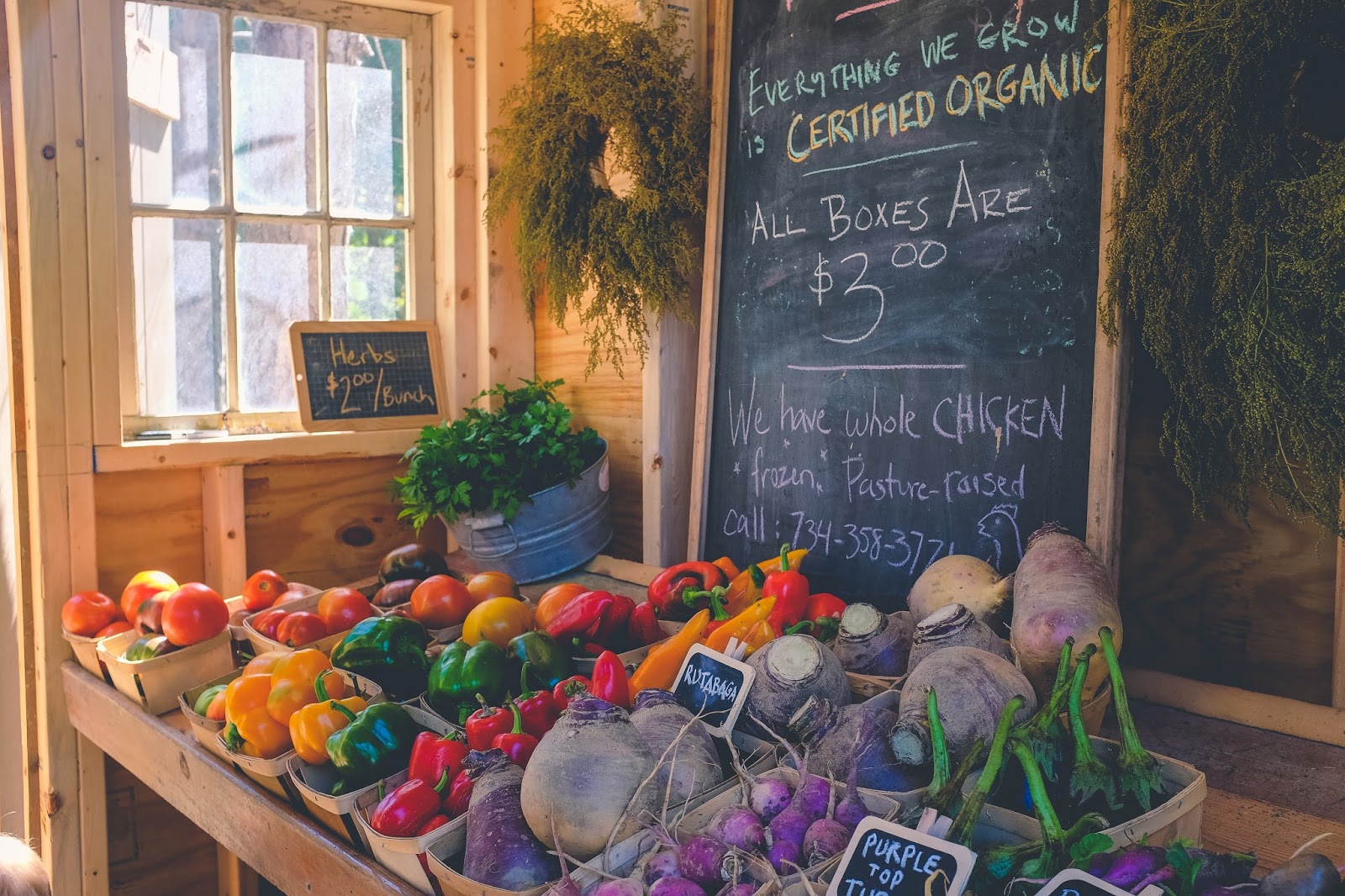
We all know the age old debate about whether a tomato is a fruit or a vegetable, but did you know that cucumbers, squash, eggplant, zucchini, corn, and pumpkin also belong to this confusion? The confusion stems from the fact that the botanical classification of foods does not match the culinary classification of food. Botanically speaking, a fruit comes from the flower of a plant and carries the plant's seeds, while vegetables come from the rest of the plant.[4] From a culinary perspective, however, the distinction is about taste. Fruits are generally used to garnish something or as a dessert, while vegetables are typically more savory. This difference enables us to think of something as a vegetable even though it is a fruit scientifically.

Generally, if it seems more like a vegetable than a fruit (e.g., tomatoes, eggplant, etc.) you can count it toward daily vegetable intake. I base this assumption on the United States Department of Agriculture's (USDA) Choose My Plate website, which lists recommended serving sizes under vegetables for foods that can be classified as fruits scientifically but are thought of as vegetables.[2] What determines this distinction? I'm not sure, but I would guess it has to do with the nutrients these foods provide.

Vegetable Nutrition

That brings us to the question of what exactly vegetables give us that is important for our diet. They're always listed separately from fruits in nutritional eating diagrams, but what does a vegetable give us that a fruit won't (especially since many vegetables are actually fruits!)?

According to the USDA, they provide the same nutrients.[3] Healthline makes the claim that fruits have more sugar and thus, more calories.[4] Although I have not been able to verify this as a fact, it makes sense logically, considering that fruits are generally more sweet than vegetables. I think it is very possible that the reason fruits and vegetables are separated in diagrams is to make sure you don't overdo it on sugary fruits (which we typically prefer) and neglect vegetables which may provide different nutrients, or the same nutrients with less sugar. (I'll dig into variance of vegetables later in the post.)

Healthline also tackled the question of nutritional differences between vegetables and fruits.[11] As could be expected, they found the difference is merely what vitamins, minerals, etc. are more easily extracted (if extracted at all) from the food. They also point out that fruit is higher in calories

Benefits

According to the USDA, vegetables:[2]
  • are low in fat and calories
  • do not have cholesterol
  • rich in the following vitamins and minerals
    • potassium
    • dietary fiber
    • folate (folic acid)
    • vitamin A
    • vitamin C

Harvard's School of Public Health lists even more benefits studies have proven we reap from eating more vegetables. Among these benefits are reduced risk of cancer, diabetes, heart disease, and stroke, improved eye health, lowering high blood pressure, and relief from irritable bowel syndrome (IBS).[12]

Raw vs. Cooked

Some people think it's healthier to only eat raw vegetables; in fact, there's a group of people, known as raw vegans, who don't eat anything cooked. I'm not here to debate their food choice, but after watching a few raw vegan bloggers, I was definitely curious as to the research behind eating raw versus cooked vegetables.

After comparing 22 studies, researchers found that both raw and cooked vegetables have inverse correlations to cancer, meaning those who ate more vegetables had a lower risk of many types cancers. This relationship was found more often for raw vegetables than cooked vegetables, but there was one instance in which cooked vegetables were found to lower the risk of a type of cancer that raw vegetables did not.[5]

Another study found a decreased risk in breast cancer among women who consumed raw vegetables.[6] Cooked vegetables neither increased nor decreased the risk, according to the study.

Based on the studies I've read, cooked vegetables are not harmful and in some cases makes it easier to absorb nutrients.[5][6][7] Raw vegetables, however, have been proven to reduce the risk of cancer for more cases. As such, it is important for us to get an adequate supply of both.

Fresh vs. Canned vs. Frozen

You can probably guess that if there's a debate about raw versus cooked there's probably a debate about fresh, canned, and frozen vegetables as well. Personally, I've always disliked canned vegetables; it's something about the preservatives that make them taste funny to me. I was a stickler for fresh vegetables for most things until I went graduate school and became poor. During that time I learned to love frozen vegetables. Not only can you buy in bulk without worrying about expiration, it's cheaper! Of course, that probably matters less if one is significantly better for you, huh? My gut instinct says that fresh and frozen are the better options. I would assume the preservatives in canned food have some kind of effect—but that's just a hunch, so I did some research.

Most of what I've seen asserts that it's impossible to know. Studies couldn't seem to find an absolute correlation to say fresh or frozen vegetables were better than the other.[9][13][14] In some cases the frozen vegetables retained more nutrients, while in others, the fresh vegetables were more nutritious. Seems like the theme is going to be variety!

How Much Should You Eat

The USDA suggests that about a quarter of your plate should be vegetables. Personally, I think looking at it in terms of ratios is much easier to deal with. Of course, in the US we typically over eat, so it's good to know how much that actually should be as well. Bearing in mind that age, sex, and activeness play a role in how much you should eat, adults should be consuming somewhere between 2-3 cups of vegetables a day.

What Does A Cup Look Like?

Measuring out a cup of vegetables is one way to determine if you're meeting the requirement, but in some cases that's too much extra work, or not quite accurate. Leafy greens, like spinach and kale, can be eaten raw or cooked; a cup of raw spinach can easily cook down to a much smaller portion size. For both spinach and kale, you can count 1 cup toward your daily vegetable intake with 2 cups in the raw state or 1 cup in the cooked state.[19]

Variety

Values from ChooseMyPlate.gov
It is also important to vary the type of vegetables you eat. I use the "eat the rainbow" method to check my eating habits—basically, I make sure I'm eating fruits and vegetables of every color. According to the USDA, the bulk of our vegetable intake should come from red or orange vegetables (e.g., tomatoes, carrots, and peppers) and starchy vegetables (e.g., potatoes, corn, and peas). We should also have a portion of beans/peas, dark leafy greens, and all the other vegetables.[19]

In the Bible

God created vegetables with the intent for us to eat them—in fact, they were one of the few foods that were actually included in our original diet. So, you know He had to mention them throughout scripture. He may not be as heavy handed as our earthly parents when it comes to telling us to eat our vegetables, but He definitely makes the point.

Genesis

And God said, Behold, I have given you every herb bearing seed, which is upon the face of all the earth, and every tree, in the which is the fruit of a tree yielding seed; to you it shall be for meat. And to every beast of the earth, and to every fowl of the air, and to every thing that creepeth upon the earth, wherein there is life, I have given every green herb for meat: and it was so. And God saw every thing that he had made, and, behold, it was very good. And the evening and the morning were the sixth day. Genesis 1:29-31 KJV
Unlike processed foods, and meats, vegetables were given to us for food from the very beginning of God's design, back when everything was perfect. Genesis 1:29-31 gives us permission to eat herbs and fruits from seed bearing plants. Although it could be mere coincidence, the time in which mankind was only permitted to eat fruits and vegetables is also the time when people lived into their 900s. Given that research today shows increased vegetable consumption promotes good health and prolongs life, I don't think it was a coincidence.[3][15][16][17]

Daniel

Another place where the Bible promotes vegetables is in Daniel 1:8-16, often referred to as Daniel's fast.18 In this passage, Daniel, Hananiah, Mishael, and Azariah (the latter also known as Shadrach, Mesach, and Abendego) refuse to eat the meat of Babylon's king. The person in charge of them was worried that a vegetarian diet would make them weak and frail, which is very reminiscent of the feedback I receive when telling people I'm vegetarian today. However, after a trial period of only ten days, the 4 men proved to be stronger and healthier than those who were consuming meat! While this diet includes fruits, it says a lot about how important vegetables are to our health.

Romans

1Him that is weak in the faith receive ye, but not to doubtful disputations. 2For one believeth that he may eat all things: another, who is weak, eateth herbs. 3Let not him that eateth despise him that eateth not; and let not him which eateth not judge him that eateth: for God hath received him.Romans 14:1-3 KJV
An oft misunderstood passage, Romans 14:2 is also about vegetables. Many take this passage to be permission to eat unclean meats, but that is a topic for another post. Right now, I want to concentrate on the juxtaposition of eating "all things," versus "herbs." Clearly, "all things" includes both herbs and meat and refers to an omnivorous diet, whereas herbs would be a vegetation only. Paul says that those who believe they can only eat herbs are weak, causing many to associate vegetarianism with weakness.

Before we dechiper what Paul meant in this passage, ask yourself this: was Daniel weak?

Romans 14 is addressing the issue of belief; he starts out telling us that those who are weak in faith are doubtful, then goes into the famed verse about those eating only herbs being weak. In context, this is clearly an issue about faith. Ask yourself, why was there a dispute about whether the people could eat meat or not? Vegetarianism hadn't been the standard diet for that region since before the flood—the Israelites even complained about the lack of meat while they were in the wilderness (Exodus 16 and Numbers 11). Furthermore, this letter is addressed to the Romans, who were Gentile converts to Christianity. The issue they had was actually very similar to the issue Daniel had: meat given to them at their neighbors' homes was meat sacrificed to idols.

Remember, as converts, Paul's audience may have participated in these pagan religions before finding truth in Jesus. Being around paganism was a temptation for them the way being in a bar is temptation for a recovering alcoholic. They were weak because they were not yet confident in their faith to resist that temptation, not because of their food choices. I can't wait to really dig into this verse in it's on post, but for now, I think it's sufficient to establish that it is not condemning vegetarianism, after all Isaiah 11 sounds like the ideal society is a vegetarian one from God's viewpoint.

Other

The examples above are food-focused, meaning the consumption of food is a major point of the synopsis, so it's hard to miss (though many forget about this specificity in Genesis). However, there are many other times the Bible shows God's people enjoying vegetables, it which it's just a passing fact.

In 1 Samuel 17:27-29, the people who take in King David during his son Absalom's rebellion bring a feast for David and his men. The feast includes "corn," lentils, and beans. I put corn in quotations because the word translated to corn in the Bible doesn't mean corn in the sense we think of it today. It was likely referencing some type of grain.[10] Newer translations such as the New International Version (NIV) or English Standard Version (ESV) show the word grain instead of corn.

Another example can be found in Numbers 11:4-5. The Israelites had just escaped bondage in Egypt and were complaining about the food supply. While they do ask for flesh (i.e., meat), they reminisce on fish, cucumbers, melons, leeks, onions, and garlic. Obviously fish is the only meat, and melons are fruits, but the majority of the foods they list are actually vegetables. Stop and think about us today; you've just been freed from being held in captivity and you aren't asking for potato chips, pizza, or any other junk food; you're not even asking for steak! Instead you want cucumbers, leeks, onions, and garlic, all of which are vegetables (not the first vegetables that would come to my mind to ask for, but oh well).

References

  1. "My Plate". USDA; visited March 2018
  2. "Why is it important to eat vegetables?". USDA; visited March 2018
  3. "Why is it important to eat fruit?". USDA; visited March 2018
  4. Rachael Link, MS, RD. "What's the Difference Between Fruits and Vegetables?". Healthline. April 5, 2017
  5. Lilli B. Link and John D. Potter. "Raw versus Cooked Vegetables and Cancer Risk". Cancer Epidemiology, Biomarkers & Prevention; Volume 13, Issue 9. September 2004
  6. Karl-Heinrich Adzersen , Patricia Jess , Klaus Wilhelm Freivogel , Ingrid Gerhard & Gunther Bastert. "Raw and Cooked Vegetables, Fruits, Selected Micronutrients, and Breast Cancer Risk: A Case-Control Study in Germany". Nutrition and Cancer; Volume 46, Issue 2, pg. 131-137. 2009
  7. Stephanie Brookshier "Raw Vegetables Vs. Cooked Vegetables". SF Gate. April 2, 2018
  8. Cheryl L. Rock, Jennifer L. Lovalvo, Curt Emenhiser, Mack T. Ruffin, Shirley W. Flatt, Steven J. Schwartz. "Bioavailability of β-Carotene Is Lower in Raw than in Processed Carrots and Spinach in Women". The Journal of Nutrition; Volume 128, Issue 5, pg 913–916. May 1, 1998
  9. DJ Favell. "A comparison of the vitamin C content of fresh and frozen vegetables". Food Chemistry; Volume 62, Issue 1, pg. 59-64. May 1998
  10. "Corn". Bible Study Tools; visited April 1, 2018
  11. Rachael Link, MS, RD. "What's the Difference Between Fruits and Vegetables?". Heathline. April 5, 2017
  12. "Vegetables and Fruits". Harvard School of Public Health; visited April 2018
  13. Joy C. Rickman, Diane M. Barrett, and Christine M. Bruhn. "Nutritional comparison of fresh, frozen and canned fruits and vegetables. Part 1. Vitamins C and B and phenolic compounds". Journal of the Science of Food and Agriculture; Volume 87, Issue 6, pg. 930-944. March 14, 2017
  14. Roni Caryn Rabin. "Are Frozen Fruits and Vegetables as Nutritious as Fresh?". NY Times. November 18, 2016
  15. Carlos A. González, et. al. "Fruit and vegetable intake and the risk of stomach and oesophagus adenocarcinoma in the European Prospective Investigation into Cancer and Nutrition (EPIC–EURGAST)". International Journal of Cancer; Volume 118, Issue 10, pg. 2559-2566. May 15, 2006
  16. Luc Dauchet, Philippe Amouyel, Serge Hercberg, and Jean Dallongeville. "Fruit and Vegetable Consumption and Risk of Coronary Heart Disease: A Meta-Analysis of Cohort Studies". The Journal of Nutrition; Volume 136, Issue 10, pg. 2588–2593. October 1, 2006
  17. Lydia A Bazzano, Jiang He, Lorraine G. Ogden, Catherine M. Loria, Suma Vupputuri, Leann Myers, and Paul K. Whelton. "Fruit and vegetable intake and risk of cardiovascular disease in US adults: the first National Health and Nutrition Examination Survey Epidemiologic Follow-up Study". The American Journal of Clinical Nutrition, Volume 76, Issue 1, pg. 93–99. July 1, 2002
  18. "What is a Daniel fast?". GotQuestions.org; visited April 2018
  19. "What foods are in the Vegetable Group?". USDA; visited March 2018

DON'T MISS

Book Review,Food,Testimony
© 2022 all rights reserved
made with by templateszoo