
Showing posts with label Cultured Expressions. Show all posts

Origin

Photocredit: Unplash.com/Jeremy Bishop
Brown
The color of soil
Ripe for planting seeds
That grow bountiful plants—
Beautiful blooms and healthy harvests...
Hands,
Work steadily in the sun,
Brown from the golden rays,
They feast on scintillating crops
Seasoned for the soul and perfectly prepared...
Lifted
My spirit each evening—
Sitting around the dinner table,
Antique wood—brown and rich
With memories spanning lifetimes of generation,
Familiar folk tales and memories made...
Me
In the middle
Of wise old women
Shaped and sharpened by time—
The brown bags of betrayal beneath their eyes...
High
We aim, above and
Beyond our wildest dreams
Covered by this brown that births
Life, gifted by God for glory and greatness.
"It's not racism, just preference "

"People prefer people who are like them." That is the gist of a lot of comments beneath a YouTube video I found after reading an article called Two Little White Girls Crying After Receiving Black Dolls Is Hardly Funny. I thought it would be obvious why something is wrong with the video, which shows two young girls receiving a black baby doll each, followed by one crying and the mother laughing. Yet, some people were "confused" and "appalled" that on lookers labeled the video racist. Now I feel the need to explain the not-so-fine line they seem to be missing.

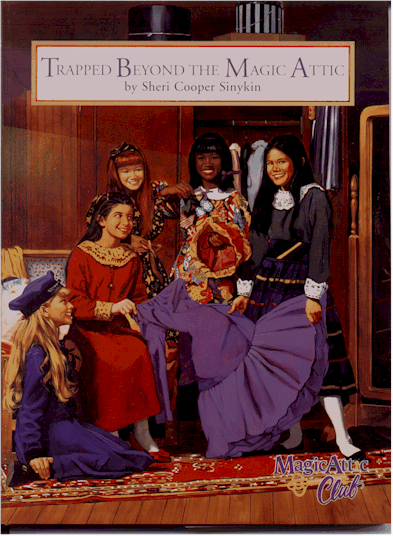
I had dolls as a kid, but not many because I don't like dolls, so I'm going to substitute books for dolls in this discussion to illustrate my point. As a child I was a fan of many book series, including (but not limited to) The Magic Attic Club, American Girl, and The Babysitters Club. The Magic Attic Club was my favorite; it followed the adventures of 4 (later 5) girls who upon trying on clothes from an old trunk in "the magic attic" would be teleported to a different time or location. Three of the girls were White (a blonde named Alison, a redhead named Megan, and a brunette named Heather), the fourth was a Black girl named Keisha, and the fifth girl was a Native American named Rose. The first book in the series and one other book (which introduced Rose) features all the girls, but the others focus on a single girl taking an adventure.

Preference: Yes, when I began the series, I started with the books featuring Keisha, as I imagine little blonde girls may have started with Alison.  I was happy to see someone who looked like me on the cover (particularly since you don't often see people of color on the cover of books), and I was excited to read her adventures. However, I have read all of the books. After completing Keisha's first arc of stories, I began reading the others (similarly I've read more than the Addy series from American Girl). As I type, 3 stories stand out to me: one features Megan, one Keisha, and the other Rose. In the end my favorite story from the series is not a Keisha story. Keisha may have brought me to the story (I can't remember if I started with book one or one of her stories), but the story itself is what kept me and regardless of skin color, I became engrossed in the other characters' stories as well.

Racism: My family members knew I loved to read, and at that age, they knew what I loved to read. Come my birthday, Christmas, or just because, you can bet they'd bring me a book from this series. Sometimes the book featured Keisha, sometimes it didn't. They picked up one that sounded like something I'd like and didn't already have, wrap it up, and hand it to me just like the girls in the video. I never reacted that way upon receive a book about a White character. I didn't drop the book on the ground and throw it as though it was worthless or burst into tears. I said thank you, went to my reading chair, and started reading. The only time I was disappointed was when I specifically asked for a particular title and received a different one. This wasn't race or even character based but story based—if I asked for Heather Takes the Reins and received Heather at the Barre that was disappointing; randomly receiving Princess Megan (as opposed to a book about Keisha) was still a treat. Nonetheless, had I acted the way the child in the video did, my mother would not have laughed. You can bet she would have lit into me about my ungrateful-self, demand I thank the gift giver, and sternly confirm that it might be the last gift my ungrateful-self ever got.

What makes the video disgusting and racist is not that the little girl prefers White dolls, but the dramatic reaction they have followed by the mother condoning and laughing—LAUGHING!—at their reaction. She prompts them with "you don't like it" as though she knew they wouldn't like the dolls. My reaction would have been to ask why they didn't like the doll. Or to explain that there was no difference between the White doll and the Black one (aside from appearance)—both can be named and played with in exactly the same fashion, you can play dress up with the doll no matter the color, and whatever personality you give it, that is who the doll becomes. Not only is the mother showing her daughters that she thinks their disdain for a Black doll is funny, she's letting them behave like a brat! If I had acted like that upon receiving a gift, I would never have gotten another one from my mom again.

While I'm sure those commenters are actually racist and have no desire to understand why people called the video racist (perhaps they even know and simply want to defend the video), I hope someone can take something from this.

Affirmative Action: To Stay, or Not To Stay

I remember when Abigail Fisher's story broke. I'm not much older than Ms. Fisher, so I was well aware of the stress and strain of attempting to go to college when her story broke. Her assertion that the University of Texas discriminated against her on the basis of being white was a front page headline (or at least it was all over the internet). She isn't the only one who feels like affirmative action discriminates against white people and is "reverse racism"—*rolls eyes* racism is racism people, there is no reverse racism. Now, almost 8 years later, and after graduating from a different school, her case against affirmative action is back. The Supreme Court will soon be ruling on whether to keep or end affirmative action.[1, 2]

In order to explain what I think on the matter, first let me give you a bit of a back story on my own dealings with such accusations.

As a black female who attended the #1 school in my home state, I'm no stranger to the accusations against affirmative action. The first time someone accused me of getting something I didn't earn was in high school. A classmate suggested that I was informed about more scholarships because I was black and the guidance counselor was black. She didn't suggest that the scholarships were minority based, and she didn't ask if they were need based. What she also never considered was difference in GPA and difference in major. You see, she just assumed I was of equal or less intelligence, therefore we should be getting approximately the same amount of opportunities. However, on paper, we weren't equal candidates. I scored higher on the ACT. I was in the top 2% of my class, while she was only in the top 10%. I was involved in more extracurricular clubs than her, and I did more community service. Being black wasn't what gave me a leg up, but she didn't bother to investigate that far. She simply assumed I couldn't be more qualified than she was. It's disheartening to experience these types of accusations; people don't even give you a chance to speak, they just assume you're dumb because you're black. Because two black people were involved, we had to be cheating the system? Nevermind that the other guidance counselors and all of our teachers were white. No one said to the valedictorian you just got there because you were white and all of your teachers were also white.

Around the time of Ms. Fisher's case, I experienced such an accusation again. This time, a student in the cafeteria said we (the black students) were taking up the spots of more deserving white students. The student went on to say their friend didn't get accepted because they "let" us in instead. At that point (the beginning of my Junior year in college), I still had a 4.0 GPA, even as a Mathematical Sciences major. I was Vice President of a sorority, involved in community service organizations, an undergraduate teaching assistant, involved in a research project, and a part-time mentor for minority students, in addition to keeping that 4.0, but the student never asked a single question about me. The student never spoke directly to me. He simply glanced in the direction of my friends and uttered his insult. Since then, I've stopped counting the number of people who seem to think the only way a black person can achieve is through affirmative action.

The question at hand is not about me, though. It's about the general population and whether it affirmative action is necessary. There are a lot of things that effect your chances of getting into college, primarily the schools you attend for elementary, middle, and high school. These are the building blocks to your educational career; imagine, if you go to an elementary school that teaches more than the other schools, you'll be more prepared in middle school, if your middle school is above average as well, you'll be even farther ahead for high school, etc. Living in a poor school district pretty much dooms you to a second rate education. Minorities are more likely to attend these schools. Even in the case of poor families attending better funded schools, they can't always afford the same opportunities (SAT prep classes, transportation to after school activities, etc.). Another major factor is the experience and education we are judged upon. The schools I attended never taught minority lit or history. I sat in classes where students blurted out the n-word without regard, remorse, or reproach. We read books that used the n-word heavily and if a black character was present, they were a slave. Yet, I was expected to ignore the hostility, put aside my feelings, and come out with the same interpretations as the white students. I had a teacher give white students a pass on one of the few books written by a black author we were given the opportunity to read (it wasn't even required, they could have chosen a different book) due to "cultural differences"—the teacher's words, not mine—but no one cut me slack when we read the countless books about white people.  I had teachers try to change my grades, tell me I was going to end up in jail or pregnant, and refuse me (and the other black student) a textbook. If I hadn't performed at the top of the class it wouldn't have been all that shocking, nor would it have indicated my level of intelligence.

I doubt being black had anything to do with me receiving any of the opportunities I have, but I often wish affirmative action wasn't in place so I wouldn't have to continually prove myself. Though people have proven that they would doubt my abilities regardless, so I'm not sure that would solve anything. I do think that upon repealing affirmative action, the number of minorities in top colleges across the nation would drop, though not as significantly as people assume. I also think a lot of these people crying "reverse-racism" would then scream "I told you so" and neglect what's in front of them. The fact that there are a number of Blacks that have excelled and continue to excel proves that its a matter of opportunity not ability. I think without affirmative action, people would be able to see the problems in primary and secondary education more clearly. The question is, will they do anything about to fix them?

References

  1. Liptak, Adam. "Supreme Court Justices’ Comments Don’t Bode Well for Affirmative Action". NY Times. December 2015
  2. Glum, Julia. "Who Is Abigail Fisher? Facts About The 2015 Supreme Court Affirmative Action Case". International Business Times. December 2015

The Wiz Live

I did what I told myself not to do: I looked at the comments section.

Let me start from the beginning, ever since the moment I heard there was going to be a modern adaption of The Wiz, I've been stoked. I've only seen The Wiz once and it's been quite a while. I love music and I love The Wizard of Oz, it stands to reason that a Black musical version of The Wizard of Oz is bound to lure me in (yes, I'm also a fan of Wicked).

In the back of my mind, I knew people would come for The Wiz because of the "all Black cast"—I don't really see why IMDB needs that in the description, movies like Legally Blonde and Aloha don't say "all White cast"—but I didn't want to think about it, so I didn't. Then I did what I told myself not to do: I looked at the comments section... The number of comments that started with "if they made an all White version..." blew my mind.[5, 6] Have these people never seen the original Wizard of Oz? Have they never seen the original cast of Wicked? The moment I thought my brain would explode came when a commenter said "if they made an all White Roots, people would be mad." Now, I want to talk about movies and color (and The Wiz itself).  I'm diving this post into two parts: Part 1: The Wiz Live and Part 2: Movies and Color.

Part 1: The Wiz Live

Brief history: The Wiz is a musical based on L. Frank Baum's The Wizard of Oz (no it's not based on the 1939 movie starring Judy Garland) with an R&B/Soul vibe. Despite the uproar and from what I can remember, The Wiz is actually a closer adaptation to the novel than the 1939 movie. It started as a stage play in 1974, eventually making it to the big screen in 1978. The 1978 version features Diana Ross (as Dorothy), Michael Jackson (as Scarecrow), Lena Horne (as Glinda the Good Witch), and Richard Pryor (as the Wiz). Continuing the pattern of placing phenomenally talented (and/or famous) Black artists in the production, The Wiz Live features new comer Shanice Williams (as Dorothy), Elijah Kelley (as Scarecrow), Queen Latifah (as the Wiz), Uzo Aduba (as Glinda the Good Witch), Stephanie Mills (as Auntie Em—note she was also the original Dorothy), Mary J. Blige (as Evillene—the Wicked Witch of the West), Ne-Yo (as Tin-Man) and more.

The singing was phenomenal!

My honest review is that it was pretty darn good. I loved, loved, loved! Elijah Kelley as the Scarecrow. Not only is his voice phenomenal, but he brought the character alive. Unfortunately, since I had a long day yesterday I was too tired to stay awake for the whole show. Luckily, there's DVR so the rest of it is waiting for me when I get a minute. From what I saw, I can't wait to watch the rest!

Were there things I didn't like? Of course, though most of it is trivial. Nothing ruined the movie for me (at this point), and I've seen where others liked those touches. Personally, I didn't care too much for the tablet bit... if you have a tablet, shouldn't you have a cell phone too, at which point you could just call the Wiz? I guess they were trying to make it more modern, but that bit seemed a little silly to me. Not a big deal. I spent the first 20 minutes trying to figure out why Toto didn't come to Oz with Dorothy, but it finally hit me that trying to train a dog for a stage play would have been a disaster. What if he got distracted midway through the scene? Ran off the stage? Didn't run off the stage? The actors had enough to worry about without trying to keep track of a dog who wouldn't really know what was going on. Again, not a big deal. I also spent a good bit of time trying to figure out why they were reading the stage cues aloud. I finally Googled it and realized it was for the blind or visually impaired.  That's nice... It was quite distracting for the first hour; after that I'm not sure if it was me falling asleep that made it better or if I'd gotten use to it. Since, I'm only 1/2 through the movie, I can't really give a full-fledged review. However, I can reiterate that the singing was phenomenal! The backdrops were phenomenal. The stage make-up was also phenomenal. 

Part 2: Movies and Color

Hollywood has a bad reputation for its portrayal of minority characters, but this seems to be a unanimous case only in minority circles. There are still Whites who gripe about BET (which is owned by the White-owned and operated Viacom and shows about as many White people as a network like the CW, shows Black people) and any movie where Whites are not the majority. When Beyond the Lights came out, a White IMDB commenter was enraged that all the White people were "bad."[7] The commenter was deeply offended that none of the White characters were portrayed in a positive light. It was obvious to the commenter that his race was not shown favorably in that particular movie, but was it obvious to the commenter that this statement is true for minorities in 99% of the movies we see? Even movies created by Blacks (e.g. Friday) are wrought with stereotypes—don't get me wrong I like Friday, but it isn't exactly a "positive" portrayal of Blacks. Think about it, when is the last time you show a movie where the Black person wasn't a token character? When was the last time you saw an Asian guy in the role of "hot male lead?" An Indian character that wasn't awkward and nerdy? A Native-American character actually played by a Native-American? Hispanic characters not playing the "exotic female" or the hired help? I have to think really hard to answer those questions and an even harder time trying to name more than one movie for each question, but when it comes to Whites filling those roles, I can answer without batting an eyelash. Yet, almost every movie with a majority Black cast has lower ratings and comments with a disdain for the casting choices on IMDB, Twitter, and the like.

When The Hunger Games was released, people were upset that Rue, described as having dark skin in the books, would be played by Black actress Amandla Stenberg.[1, 2] There didn't appear to be any outrage that the olive skinned Katniss would be played by Jennifer Lawrence. Having read the book and seen the movie, I thought that while not matching the character description, Ms. Lawrence did a great job as Katniss, but in addition to matching the description, Ms. Stenberg was a perfect Rue.

When rumors surfaced that Idris Elba was in the running for James Bond (unfortunately this isn't even true, I would definitely pay to see Mr. Elba as James Bond), people were mad. People were mad that they cast a Black man as Johnny Storm in the latest iteration of Fantastic Four.[9, 10] Someone commented that in Disney's live action Cinderella (the one staring Lily James), having a Black man as the captain ruined the realism.[8] Really? Not the pumpkin being turned into a carriage or a lizard being turned into a man? You can suspend belief for magic, but not for a Black grand duke? Sticking with Cinderella, people were flabbergasted as to how a Black queen and White king could have an Asian prince in Roger and Hammerstein's Cinderella staring Brandy as Cinderella.  It seems as though the only time people are comfortable with minorities in film is when they are relegated to those token stereotypes in the shadow of the main character.

When The Wizard of Oz film aired in 1939, not only was it legal to exclude Blacks (or any other minorities) from production, we were also excluded from viewing the movie in theaters or forced to watch from the "colored" section. The Wiz was first performed in the 70s, when being Black was only just becoming something one could be proud of. Wicked, on the other hand, was first performed in 2003, so one would expect the original cast to be more diverse. The current cast has a few minority faces in the ensemble cast (i.e. the extras) and 2 named characters that are minorities, but the original stage production still had an all White main cast in 2003.[3, 4] There was no outrage.

One commenter tried to draw a parallel between recreating Roots with an all White cast to convince people The Wiz  was racist, but it only shows a lack of knowledge and prospective. Movies like Roots or The Great Debaters depict a specific reality of an era (or eras in the case of Roots). Roots, for those unfamiliar with the book or movie, is about the evolution of a Black family from being taken captive in Africa through enslavement in the South of the U.S., through post-civil war America and the Civil Rights movement, all the way to the 1970s (which was present day at the time of publication). The original book (and movie) include White characters throughout, whether they are likable or not. There really is no need to recast the movie with an all White cast, because Whites were never excluded from the cast in the first place. Moreover, the movie wouldn't make sense—you'd have to rewrite the entire premise of the plot. The book is about racism and the treatment of Blacks in the U.S., replacing the Blacks with Whites not only proves the point of the book, but fundamentally changes the purpose of the book. This isn't true about The Wizard of Oz; Dorothy's trip to Oz and subsequent adventures have nothing to do with her race. The plot loses nothing with a mixed race cast or an all Black cast. You see, something like The Wiz is not just about remaking a classic movie with Black faces, its about allowing a community of people to see themselves where they otherwise wouldn't.

In a perfect world, color and casting wouldn't matter—you could have all White movies and all Black movies without reproach because there would be a gazillion diverse movies to temper perspective. As it is, Black movies are either about slavery or surviving the hood (with very few exceptions) and Blacks in predominately White movies are always subservient to the White main character. If these roles weren't shaping our opinion of Whites and Blacks or how we fit into society based on color, there would be no outrage when suddenly Blacks are the main characters and Whites are the villains or when a Black child is the person you are to feel sorry for instead of a White child. If you weren't conditioned to think Blacks should always be the villain or that innocence is directly correlated to whiteness, you wouldn't notice these changes, you'd just see people. Could we mix things up like Rodgers and Hammerstein's Cinderella and cast someone from every race without regard to the script? In some cases, perhaps. Personally, I don't see a problem with mono-racial movies and TV shows as long there is balance. Truthfully, when I go home, I go home to Black neighborhood. If I were to turn one of my weekends, vacations, or family reunions into a movie, it would be predominately Black (though I do have family that are not Black so it would never be all Black). Similarly, it doesn't strike me as odd that some circles are all or predominately White. That says more about the lingering segregation in America than anything else. The problem is when predominately or all White is promoted as normal and acceptable but anything else is trashed. That is by definition the mentality of White Supremacy. Why should it matter if fictional people, with purposes that have nothing to do with race, are cast without race taken into consideration?

References

  1. Holmes. Anna. "White Until Proven Black: Imagining Race in Hunger Games". The New Yorker. March 30, 2012
  2. Rosen, Christopher. "'Hunger Games' Racist Tweets: Fans Upset Because of Rue's Race". Huffington Post. March 26, 2012
  3. Wingfield, Garth. "Where Are They Now?: The Original Cast of 'Wicked'". NewYork.com. October 23, 2014
  4. "Wicked: Cast&Creative". Wicked; visited December 2015
  5. Neuenschwander, Andy. "These People Complaining About "The Wiz" Seem to Have Forgotten That "The Wizard of Oz" Exists". Buzzfeed. December 2, 2015
  6. bshilliday. "The Wiz Racist? Twitter Explodes In Furious Argument Over Show's All Black Cast". Hollywood Life. December 3, 2015
  7. "this movie whats you to hate white people". IMDB: Beyond the Lights (2014). February 7, 2015
  8. "Was the only reason for Captain to be black, because...". IMDB: Cinderella (2015) (I). August 5, 2015
  9. Holmes, Mannie. "Michael B. Jordan on 'Fantastic Four' Casting Backlash: I'll 'Shoulder All This Hate'". Variety. May 22, 2015
  10. Toro, Gabe. Michael B. Jordan Addresses Controversy Over Fantastic Four Casting". Cinema Blend. 2013
  11. The Wiz (1978)
  12. The Wiz Live (2015)
*IMDB Removed all Message Boards (maybe because of the racism spewing on them), therefore all links to comments witnessed there are broken.

Remember When A Chunk of the U.S. was Owned by Spain?

Shutterstock.com/Iryna Rasko
Today, I found this nifty timeline of Hispanic influence in the United States, and while I hope to be able to spotlight individuals who've made history, I was sidetracked from that idea over one particular fact on the timeline. The oldest European settlement in the U.S. is St. Augustine—one of those facts the teacher mentioned once and you vaguely remember, but people consistently talk about Jamestown Virginia, instead. As presidential candidates continue to argue about immigration and conveniently ignore the fact unless you are of only Native American descent, you are also an immigrant (I'm looking at you Donald Trump), I thought it was the perfect time to refresh that part of U.S. History the teacher rushed through to get back to English U.S. History.

The U.S. started with the 13 colonies of America, all of which were English settlements (hence their common enemy). Although these colonies created the beginning of the U.S., both the Spaniards and the French had colonies in what we now consider the continental U.S. (I'm sure you remember the Louisiana Purchase). The Spanish settlement of St. Augustine, founded in 1565, was the first European settlement in the U.S.1 Southwestern states such as California, Texas, and the self-explanatory New Mexico, were all apart of Mexico and settled by the Spanish originally. These states became part of the U.S. after the Mexican War.2 Although the U.S. was founded in 1776, Arizona and New Mexico didn't become part of the U.S. until 1912.3 Yet, New Mexico was stolen—might as well keep it honest—from the Tewa people in 1560 and Santa Fe is the oldest capital city in the U.S.4 Needless to say, there has been a Spanish/Hispanic/Latino presence in the U.S. since the beginning of colonization.

While the borders may have changed over time, the cultural history of the people who make up the nation should never be forgotten. The U.S. was never a homogenous nation; before colonization there were at least 561 of Native American tribes.5 Before the American Revolution, these tribes along with Africans (also from various tribes), Spaniards, and many others were present throughout the continental U.S. We have always been diverse. Like other minorities, much of this history is glanced over without much thought. Honestly, I don't know if I learned about the history of the Southwestern states in class or out of curiosity after watching Zorro (the TV series, not the movies). It is extremely important to value not only the contributions of individuals from all backgrounds in the history and shaping of our country but the presence of different cultures in the country before it was the nation of today. Spanish and Hispanic (I'll leave the post on terminology to someone from the Hispanic or Latino community, for now see this) culture have been a vital part of the U.S. from the very beginning and played an instrumental role in shaping where we are today.

References

  1. Centanni, Evan. "What Was the First Settlement in the U.S.?". Demand Media. Synonym.com. 2015
  2. "Mexican-American War". A&E Television Networks, LLC. History.com. 2015
  3. "States Ranked by Date that State Entered the Union". Drexel University. IPL2. 2008
  4. History of Santa Fe. Wiley Studios. TheSantaFeSite.com. 2013
  5. "Frequently Asked Questions". US Department of the Interior Indian Affairs. 2015

Hispanic Heritage Month

Today marks the first day of Hispanic Heritage Month; it was started as Hispanic Heritage Week by President Lyndon Johnson in 1968 and expanded in 1988 by President Ronald Reagan. It starts on September 15 because that is Independence Day for many Latin American countries such as Costa Rica, El Salvador, Guatemala, Honduras and Nicaragua1. Throughout the month there will be posts to celebrate and encourage people to learn more about Hispanic culture. If you want a head start, it looks like NBC started the month of with a Hispanic Heritage Month Quiz!

Happy Hispanic Heritage Month! :)

References

  1. "About Hispanic Heritage Month". Hispanic Heritage Month; visited September 2015

I am part of "The Problem"

Sometimes I think (and less frequently actually say) things that sound outrageous, even to me. I mull over the words that have passed through my mind, and wonder if there is any validity in the thought or if I'm just crazy. Why am I telling you this? Because what I'm about to say might sound a little crazy at first, but bear with me until the end—hopefully it won't sound crazy in the end.

Last year this time, at the university I received my B.S. from, there was outrage in the Black community over racist comments posted on social media sites. At some point a #BlackLivesMatter chalking on campus was defaced. At the end of the Fall Semester one of the predominately (possibly all) White fraternities held a #Cripmas party that many students felt was essentially a blackface party. Amid the rising racial tension, the Black Student Union, launched a petition against the school for naming its "signature" building after renowned racist Benjamin Tillman. There was a lot of discussion on the topics all of which revolve around racism and white privilege.

I have to admit, I wasn't bothered by the comments on social media, the party, or the building name. It's a predominately White institution that was just letting Black people in its doors when my dad graduated from high-school. I knew who Benjamin Tillman was when I sent in the application, and I'm willing to bet that Thomas Green Clemson, friend of Benjamin Tillman and founder of Clemson University, was not opposed to anything Tillman said about Black people. I came from a predominately White high school where I had experienced racism in various forms and I didn't expect college to be much different. Ironically, during my tenure in undergrad, I felt like I experienced much less racism than in high school.

My freshman year, my roommate, who was White, and I went to see Stomp the Yard. She was mesmerized and had tons of questions about Historically Black Colleges & Universities (HBCUs), which of course culminated in "So, why didn't you attend an HBCU?" At some point, most Blacks ask themselves if they will attend an HBCU or why they didn't go to an HBCU. There are even raging debates on (and off) line about the topic. As I see the recent posts on the issues at Howard University (like this one), a lot of thoughts resurface...

When I was in high school, I never really considered going to an HBCU, even though 90% of my family had obtained their degrees from an HBCU. Most of my aunts and uncles went to school during segregation when they didn't have any other choice, but none of them suggested I go to the schools they graduated from. I attended South Carolina State University's (SCSU) homecoming every year, even got my desire to participate in band from their marching 101, but my dad didn't want me to go there. When we went to homecoming and my dad went to show me the dorm he stayed in, it was condemned by the city. Most likely due to the financial problems the school has been having—the state tried to shut the entire school down just last year. Interestingly, as I received recruitment letters and phone calls from schools like Clemson, Duke, West Point, and Cornell, I didn't receive anything from any of the HBCUs. In March of my senior year, after I'd already been accepted to the schools I applied to, accepted admission into Clemson, picked my dorm, and received the contact information for my roommate, I met SCSU's band director at a band function. He came to talk to me about coming to SCSU to be in their band after hearing my solo, even though my band had attended that festival all 4 years I had been in high school, I'd had a solo 3 of those years, and I'd gotten "Best Solo" the previous year, their band director had never approached me before. I might have actually considered it, if he had come to me the year before—I loved SCSU's band! Another HBCU in South Carolina sent me an acceptance letter that June some time after I'd gone to orientation and picked my class schedule.  At the close of my Senior year, I knew about 20 Black classmates who were headed off to college; 3 were going to HBCUs. One of these HBCUs completely dropped the ball and screwed up one of those student's financial aid leading them to sit out a semester and eventually have to enroll at the University of South Carolina. So 10% of my Black friends left to attend an HBCU...

Our HBCUs are struggling. There was a bridge program from one HBCU and Clemson (automatically this implies that it's better to graduate from Clemson than that HBCU, which is part of the problem I'm going to get to), and almost everyone I met who came from the bridge program was struggling. They'd had 3.5s and 4.0s at the HBCU but were struggling to get a 3.0  at Clemson. People often use this as an excuse for why they attend predominately white institutions over HBCUs and HBCU alum often complain about this mentality and refute the idea that HBCUs are sub-par. I agree with the HBCU alum; I have a feeling that Clemson students who transfer to MIT would experience the same struggle. But when I read about states trying to shut down HBCUs and the problems surrounding Howard, I think about all of the aspects I've mentioned above.

What's my point and why do I sound like I'm bashing our HBCUs?  White people have #WhitePrivilege because there's nothing that requires them to interact with minorities. I've had 3 Black teachers my whole life and I've always gone to a predominately White school. Yet, I didn't have to go to Clemson where they have buildings named after klansmen and blackface parties. I could have gone to SCSU, Claflin, Benedict, or Allen—all in-state HBCUs, all currently struggling. Why is it that most of the NFL and NBA players are Black, but HBCUs are never in the bowl games or the NCAA Final Four? Why is it that old schools like Harvard are wealthy Ivy Leagues, but schools like Howard are struggling? Most successful Blacks of today, from business entrepreneurs to entertainers, civil rights leaders to your local Black doctor, received their degrees from HBCUs. We wouldn't have problems with #WhitePrivilege if we were creating #BlackPrivilege. Think about it, all the time students spend in forums and meetings discussing racist behavior on campus, they could be studying, making art, researching, solving world hunger... But a lot of us aren't going to HBCUs. I've had at least 10 Black friends graduate with a PhD in the last two years and not one of these PhDs that went on to academia took positions at HBCUs.

Photocredit: ShutterStock.com / michaeljung
Why are we not building our schools up? What if Howard had a football program as massive and recognized as say Alabama? What if all the top Black researchers were making names for themselves at HBCUs? What if these schools were top rated universities that everyone was trying to get into? Can you imagine, top 20 schools where Black people are the majority? Would we not be more accepting towards other minority groups, from our own experiences? Would we not eliminate many of the problems we face at predominately White institutions? Could we not wield such popularity to have an even greater impact in mentoring Black youth? So I ask again, why are we not building up our HBCUs?

Book Review: Mullumbimby

Mullumbimby is a novel by Melissa Lucashenko. The novel is set in the real town of Mullumbibmy, Australia. The town was originally inhabited by the Bundjalung people, a group of Aboriginal Australians. The story focuses on Jo Breen, a woman with Bundjalung ancestry as the families around her begin to fight for their land. Jo falls in love with TwoBoy, a Bundjalung man fighting against her family for his family's rights to the land.

I was really excited to read Mullumbimby, as I've never read anything about Aboriginal life in Australia. With Ms. Lucashenko having Aboriginal heritage and growing up in Australia, I thought Mullumbimby would be a great introduction to a new culture and an exciting read. Mullumbibmy has won several awards and even a cash prize for its brilliance. Unfortunately, I found it a bit dull. I read about half way through the novel before giving up. While there were cultural references—which I enjoyed—I felt it read more like a romance than anything else. I was never a fan of romance novels, and wasn't particularly intrigued by Jo and TwoBoy's "courtship." Perhaps the story picks up later in the book, but I was lulled into sleep and have not finished yet. I will hopefully get around to finishing it one day.

If you are thinking of reading this, or having your child read this, a warning that there is a bit of profanity and a brief/mild sex scene (at least until the point I read).

Book Review: Kindred

Most books fit in a spectrum within 1 of 3 categories: (1) I couldn't finish it, (2) it was entertaining enough to finish, (3) I could not put the book down. Kindred by Octavia Butler falls in category 3. I picked up the book around 6:30 or 7pm when I got home from work and with the exceptions of getting ready for bed and eating dinner, I didn't put the book down until about 1:30-2am when I had turned the last page.  Needless to say I was completely sucked into the story and obsessively concerned with what happened to the characters.

Kindred follows the strange "adventure" of protagonist Dana who time travels from 1976 to 1819 (and subsequent 19th century years) unexpectedly. The time travel aspect solidifies it as science fiction fantasy, which is the norm for award wining science fiction author, Octavia Butler. However, with majority of the story taking place in the past, it reads like historical fiction more than science fiction (luckily I'm a fan of both!). It's a strange mix, but it works.

Generally when I think of time travel I think of it the way I would think of a super power, and in my experience it's usually shown positively—a chance for someone to save the future—or as a bittersweet challenge such as in The Time Traveller's Wife. Dana, however, is a Black woman, born and raised in 1976 L.A. who is transported to a plantation in early 19th century Maryland. Can you imagine the horror? Dana's time travel seems to be linked to a young white boy (whom she witnesses grow) named Rufus Weylin. Though Dana can't control when she appears in Rufus' time (or when she returns to 1976), she always appears just in time to save Rufus' life. Regardless of Dana's role in saving Rufus' life, each visit brings her closer and closer to death, leaving her afraid, even while safely in 1976, that she will never regain her freedom.

At the end of the book I was initially disappointed; there were many questions I had that were not answered and I didn't necessarily feel like "justice" was served. After a few minutes (literally, about about 5-10 minutes) I began to think the end was perfect—it's real. There was no neat tidy end to slavery and justice wasn't really served. People were bought and sold, and no one ever knew what became of the family or friends they lost.

Warning: the following text contains spoilers. Hover over text to reveal.

Dana discovering Rufus is her distant relative and stumbling upon the relationship that led to their relationship is one of the most emotional points in the book. While most Blacks in America today have white ancestry dating to before it was legal for Blacks and Whites to marry or have relationships, very few of us know the circumstances of relationships. Was it always rape? Were there any consensual affairs? Rufus claims to be in love with Dana's ancestor Alice, a free Black woman who lives not far from his plantation. Alice, however, is in love with a slave named Isaac, whom she marries. Rufus rapes Alice and is caught in the act by husband Isaac who subsequently beats Rufus silly. Dana appears just in time to break up the brawl, pleading for Isaac and Alice to run and for Rufus to lie about who attacked him. Alice and Isaac mistake Dana's concern for Rufus as "white-loving" but in truth, Dana wants to make sure Alice conceives Dana's distant relative so that she doesn't cease to exist. At the time, I thought this one time incident would be the conception of Dana's relative, Isaac and Alice would escape, and all would be well with that portion of the story. Of course that's not what happened. Alice and Isaac are caught. The punishment for Isaac as a runaway slave is to lose his ears—something that would sound too gruesome to be believable if it weren't for the fact that my own great-uncle had his ear severed by angry Whites in the late 1800s (and lived so long I was able to meet him to see the handiwork for myself). Alice's punishment for helping a runaway slave is to become a slave herself—not mention the brutal beat down and dog attack she suffers as well. Rufus buys Alice and has Isaac sent further South (we never learn what happens to Isaac) and sets her up in his own bed to recover. Poor Alice is nearly catatonic and has to piece the events together bit by bit, as Dana looks after her. Just when her body begins to heal, she is given the ultimatum that she will sleep with Rufus willingly or he will beat her until she complies. Giving in to the horror, Alice becomes Rufus' sex slave bearing him two children before attempting to run once again. Rufus not only beats her when she runs but takes her children away to make her believe they have been sold. This is the final straw for Alice who then takes her life. As Dana comments to her husband, the women who lived through that era had something powerful within them, something Dana (nor I) believe that she (I) had in her (me). Her ancestor survived the initial rape, which is a hard task for any woman, but not unheard of. She attempted to run to freedom through the woods with no GPS or map and we aren't talking about a 2-3 mile journey, we're talking about crossing a whole state. She survived being mauled by a dog and beaten by men. She healed from mental trauma and coped with the loss of her husband (it's one thing for someone to die, it s quiet different for them to be sold). She endured constant rape, miscarriages, and physical abuse. And in the end the thing that brought her to her knees was the "selling" of her children. Did one of my own ancestors suffer this as well? Were the women in my family just as strong? Am I that strong?

Kindred is a powerful book that will make you ask if you could have endured what the Black characters from 1819 endured, and if you are Black it will also remind you of the strength our ancestors had which is still running through our own veins.

Why I'm Tired of Being a Black Woman

In school they teach you that if you work hard you can be whatever you want. And I did work hard...

I was on the honor roll every semester—I don't think I got a grade below 90% until my Junior year in college. I didn't let it effect me when my teacher said Black people had babies and went to jail. I masked my trauma when they took us to a plantation, showed us the slave quarters, and all my White classmates pointed out that's where I would have been. I worked harder for every nitpick my teachers could come up with, and I ignored the "speak-for-your-entire-race" questions I received on a regular basis. I curtailed my temper so that I didn't react violently to racial slurs or microaggressions, and I mastered the art of self-confidence so that no matter how alone I was, I didn't feel bothered. And then I went to college...

College: where people asserted that I'd only gotten there because of my skin color. Where groupmates would ignore my correct solution for hours because they assumed I was incompetent. Where I kept a 4.0 GPA in Mathematical Science minoring in Computer Science for 3 years, but people wanted to know how I got a scholarship and what sport I played. But I did the work, I learned the material, I earned the grades, and then I went to grad-school...

People said I got there because I was Black, too. They also said I the only reason I had a high GPA and made it through the sciences was because I was a woman. They told me I either cried or slept with my professors to get the grades. But I didn't waste my time arguing, I had code to write—every line of code I wrote fit perfectly in a project, and every project I turned in worked perfectly. When my group wouldn't listen to my suggestions, then bailed on their broken mess, I spent Thanksgiving creating a working project from scratch; but when I told the TA they didn't help, he didn't believe me. Even when they couldn't explain a single thing about the project they got As and I still got an A-.

Then today, at a presentation of giving presentations, the presenter at the company I'm interning for commented on the credibility of presenters by saying:
"If you are a woman you will be seen as less credible. Also, if you are a different race than the execs, you will be seen as less credible. So, minorities will have to work harder. But don't worry, once you've proven your credibility you will be OK for future presentations."
And I almost walked out of the room.

Photocredit: ShutterStock.com/mikeledray
I know this; I've been living this reality for 26 years and 364 days. I was livid that she—yes, the presenter was also female, though not a minority—had the audacity to nonchalantly mention that after having to prove myself over and over and over and work harder and harder and harder, people still wouldn't take me seriously like it was ok, no big deal. She wasn't upset. She wasn't bothered. She didn't think there needed to be reform in the company, she thought I (and all the other minorities and women) needed to work even harder to make myself credible for people who've been viewed as credible their whole lives regardless of what level of work they put into it. I wanted to explode, because I'm tired.

I've been working hard all my life. I'm two feet away from a doctorate. And it'll never be enough.

Book Review: The Book of Unknown Americans

Possibly one of the most touching novels I've read in the last few years, The Book of Unknown Americans by Cristina Henríquez tells the intertwining stories of several Hispanic and/or Latino families who have immigrated to the United States and are staying in the same apartment building. Some of the characters came seeking fame and wealth, while others came seeking hope. The central focus of the story is on a young girl named Maribel Rivera and a young boy named Mayor Toro. When Maribel nearly dies in a tragic accident, her parents give up everything they know and leave their home in Pátzcuaro, Mexico to come to America in search of treatment for Maribel's recovery. Mayor's parents left Panama when he was only a baby, so both he and his older brother have spent the majority of their life in the United States; but Mayor doesn't feel like he belongs anywhere. He's bullied at school and unable to live up to his father's expectations of being a superstar soccer player like his brother. The young teens find solace in each other, striking up a bond that changes everything for their two families, and the community around them.

The book alternates between first person narratives featuring the residents of Maribel and Mayor's apartment complex, all of whom share their experiences immigrating to the U.S. from Latin America. While we never get a first person account from Maribel, her story is told mostly through her mother, Alma, and Mayor's eyes. While the other characters' stories are not particularly relevant to the main storyline, they help set the tone and feel of the community. Admittedly, sometimes, I felt like skipping or rushing through the secondary characters' thoughts to get back to the plot, however, there were times I was moved by that character's story.

Dialogue between characters and thoughts of characters make it clear that the book is a commentary on the state of the U.S.'s policy on immigration. I've seen reviews from people who were bothered by this, but knowing people who have come to the U.S. from various places for various reasons, hearing true stories, and seeing these people navigate the politics of the U.S. daily, I find the book to be fairly spot on. It may be blunt in some places, but I don't think anything is over exaggerated (of course, I'm neither Hispanic, Latina, nor an immigrant so this assumption is something I can only verify through hearsay).

Overall, I found the book quite enjoyable and myself quite attached to the characters of Alma, Maribel, and Mayor. It is not a happy story, and while some passages made me smile, much of the book tugged at my heart leaving me a little sad. There is mild sexual language so I would recommend parents reading first to determine if they feel it is suitable for their child. Anyone who has never spoken with or heard about the experiences of someone who immigrated to the country or 1st generation Americans should definitely give this book a read. While I can not say for certain, as I am not the author, at the end of the book I definitely felt the author's target audience is those of us who have lived in the U.S. for generations. 'Twas a great read; I hope you will pick it up and enjoy.

Diversity in Ballet

Ballet is an art form that's not known for diversity. One contributing factor to the lack of diversity could be cost—on top of the cost for lessons, there are also shoes, practice leotards, and performance costumes to be bought. Juilliard, which is one of the best (if not the best) schools for ballet, offers a ballet summer camp for teens that costs $1200 plus $1000 for room and board. Private lessons can cost up to $75 per hour[5]! So, on top of hard work and dedication, there's the ability of parents to afford the training. Once you've stepped over that hurdle, there's the politics. It's no secret that the politics of ballet can cause ballerinas to struggle with body image; similar to models or celebrities, there's a certain "image" that is expected and it often doesn't include minorities. Ballerinas bring to mind gracefulness, but also beauty, two terms often steeped in European ideals. Throughout the years several minority dancers have fought their way to the top and graced the stage with poise, dignity, beauty and elegance.

Maria Tallchief, born in 1925, was the first Native American to gain success in the ballet world. Ms. Tallchief was born in Oklahoma and was of the Osage Tribe, however, she grew up in Los Angeles, where she took up ballet. She became one of the country's leading ballerinas in the 1940s and continued in stardom through the 1960s. She began her career dancing with the Ballet Russe de Monte Carlo and became first prima ballerina of the New York City Ballet in 1947. In addition to breaking ground for Native American ballerinas, Ms. Tallchief was also the first American (regardless of race) to dance with the Paris Opera Ballet. She preformed in productions of Orpheus, Scotch Symphony, Miss Julie, Firebird, and The Nutcracker. She was a muse for choreographer George Balanchine, whom she married briefly. He also created parts especially for her. Upon retiring in 1965, Ms. Tallchief became a ballet instructor and founded the Chicago City Ballet. In 1996, Ms. Tallchief was inducted to the National Women's Hall of Fame and won received the Kennedy Center Honors for her contribution to the United States.  In 1999, she was awarded the highest award given to artists by the United States government, the National Medal of Arts[1]. After breaking the mold, setting records for both Native American ballerinas and American ballerinas in general, and inspiring those around her, Ms. Tallchief passed away in 2013[2]. Ms. Tallchief's sister, Marjorie, is also a ballerina[3].

More amazingly talented historical and contemporary minority dancers!

  • Carlos Acosta, Afro-Cuban principal guest artist at The Royal Ballet 
  • Alvin Ailey, choreographer and founder of  Alvin Ailey American Dance Theater, a multiracial modern dance ensemble
  • Chi Cao, Chinese principal dancer of Birmingham Royal Ballet, Gold medalist of the Varna International Ballet Competition
  • José Manuel Carreño, former soloist of American Ballet Theatre, current artistic director of Ballet San Jose 
  • Evelyn Cisneros, first Hispanic/Latina prima ballerina in the U.S.
  • Janet Collins, first African-American/Black prima ballerina of the Metropolitan Opera
  • Misty Copeland, currently performing with American Ballet Theatre, first African-American/Black ballet soloist in New York in 20 years
  • Michaela DePrince, born in Sierra Leone, orphaned, adopted in America and told America "wasn't ready for a black girl ballerina," currently in American Ballet Theatre's preprofessional division and the Dutch National Junior Company
  • Lisa Macuja-Elizalde, first Filipina prima ballerina
  • Shiori Kase, Japanese first soloist of English National Ballet
  • Sanjay Khatri, first Indian male ballet dancer
  • Desmond Richardson, co-founder and co-artistic director Complexions Contemporary Ballet, former principal dancer at Alvin Ailey American Dance Theatre
  • Yuan Yuan Tan, first Chinese principal dancer with the San Francisco Ballet 

References

  1. "Maria Tallchief". Bio. A&E Television Networks. 2015
  2. Anderson, Jack. "Maria Tallchief, a Dazzling Ballerina and Muse for Balanchine, Dies at 88". New York Times. 2013
  3. De Leon, Jenefar. Five Indian Ballerinas. NewsOK. 2015
  4. Brooks, Katherine. "17 Ballet Icons Who Are Changing the Face of Dance Today". The Huffington Post. 2014
  5. "Cost of Ballet Classes". Cost Helper Fitness. 2015

Book Review: They That Wait

They That Wait is a personal reflection and guide for new believers on the journey to living a Godly life. I'm not going to give a review per se as I'm not a member of the target audience (non-believers and new believers) and I know the author personally, so any review I give will undoubtedly be biased. The book features sections on the struggles and triumphs of abstinence,  financial management, getting rid of extra baggage, finding your purpose, and more. At the end of each chapter, the reader is given a series of questions designed to help them reflect on their own situations and connections to the chapter's topic. Ms. Ragin tells the story of how when her plan for life (married with children by the age of 25) didn't succeed, she became closer to God and learned to wait on His plan, instead. If you want to know more about the experiences of someone living their life for God, are a struggling new believer, or simply curious, check out They That Wait by Faneisha Ragin.


Pool Party Gone Wrong

When I watched the Mckinney, TX pool party video (click here to view—UPDATE: second video released) that went viral yesterday,  my mind whirled in a million directions. The first was on my parents. My parents were real sticklers about who's house I could go to when I was a kid. A party at the public skating rink? Sure, no problem. A party at Sally Sue's house? Then came the 50 questions: who are her parents? What do they do? Where does she live? Who else was invited? Does she have sibling? How old are they? If it was a slumber party, it required clearance of even more questions.  As I a teenager, I thought it was rather silly. In my elementary and middle school years most of friends lived within a 5 mile radius of house—our parents had known each other all their lives and I was never denied the opportunity to go to a party at their houses.  Late middle school and high school saw a increase of friends who my parents weren't so familiar with and they weren't keen on letting me go to their houses. Now that I'm older, I completely understand the overprotective instinct of my parents: people are crazy, and crazy is colorless.

ShutterShock.com/Blend Images
Next, I was taken back to my first year in graduate school. I attended a back to school pool party hosted by the Black Graduate Student Organization (BGSO). It was at a local apartment complex where most students live, and maybe about 30 people were in attendance. A few people were in the pool, a few people were playing spades, but most people were just standing around talking. It was by far the most low-key party I've ever been to—I don't even think there was music. About thirty minutes to an hour in, 2 police cars showed up. They hopped out, entered the pool area, informed us that we were trespassing, and told us to leave. The front office, which was open and adjacent to the pool, had not said a word to us nor asked us to leave, furthermore most us had walked through the front office to get to the pool. The BGSO president took responsibility for the event, approached the police officers and explained what was happening. That didn't appease the police, who went to the office, retrieved a list of residents, and returned to verify that each person lived there. Residents were allowed a maximum of 2 guests at the pool so each member of BGSO that lived there could claim two members who didn't, but at least half of the members did live there. Once we were all verified, the police shuffled back to their cars and left. We lucked out that there wasn't any violence, but we were also 21+ year old adults; I don't know how each of us would have reacted as children...

I saw that video, and I wanted to know what happened. In my case, there was no rambunctiousness to blame on us, but I know better than to assume 13-15 year old kids were being perfect little angels.  There are always three sides to a story: yours, mine, and the truth. I didn't expect to find a report where the neighbors said "yeah, we saw a bunch of Black kids and called the police because we're scared of Blacks." I also didn't expect to see kids sayings "yeah, we were trespassing and started a fight." I expected exactly what I found, adult claiming the kids were rowdy and trespassing, and kids claiming they were invited and the adults started the fight. After reading different articles (see NYTimesHeavy.comWashington Post, and NPR) on the story, I came away with the following thoughts for the parties involved.

Police

  1. Regardless if whether the kid trespassed or not, there is no excuse for cussing at pre-teen and teenage kids.
  2. Every approach he made to non-white children was hostile, even if their response was not.
  3. You're there to disperse teens (all of whom look 13-14) who have been accused of trespassing, but say they're there for a party. You keep yelling at them to leave, but where do you expect them to go if they don't live there and aren't old enough to drive? This is clearly in the suburbs where walking or catching the bus home is not an option. A more logical command would have been "Call your parents to come get you."
  4. An unarmed girl weighing all of 100lbs, whether she is running off at the mouth or not, is not an element of danger. Grabbing her by the hair, tossing her around like a rag doll, and proceeding to sit on top of her is not only excessive, it's assault.
  5. Pulling a gun on unarmed teens trying to stop you from assaulting said girl is not self-defense, it's bordering on attempted murder. Nothing in that situation called for force.
  6. Being a brat, a pain, and/or a smart aleck is not equivalent to being a criminal, just in case you were unaware.
  7. That trip and barrel roll was hilarious! I thought it was a parody video at first.

Residents

  1. To the man that stood there and watched the officer assault the girl, if that was your daughter, would you have let him do that to her?
  2. Did anyone confront the DJ first? He's either the person who set it up, or being paid by whoever set it up—he would have been a sure bet for person with the most helpful information at the party. Also, you could have simply asked him not to play explicit music. Plus, the fact that a DJ is there (with equipment, I assume) is an indicator that this was a planned event and the person you should have a beef with is the person who planned it, not the kids who simply responded to an invitation.
  3. Where any of the teens there from that neighborhood? Did you ask them what was happening or who the people were before you called the police?
  4. When you confronted the teens where you hostile like the police in the video, or politely firm? (Yes, there's a difference in being hostile and simply telling someone to leave.)
  5. You say the teens were fighting, they say a mom started the fight. If you weren't at the pool, how did you know they were fighting? Or did the fighting start when you got there? Are you sure you did nothing to ignite the fight? Why wouldn't the teens pin the fight on another teen? "We were invited and this one kid started acting a fool its all his/her fault, I was just defending myself" sounds a lot more plausible than "Someone's mom started it all." I'm just saying, if I was going to make up a lie I would have gone with the first or denied the fight all together...
  6. Pre-fight, were the teens really disrupting you (also was it a real fight or just horsing around?). Or was it the music that bothered you. If it was the music, why didn't you just ask the DJ to turn it down and leave the kids to enjoy the summer?
  7. Are there HOA rules about this? Don't you have some kind of reservation system for the pool? Was the party on record?

Teens

  1. Who invited you to the party? Was it just the spam flyer on social media or did you get a personal invitation from the person/group hosting the event? If a party is happening at a private venue (i.e. in a gated community) and you aren't personally invited, you shouldn't go. If you don't know anyone who lives there and/or you don't know the person hosting the event, you shouldn't go. #OldSchoolEtiquetteRules
  2. If you're at a pool and there is no adult (especially with that many people around), chances are you shouldn't stay—not even for trespassing concerns but for safety concerns. What if someone began to drown? Slipped and fell? Hit their head when they fell?
  3. Even if a police officer is being a jerk, he/she is an authority figure, carries a weapon, and can legally shoot you if they feel threatened. If you end up dead, you can't even give your half of the story. In that kind of situation, it's safer to be calm, record the incident if you can, inform your parents, and report it to the officer's superiors (with the recording for added evidence).
  4. It is brave that you stepped up to protect your friend. It was also dangerous—he almost shot you. Running up on a police officer doesn't usually end well (not that I blame you, I probably would have ran up on him too).
  5. For the person who organized it (I'm assuming its a teen since no parents have claimed responsibility, that I've read), throwing an unchaperoned party with a high volume of attendance really only works without problems if you are in the country where your neighbors are too far away to notice (though it's still unsafe and not a great idea), you have tons of money, and/or you're in a movie.

Parents

  1. Did you know your teen was at this party?
  2. Did you see the invitation? Did you ask any questions?
  3. If teens were jumping over the fence it implies you dropped them off outside of the fence (probably because they said you accompanying them inside would have embarrassed them)—sometimes its good to embarrass your child if it ensures their safety.
  4. Are you pressing charges? I know I would be in jail if I saw my child slung around like that. #ParentsAgainstViolentPolice


Something Dash American

Most American who aren't White (though some that are, like Arabs) are labeled "something-American." Personally, the idea only makes sense to me for people who have lived in and/or hold dual citizenship for America and another country, but if a person was born and raised in America, why should they have to hyphenate their status as American? No one refers to Whites as European-American or French-American  or Irish-American, etc.  To me this is just an example of where White is considered normal and everything else abnormal. I get being proud of your ancestry—we all should be—but why do have to add qualifiers to our Americanness? As an I-can't-even-count-the-number-th generation American who grew up around other I-can't-even-count-the-number-th generation Americans, it wasn't until I was surrounded by people who weren't American that I realized how much I was conditioned to believe I was Black or African-American instead of just American. I didn't identify as American at all and much of what they considered "American" was "White." I was shocked how many people asked me where I was really from, but the real eye opener came from a single conversation.

Shutterstock.com/Blend Images
I was at lunch with a group of friends once, and somehow we came to the topic of the offensiveness of the word "twinkie" (in the context of referring to an "Asian-American" person). The question was directed at my friend who is Chinese (actually from China, not "Chinese-American"), but she had never heard the word. Another friend, who was White-American, explained that twinkie meant "Asian or yellow"—which I would think is offensive enough, right there—"on the outside and American on the inside." When I pointed out that she must have meant white on the inside, she simply stared at me. I don't know if she was speechless at realizing she had just implied that White = American or if she was confused. So I elaborated by pointing out that just as Asian are subjected to words like twinkie, Blacks (or African-Americans) who "act White" are often called oreos. If we were born in America, how can we act American? We are American—I got the long form birth certificate to prove it!

I know that there are debates in the Black/"African-American" community on which is preferred (you can probably guess which side I'm on), but what about everyone else? Do you care? Is it something you've ever noticed or had experiences related to how people label you? Let us know your preferences and why.


Nick Gabaldon: Surfing the Waves

Photocredit: Netfalls - Remy Musser/Shuttertock.com
Born in 1927, Nick Gabaldon is noted as the first Black and Mexican surfer[1]. He taught himself to swim during the 1940s and was encouraged to continue by surfing legends Pete Peterson and Buzzy Trent[2]. Paddling approximately 12 miles from "Inkwell"—the Black beach—to Malibu for the best waves in California, Mr. Gabaldon went above and beyond the extra mile to enjoy something he loved. Beach goers were quick to show their disdain for his presence with by calling him derogatory names, but was able to experience camaraderie with many of the White surfers. Many of the racial barriers in the U.S., were massaged away by people like Mr. Gabaldon who may have simply been pursuing the ability to participate in a sport or hobby, but ended up reminding others that they weren't so different.

Mr. Gabaldon died in a surfing accident in 1945, but his memory and legacy is living on. Both a day June 2013[3] and June 14, 2014[4] were declared Gabaldon day with several organizations hosting events to honor his memory. The documentary 12 Miles North was also made in 2012 to bring his story back to life[5]. Mr. Gabaldon is not only an inspiration for minority surfers in the states, but he proved that some times, all you need is a common language. More information on Mr. Gabaldon as well as information on other Black surfers can be found at BlackSurfing.com.
Photocredit: BlackSurfing.net

References

  1. Blocker, Rick, and Jefferson, Alison Rose."Gabaldon, Nicolas Rolando". BlackPast.org. University of California, Berkley.
  2. "Nick Gabaldon". Surfer's Encyclopedia
  3. Lozano, Carlos. "Nick Gabaldon Day celebrates surfing pioneer today in Santa Monica". LA Times. June 1, 2013
  4. Gabaldon Day 2014
  5. Weisberg, Zach. "12 Miles North: The Nick Gabaldon Story". Jan 19, 2014

Book Review: Throne of the Crescent Moon

Throne of the Crescent Moon is the debut novel of Saladin Ahmed, won the Locus Award for Best First Novel in 2013[1], and was nominated for the Hugo Award for Best Novel in 2013[2]. When I decided to read this book there were three things in particular that caught my eye—a comparison to The Arabian Nights in the reviews, the skeleton-like figures on the cover, and the author's name which stands out against all the names of the other fantasy authors, most of whom are white males. I was curious as to the story in general, but also how the the author's culture would influence the story.

The novel follows three main characters—Doctor Adoulla Makhslood, Raseed bas Raseed, and Zamia Banu Laith Badawi—who are each on an individual quest which links them together. Adoulla is an old ghul hunter, specifically the last ghul hunter. He worries that he is too old to continue fighting and there is no one left to take his place. Raseed is a young dervish who wishes to honor God by training under Adoulla to fight ghul's (other wise known as agents of the Traitorous Angel). Zamia is a young girl and the only survivor of the Banu Laith Badawi band, which is brutally murdered by a pack of rouge ghuls. Zamia joins Adoulla and Raseed's quest to rid the city of the rouge ghuls with the intent of avenging her band.

The world created in this book is quite interesting and there is a bit of mystery surrounding the roles of the Kahlif and a Zorro-like rebel in the creation of the mysterious packs of ghuls terrorizing the city. World building is definitely a strong point for the novel—if you want to take a mental trip somewhere else, this book will definitely transport you from your reading spot into the world Mr. Ahmed has created. The inclusion of words and phrases such as Kahlif and dervish from Middle Eastern culture not only adds to the feeling of being transported into another realm, but added to my vocabulary knowledge. It brings about a refreshing shift from Arthurian and Tolkienesque fantasy. Also, the action is set just so, giving the book a nice pace that keeps you from dosing off but doesn't come off as excessive. The character I connected to most was not a main character which made the novel drag a little for me in certain places. Adoulla, Raseed, and Zamia are all likable characters with extremely different personalities and backgrounds, however I never felt deeply invested in whether or not they succeeded.

Like most science fiction and fantasy novels, Throne of the Crescent Moon is part of a series. According to the author's website, the second book should be available some time in 2016. The first book was definitely enjoyable and strong enough that I want to read the sequel, but not so earth-shattering that I've penciled in the release date and pre-ordered a copy. If you like fantasy with just the slightest hint of horror or are looking for a slightly different world to dive into, I definitely suggest this book. If you're squeamish over violence, this may not be your cup of tea. Overall, it was a good, fun read, and I can't wait to see what Mr. Ahmed comes up with next.

The Fast and The Furious: Diversity in Hollywood

Actors from left to right: Dwayne "The Rock" Johnson, Michelle Rodriguez, Paul Walker,
Vin Diesel, Tyrese Gibson, Ludacris, Jordana Brewster

I have been a huge fan of The Fast and the Furious franchise from the very beginning, but I never thought it would explode in popularity the way it has since the first movie in 2001. Initially, I watched the movie because I liked Vin Diesel in Pitch Black and I love cars. For anyone who hasn't watched the movies, they follow the lives of main characters Dominic Toretto (Vin Diesel) and Brian O'Conner (Paul Walker) and their crew—often referred to as their family: Toretto's sister and O'Conner's girlfriend Mia (Jordana Brewster), Toretto's girlfriend Letty (Michelle Rodriguez), Vince (Matt Schulze), Roman (Tyrese Gibson), Tej (Ludacris), Han (Sung Kang), and Gisele (Gal Gadot). Other characters that appear as important characters at some point in the franchise include Hobbs (Dwayne "The Rock" Johnson), Elena (Elsa Pataky), Monica Fuentes (Eva Mendes), Sean (Lucas Black), Twinkie (Bow Wow), Neela (Nathalie Kelley), Leo (Tego Calderon), and Santos (Don Omar). As of now, there are a total of 7 feature length films in the franchise, and the actors/actresses listed previously are only the major players on the same side as Toretto and O'Conner. As the franchise grew and introduced more characters, it became impossible not to notice how diverse the main cast is. The villains, minor characters, and extras are equally as diverse. But simply casting actors and actresses of different races isn't why this franchise is radically diverse for Hollywood, nor why I love the casting choices.

Matt Schulze plays Vince
Photocredit: Featureflash/Shutterstock.com

Elimination of the Token Character

Most movies or TV shows contain a token minority character which is under developed and there just for the sake of adding color to the cast. Generally the first to die in horror or slasher films, the token character is predictable and boring. Token characters are almost always the spitting image of a stereotype. Often the token character is the side-kick of the main character or some forgettable minor character that pops in and out of the plot. Fortunately, there are no token characters in The Fast and the Furious franchise. Every character has a purpose and a back story, which not only gives each character depth, but allows you to focus on the story as each character fits into the story like a piece of a puzzle. Essentially, it nails the concept of subtly; you can enjoy the diversity without being led to focus on the diversity.

Gal Gadot plays Gisele
Photocredit: s_buckley/Shutterstock.com

Diverse Personalities

Along with giving each character a back story and purpose, the franchise enables the audience to see different personalities within a single race. One of the problems with token characters, is that they come off as a statement on the producer's opinion of a particular race. There exists no counter balance in the character's personality, which only serves to perpetuate the stereotypes from which the character stems. Take, as an example, the series' characters Roman and Tej. Both are Black men, but have vastly different personalities. Roman is the loud mouth of the group and as one of the other characters puts it, can "BS his way through anything." He's a bit of a jokster and provides much of the comic relief in the the series, whether he's making the jokes or is the punchline of the joke. Tej on the other hand is more low key. Tej takes on the role of the smart guy; he's good with computers and circuits. This enables viewers to leave each movie with multiple perspectives on how someone of a given race behaves, enforcing a subconscious reminder that people of a certain race are not all the same. This trait is an extreme necessity in bringing racial harmony to our society.

Strong Female Characters

Nathalie Emmanuel plays Ramsey
Photocredit: Tinseltown/Shutterstock.com
Action movies are generally written for male audiences. While the inclusion of scenes focusing on scantily clad women and "cat fights" still caters to the male audience, the main female characters are just as diverse in personality as the male characters. Each leading lady has her own strengths, weaknesses, and attitude. Toretto's sister Mia is the least involved in the action, though she joins in when needed. Letty is all attitude, no frills. Gisele is a no-nonsense go getter who always succeeds when she takes charge. Elena, the widowed cop seeking to provide true justice in the wake of the unjust killing of her husband, is tough yet shows her emotional side. Furious 7 introduces Ramsey (Nathalie Emmanuel) who may not take the wheel, but is a genius hacker who has developed the worlds most powerful hacking tool. The addition of this character even brought up a dialogue in the movie about what a hacker/computer scientist is "supposed" to look like; which, as a female in computer science, I've heard quite often. Also, while the franchise featured Latina actresses Michelle Rodriguez, Eva Mendes, and Nathalie Kelley, and Ashkenazi Jewish actress Gal Gadot as leading ladies, Nathalie Emmanuel is the first woman of color in the series with a noticeably darker complexion. Though we're still waiting on an Asian woman to join the main group, the female leads are still fairly diverse in both personality and race, which is a welcome change that I would not expect in an action movie.

Sung Kang, who plays Han
Photocredit: s_buckley/Shutterstock.com

Character Relationships

First are the romantic relationships: Toretto and Letty, O'Conner and Mia, Han and Gisele. It's great that two thirds of the pairings are interracial. Most images in todays society are still of monoracial couples, but The Fast and Furious franchise went completely against the grain and made most of the couples interracial. Whats even better is that this only adds to the sense of family between the characters. Throughout the series it is continually mentioned that they're not just a team but that they're a family. While it is obvious that a special friendship exists between Toretto and O'Conner versus Tej and Roman which seems to fall along racial lines, this prevents the sidekick power-play usually present with token characters. While O'Conner is always trying to beat Toretto, Tej and Roman are trying to 1-up each other, but the series never falls into a situation where the minority character is always second-best to White character. Plus, we still get to witness the friendship between these characters as a whole, proving that their friendship is above racial lines.

Final Thoughts

For me this franchise combines elements I love (specifically cars and action) with believable and well executed diversity. What do you think of the casting choices? Do you know of any other movies that are as positively diverse?

DON'T MISS

Book Review,Food,Testimony
© 2022 all rights reserved
made with by templateszoo