
Showing posts with label Bible. Show all posts

Tips on Studying the Bible as a Literary Anthology

The Bible is actually an anthology full of literary devices! Studying it with that in mind is a game changer.
For this reason we also thank God without ceasing, because when you received the word of God which you heard from us, you welcomed it not as the word of men, but as it is in truth, the word of God, which also effectively works in you who believe. 1 Thessalonians 2:13 NKJV

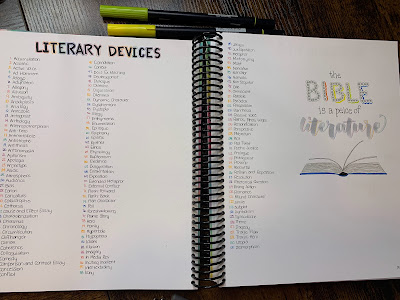
The Bible is an anthology[1]; it is several books, each of which serves a different function, compiled into one larger work. Each book was written at a different time period, and meant to convey a different message. The tone and context varies from book to book, author to author. It's imporant to remember this when reading the Bible. Even more important is the fact that inside each books is a ton of literary devices (e.g., allegories, allusions, archetypes, imagery, metaphors, symbolism, etc.). Recognizing these literary devices can help you understand the Bible on a much deeper level. That is the purpose of this study! Check out a list of literary devices in the image below—throughout the series we're going to touch on a few of these.
References

  1. "Anthology". Merriam Webster Dictionary; visited February 2022

What is the Bible?

9Whom shall he teach knowledge? and whom shall he make to understand doctrine? them that are weaned from the milk, and drawn from the breasts.
10For precept must be upon precept, precept upon precept; line upon line, line upon line; here a little, and there a little: Isaiah 28:9-10 KJV

The Bible, though often thought of as one book, is actually many books by many authors, inspired by one Holy Spirit.

What does Bible even mean?[6]
  • "Bible" is from the Greek biblio
  • It means "The Book"

How many books are in the Bible?
It depends on who you ask...
  • Protestant: 66
  • Eastern Orthodox: 79
  • Catholic: 73
What is the difference between Dueterocannical and Apochyrpha?
definition
apochyrpha[1]
noun
  1. : writings or statements of dubious authenticity
  2. capitalized
    a: books included in the Septuagint and Vulgate but excluded from the Jewish and Protestant canons of the Old Testament
    b: early Christian writings not included in the New Testament
definition
deuterocanonical[2]
adjective
    : of, relating to, or constituting the books of Scripture contained in the Septuagint but not in the Hebrew canon

Why aren't these books in the "standard" Bible?
  • There are lots of references online containing the arguments for or against the apocrypha.[3][4][5] Catholics, Protestants, and Eastern Orthodox Bibles are all slightly different because of this.
  • The primary arguments against them is their exclusion from Hebrew Scriptures and errors found within the texts (suggesting that they are not inspired by the Holy Spirit)
  • Allow the Holy Spirit to discern where they belong in your heart

There are lots of books about Biblical times that are not canon
There are books that may be in the Catholic Bible but not in the Protestant Bible (i.e., 1 Maccabees), but there are also books that are not in anyone's Bible (i.e., The Book of Enoch).[4] Those that fall in to the latter are considered false writings by most scholars. Since I have neither read them in full nor done extensive research on the matter, I cannot say which side of the argument I fall on.

How did we get chapters and verses?
  • The original scriptures didn't have verses or chapters
  • The first Bible with both the modern chapters and verses in each book was printed in the 1500s![7]
  • Even though it is convenient, we should be steadfast in countering scriptures quoted out of context. We should try to quote in context and when studying or being presented with a particular verse, we should always check the context.

Bible verses often taken out of context
  • "It's not what goes in your mouth that defiles you, but what comes out" (Matthew 5)
  • "Slaves obey your master"
  • Relationship between wives and husband (Ephesians 5:22-23)

My people are destroyed for lack of knowledge: because thou hast rejected knowledge, I will also reject thee, that thou shalt be no priest to me: seeing thou hast forgotten the law of thy God, I will also forget thy children.Hosea 4:6 NKJV

References

  1. "Apocrypha". Merriam-Webster; visited May 5, 2020
  2. "Deuterocanonical". Merriam-Webster; visited May 5, 2020
  3. Matt Slick. "Errors in the Apocrypha". Christian Apologetics Research Ministry. February 27, 2018
  4. "What are the Apocrypha and Deuterocanonical Books?" American Bible Society; visited May 5, 2020
  5. "What are the Apocrypha / Deuterocanonical books?". GotQuestions.org; visited May 5, 2020
  6. Jason Soroski. "What Does "Bible" Mean and How Did it Get That Name?". Bible Study Tools. May 31, 2019
  7. Don Stewart. "Why Is the Bible Divided into Chapters and Verses?". Blue Letter Bible; visited May 5, 2020

Illustrated Faith: A $100 Bible?

How much would you pay for a Bible? There's a certain point when companies are just being unreasonable. The price of the Day Spring Illustrating Faith Bible has me questioning the values of the company. I refused to pay that price and decided to make my own.
I was watching youtube video on Bible Journaling, and saw a pretty cool Bible. I followed the links and ended up on the page for Day Spring's Illustrating Faith Bible.[1] Somebody, please explain to me who thought it was a good idea to sell a Bible for $100 and why people are actually buying it. I don't remember the part in the Bible where any of God's prophets charged outrageous amounts of money to hear God's Word, nor do I remember the part where other people in God's kingdom charged or were charged to use their respective gifts. Whoever at Day Spring came up with this price was not just trying to get compensated and make a living, they're down right greedy and to use a phrase I've been using a lot lately, "pimping out Jesus."

How To Do It Yourself

I already make my own journals, so I can say with confidence, that Bible did not cost $100 to make. I would estimate $50-$60 for production, which may justify a price tag of $60-$70 if you must make a profit. How do I know? Because I did the math and made my own.

Printing

The biggest hurdle I had was printing. The Illustrating Faith Bible is 9x9, but I wanted to make mine a little bigger, maybe 10x10 or 11x11 so that I could have bigger print and/or less pages. Unfortunately my printer can't handle a width greater than 8.5. I found two ways to get their size of 9x9 or larger: have it professionally printed or buy a printer that handles larger sizes.

Professional printing, due to the size requirement and sheer number of pages was quoted at $200, which is insane for black and white printing. At that point, you might as well just buy Day Spring's Bible, right?

There are printers that will print these custom sizes, and while they were cheaper than professionally printing the pages, they still had a price tag of over $100. If you're an avid crafter/journal-er, you may already have a printer than can print any size for your pages, which means this isn't a problem for you. If it's something you wish to get into, it may be worth the investment. I decided to scale down and settle for 8.5x8.5 pages, since this is the only project I envision needing this functionality. However, if I had chosen to, say, mass produce Bibles at a custom size, I would have bought a printer and the cost of that printer would be spread out across each unit sold. For example, if the printer cost me $150 and I only make one Bible, I had to spend $150 in printing costs, but if I make 100 Bibles, I only spent $1.50 for each Bible in printing cost.

Of course, printing isn't just the printer being used, but the paper and ink needed, as well. You can get a ream (500 sheets) of standard white paper for anywhere from $15 to $20; I paid $17.49. That works out to about $0.03 per sheet. For the ink, I have a Brother printer that uses toner instead of ink cartridges. I can print roughly 3000 pages with one toner cartridge. The cartridges cost me $80.59, this works out to be a little less than $0.03 per page. Day Spring's Bible has just shy of 1000 pages. Depending on the translation you use (perk of creating it yourself) and the font size you choose, you may need more or less pages. Assuming you ended up with 1000 pages, the paper would cost $15-$20 (remember 1 sheet = 2 pages) and the printing would cost you a little less than $30.00.

You'll notice in the pictures I have, I chose to handwrite the text for my Bible instead of printing the text. I chose this because it helps me memorize scripture and I'm currently in a Bible Study group where we are going through the Bible chapter by chapter. This may not be a feasible solution for most people, which is why I include the estimates for printing the full text.

Cover Page

Day Spring's Bible has faux leather for a cover. I used laminated cardstock and chipboard for mine. I did this because I was in a rush and didn't care about the cover. I couldn't find faux leather exactly, but I did find vinyl covers. You can get them pre-punched for binding, or do it yourself. Once again, bulk pricing is against people who only want one notebook, but for someone who mass produces things (*cough* Day Spring *cough*) or creates journals often, the price isn't too bad. You can get 100 covers for somewhere between $36 and $50 (they may charge a little extra to have the cover cut to the desired size). Worst case, that's $2 per cover sheet and you need 2—one for the front and one for the back. So that's a worst case charge of $4. The laminated cardstock + chipboard cost me about half the price

Binding

Once you have all your pages and your cover, all you have to do is bind it. You could take it to a store like FedEx or Staples to have it bound if you don't have a binding system, or you could do it yourself. Unfortunately, I don't have an estimate for professional binding, because I've been doing my own binding for the past 5 years. I've more than paid off the machine that punches the holes in the paper. I was able to buy 25 2" coils for $44 way back when, but the company I bought them from has since gone out of business. The closest thing I could find to what I have was 100 coils for $300. That would be $3 for the coil compared to the $1.48 I paid. Of course, there are other binding methods (discs, comb, etc.) that could be less expensive.

Total Cost

In total I paid about $50 to create the same product. What agitates me about this price is that I know everything costs less when you buy in bulk, so I know Day Spring could get many of these costs down because they produce mass quantities of similar products. A $50 production cost is on the high end, if an average Joe like me can get create it for the same price. I'm not a professional and I don't have access to the suppliers or the bulk pricing that Day Spring does. Even if we include fancy packaging and foiling in the cost and ignore the better pricing they have access too, the Bible would still only cost $60 to produce. That's $40 of profit for them. That's 60% of the product's value! So you're paying them 160% what the product is worth.

Conclusion

Make no doubt about it, Day Spring is over charging, but creating the Bible yourself is probably problematic if you aren't an avid journal maker and don't already have binding tools on hand. That's what Day Spring is counting on. Of course, at the end of the day, most translations of the Bible are copyrighted (did not realize a man could copyright the Words of God, but #ThisIsAmerica), so printing more than 500 verses may or may not get you into trouble and unless I get in league with publishers for the rights to print the Bible, I can't create a competing product to offer for a cheaper price.

References

  1. "Illustrating Bible". Day Spring; visited December 2019
  2. "Vinyl Binding Covers". Binding101; visited December 2019
  3. Bill Muehlenberg. "The Bible and Copyright Law". Culture Watch. June 23, 2017
  4. "Public Domain"

KJV Only: Does the Translation Matter?

If you've spent much time on this blog you know that I lean toward the King James Version (KJV). You might have also seen posts that talk about the controversy of the various English translations and question of which translation is best. While I've never declared an official side of the argument, I can see how people would assume I support the KJV only side. In a way, I did...

I grew up in a KJV only church; we used to beg to read the New KJV (NKJV) or New International Version (NIV), but that wasn't an option. The first time I saw an NIV in the back of a pew I was in shock. Despite having struggled to read the KJV as a child, by the time I was a teen, I had a preference for the KJV. The Bible I used in high school and college was an NKJV, but I still chose the KJV when looking up verses online. Naturally, when I replaced that Bible, I bought a KJV.

My New Bible With Journaling Margins
This weekend, I decided to buy a journaling Bible—basically a Bible with wide margins so you can take notes in your Bible. They had quite a few, most of which were more like coloring books or playgrounds for doodling than for taking notes. I only found two that were no-frills with wide margins ready for my notes. One was an NIV with microscopic print and the other a Christian Standard Bible (CSB). I'd never even heard of the CSB, but it looked like my only option. Overall, I really liked the design of the Bible and the devotionals spread throughout the pages. The only thing I had reservations about was the translation. I prayed about it and scoured the shelves for another 15 minutes; I just knew a KJV was buried in there somewhere. 30 minutes later, I ceded to the Spirit and made my way to the checkout register with this unknown translation.

Today, while working on a Bible study about the importance of the word and trusting in the scriptures, I reread a verse that really spoke to me.
9But as it is written, Eye hath not seen, nor ear heard, neither have entered into the heart of man, the things which God hath prepared for them that love him. 10But God hath revealed them unto us by his Spirit: for the Spirit searcheth all things, yea, the deep things of God. 11For what man knoweth the things of a man, save the spirit of man which is in him? even so the things of God knoweth no man, but the Spirit of God. 12Now we have received, not the spirit of the world, but the spirit which is of God; that we might know the things that are freely given to us of God. 13Which things also we speak, not in the words which man's wisdom teacheth, but which the Holy Ghost teacheth; comparing spiritual things with spiritual. 14But the natural man receiveth not the things of the Spirit of God: for they are foolishness unto him: neither can he know them, because they are spiritually discerned.1 Corinthians 2:9-14 KJV

At the end of the day, the translation is only as pure as the heart who reads it. When we read of our own understanding and our own knowledge, we're bound to misinterpret things. We need the Holy Spirit to do the interpreting. Since the Holy Spirit wrote the text, the Holy Spirit can get us the message regardless of the translation. Obviously, I'm not telling you to go out and by a Chinese Bible if you don't speak Chinese (though all things are possible through Christ), and I do believe there are some texts that are severely flawed.[1] However, I think if you surrender to the Spirit every time you pick up your Bible to study, He will give you the right interpretation.

As for this new translation I'm reading, I don't hate it. There have been a few verses I thought didn't sound right that I cross-referenced with my KJV. I was still able to get the meaning of the text and the differences weren't too very drastic (so far). Cross-referencing verses with other translations is always a good idea, though—even for the KJV.
Another View

References

  1. Chenxin Jiang. "Rewriting the Biblical 'Curse' on Womankind. The Atlantic. November 20, 2016

The Devil's Confusion

Let me get this straight: you believe in God and Jesus, but you don't believe in the Bible? Confused much?

Introduction

The thing about reading the Bible is there's so much to consider: language, assumptions, culture, etc. People can read Genesis 3 multiple times back to back and still come away thinking Adam and Eve ate an apple. Why? Because it's been engrained in their mind. So, when they read "she took of the fruit thereof, and did eat," they consider that proof that an apple was eaten, despite the fact no apple was mentioned. When I read, I like to see what different commentators say, I like to see what different denominations think, and I like to look at the history behind what I'm reading (if I could read Hebrew, I'd want to read the original too). I want to shake my mind of preconceived notions that are not Biblical.

One of those notions that I'm currently investigating is how the word "Gentile" is defined. One of the things that stayed with me after I moved on from Deuteronomy 28 and investigating the Black Israelite Theory/Movement, was the allegation that descendants of Ham are not Gentiles. Naturally, I started to do some digging which brought me to the most bizarrely interesting article and comment section.

A Bizarre Post

First, there's the issue of the question "who are the Gentiles?" which I will discuss in the next post. The article tries to answer that question which is why I started reading it in the first place. The article didn't really answer all my questions, but I thought perhaps I missed some view points, so I checked the comment section to see what other people gleaned from the text.

As I ventured in to the comments, I discovered that the author kept saying weird phrases like "God or his Christ" or putting The Bible in quotations. Then he said "I do not view what is called “Scriptures” or the “Epistles” as truth." Yet, he continued to quote from the Bible and later affirmed that he believed in Jesus. So I kept asking myself, how does one believe in Jesus but not the Bible? I mean, how would you confirm that He is the Messiah? How would you even know there was a Messiah to look for? Unless God is speaking directly to this man and revealing the truth, I don't know how he would figure out this information. Even so, how would you know if God was speaking or the devil?

For some reason, I kept reading. Perhaps God wanted me to get to a particular comment, or maybe I was just mystified by the confusion, but eventually he said something that sort of made sense.

A comment from the author "explaining" his view of the Bible (transcribed below)
Good question. Thank you for asking as it will give me an opportunity to explain.

No, I do not believe “The Bible” as “The Word of God.” I believe that Jesus is “The Word of God.”

Everything written in this book – The Bible – is not from God (The Word of God). Satan is quoted in it; are Satan’s words the Word of God? Of course not.

Only those things that God Himself utters and what Christ utters is “The Word of God.” Not a book.

I am attempting to reach my readers to help them see what has happened subtly over the years: A book has been elevated to a lofty position that it should not have. It cannot be “The Word of God” and Jesus also be “The Word of God.”

What I am saying here is that we are to believe in Christ, not in a book. (Luke 9:35)

Yes, this book called by men “The Bible” does contain things that God and Christ said. It contains things that Christ taught his Apostles. But that does not make the book itself the Word of God and something we are supposed to venerate and believe in. We are to believe in Christ, not believe in The Bible.

Also, I quote from the Bible not for my sake, but for the sake of those who insist on “believing in it.” I usually quote that which Christ and God has spoken.

Notice that I NEVER say things like, “The Bible teaches” or “The Bible says.” The Bible does not teach, Christ teaches.
I had an individual say to me that “The Bible says” at John 14:6 that Jesus is the way, the truth and the life.

I explained to the individual that the Bible does not say that. He became upset at me and opened up his Bible and showed be John 14:6 and read it to me. He said to me, “You see, it does say that.”

I said, “No it does not say that.” He thought I was crazy and really became very agitated at me.

Then I explained to him that “The Bible” does not say that, Jesus Christ says it.

My point is that so many ascribe to a book (that men named, made holy, authorized and call The Word of God) the things that Christ himself says.

That shows that they believe in the Bible and not in Christ. If one truly believes in Christ, they would NEVER ascribe to a book the things that he says. When they ascribe to a book (The Bible) the sayings and teachings of Christ, then they reduce him down to someone other than The Word of God – the ONLY Word of God.

No book by any name should occupy such a holy station. The title of “The Word of God” belongs only to Christ, not to a book.

It was the Son of God that God sent, not a book. And it was to that Son, that God commanded us to listen to. Not to a book. (Luke 9:35)

We access God’s vast knowledge, wisdom and understanding not through a book, but through His Son via prayer.

If we think God speaks to us through a book, then we are saying that what Christ taught at John 14:6 is a lie. The Bible would be “that way.” It cannot be as Christ is only “the way.”

We are to believe in “a person” (Christ) not a book.

Many defend the book more than championing Christ as the ONLY Word of God. R. Jerome Harris

Playing With Words

I believe the author is playing with words; he wants people to put their faith in Jesus as opposed to worship a book, or so it seems. To an extent, I understand where he's going. We shouldn't get so caught up in the Bible that we forget about God. An example is that growing up, my grandmother used to sleep with a Bible under her pillow, she said it kept away bad dreams. My mom always insists a Bible should be the first thing brought in to a new home/apartment. These ideas are superstitious at best (which isn't a trait God promotes), but idolatry at worst. The Bible has become an "image" of God, and you are no longer seeing the power of God, but assuming the power is in an object. The Bible cannot protect you from nightmares, only God can.

At the same time, while I am guilty of saying the Word (which should refer to Jesus) but meaning the word (referring to the Bible), there is a still a level of belief that has to be given to the Bible. If the Bible is merely a book, like the Qur'an or the Vedas, or Harry Potter, how do you come by the Gospel of Jesus, or the establishment of God? To discredit the Bible is make yourself a theist. Based on this man's logic, the 10 Commandments are the words of Moses that are attributed to God and they may or may not be trustworthy. With his logic that people may have tampered with the Bible (which many translations have been tampered with), people can pick and chose what they want to believe whenever they want (likely based on personal preference). This is exactly how the church operates. You have scores of people who profess to believe in Jesus, but doubt the Bible. They believe in evolution over creation, that things considered sin in the Bible (premarital sex, homosexuality, lying, breaking the Sabbath, failing to help the less fortunate, etc.) are not really sins. People elevate the preacher's word over the words of the Bible (despite Jesus warning us of false prophets and false doctrines).

The Issue of False Doctrines

How do I know there are false doctrines and prophets? Aside from people drinking the kool-aid only to end up dead, the Bible quotes Jesus as telling us this. If we say the Bible is not the source for which we study the Word of God, then you could assume that every doctrine is valid; the only way a doctrine would become invalid is if God Himself told you. Of course, the truth is, the devil can talk to you too, so you would never know if it was God telling you this, or if it was the devil.

I agree that you should be cautious of which translation you are reading. There are many translations that conflict upon each other (a comparison of the KJV vs. the NIV can be seen here). Which version is right is an ongoing debate. Personally, I wish I'd taken ancient Hebrew and ancient Greek for my foreign languages instead of Spanish and Arabic (this might be a task I take on in the near future). Is it possible that they all have errors? Is it possible that the true message is split across multiple translations? Is it possible that some Bibles were created to water down the message and to deceive? I think the answer to all of these is yes. You should not blindly read translations without studying this controversy. There are people who are for the King James Version (KJV) only, there are people who believe some versions are safe while others aren't and there are people who think all versions are fine. This is a topic for a post by itself, I'm just introducing it to validate the author's point that we should be some what skeptical when reading.

However, you have to pick a side. Either you have a preferred translation, you think all translations are fine, or you think no translation is fine. If you think no translation is fine, you have taken off a piece of armor. The first step to not believing in God is not believing in the Bible. The Bible witnesses the testimony of God and Jesus. You are given the history, background information, prophecies, as well as direct teachings in the Bible's pages, but the moment you distrust the validity of the book, you distrust the validity of the people in the book, including God and Jesus.

The Author of Confusion

This ideology has the devil written all over it. It's confusion at its finest. The devil convinces people to turn away from the Bible. It's a 2-step program; first wean them from the source of the truth, then snatch them from God. Once you no longer cite the Bible as truth, but claim to believe in the God of the Bible and His Son, how can you ward off false prophets? How do you defend your belief? Jesus quoted Deuteronomy to shut down the devil's attempt at temptation multiple times. What will you quote?

Becoming closer to God is about a whole lot more than simply going to church or praying. Think of it like this. I could talk to you for hours upon hours, but if I never stopped to listen to you, what have I learned about you? God already knows everything about us, so in a one sided conversation, we're selling ourselves short. Reading the written word that He's left for us, allows us a glimpse at what He's trying to tell us; it gives us a template for His voice so that when we do hear Him speak, we know it's Him and not the devil (important distinction). For those on the path of truly studying God's Word, please don't fall for the devil's confusion.
Top

Finding the Right Bible

The seventh testimony is about finding the right Bible to facilitate my connection with God.
I have a ton of Bibles; I guess that's to be expected considering I come from a religious family and was raised in the church. Yet, when I look on the shelf and see all these Bibles, there's a story there. (Disclaimer, I'm talking about my personal Bibles; I'm not including the family Bible or my parent's Bibles...).

3 of the 4 Bibles I have with me in Graduate School.
The first Bible I received was from my Aunt when I was in Elementary school. I remember, it contained illustrations akin to a Precious Moments Bible—perhaps it is a Precious Moments Bible, forgive me it's at my parents' house so it's not handy for me to double check. The text was probably the New International Version (NIV), which annoyed me because I grew up in a church that only read the King James Version (KJV). Even more so, the pictures were completely inaccurate, not that I was consciously aware of that as a child, but now when I look back at the blonde haired, blue eyed depictions of everyone in the Bible I can only roll my eyes. What I did glean from this Bible was a two page spread that contained a timeline of the books and a color coded scheme to identify the books of history versus the minor prophets versus the major prophets, etc. This is what I call my introduction Bible. I would refer to that two page spread for years after, even though I never really used that Bible as a reading Bible.

A glimpse inside the Extreme Teen Bible
Shortly after my cousin (the one I mentioned in my post on Youth Ministries) bought me a simpler Bible. It was a KJV Bible with no frills, just text. This is the Bible I used as a reading Bible until I started high school. At the start of high school, one of my mom's coworkers bought me my first study Bible. I have no idea why she decided to buy me a Bible; I consider this yet another intervention by God's hand because this was one of the key turning points in how I studied the Word. This Bible was called the Extreme Teen Bible. As the title implies, it is geared toward teens and helping teens connect with the text. There are breakout bubbles that provide the reader with additional information on the time period, culture, or area of passages, articles highlighting the actions of God's people. Another feature is a FAQ section pertaining to teenage life questions. Each answer is a particular Bible verse and on the page that the Bible Verse is located, the question is highlighted to the side. I used this Bible all the way through college and although you can't tell in the picture above, I did a bit of sticky noting and marking of pages over the years—there are even notes and church handouts still tucked between pages.

When I graduated from undergrad, one of my good friends bought me a personalized Bible (probably because I looked a bit childish carrying around an Extreme Teen Bible at 21 years old). This Bible was much like the Bible my cousin had given me years before—no frills, just text with the occasional note on possible translation errors or clarifications. I was appreciative, but I missed my study Bible. Also, this was around the era that smart phones and tablets were becoming standard. So during my graduate school years I ended up with a digital Bible. It was nice because I could search the text, it wasn't heavy, and the app let me choose favorite passages or take notes during sermons. I stuck with that until this past Summer. This digital Bible is the 4th Bible that isn't pictured above.

Is it not amazing that from Moses to Jesus even up until the years before the reformation, only certain people had access to God's Word. They had to rely on priests to orate the verses (which more often than not probably was more of a summarization than an exact reading). Today, I can carry His Word with me in my pocket everywhere I go. I can search for occurrences of words, phrases, people, and places; I can share the verses online, and people can access it across the world! How awesome is that?

And this gospel of the kingdom shall be preached in all the world for a witness unto all nations; and then shall the end come.Matthew 24:14 KJV
Sample features of the Holman KJV Study Bible
But back to the topic of the post! This Summer I found the Holman KJV study Bible. It's the culmination of all the Bibles I've used before and I LOVE it. It has pictures like the first Bible, though these pictures are more accurate and more often visualizations of terrain or objects like the Ark of the Covenant instead of people. It also has a timeline at the beginning of each book. There are charts and tables that summarize information and cross referencing notes in the margins to help you locate other verses on the same topic. Maps are available for visualizing locations and routes mentioned. Introductory essays accompany each book discussing who wrote the book, when the book was written, the motivations of the book, as well as the intended audience and influence of the book on the Bible as a whole. Further, there are separate essays throughout the book on various topics. It is an epic study Bible. I'm really thankful God led me down the right aisle to find it sandwiched between thousands of other Bibles.

It seems, as with all things, God knew how to get my attention and keep it. He started me off small, a little extra information to remind me to put His Words in the right perspective. He kept feeding me a little more until here I am, a dedicated Bible studier keeping a blog on His Word. Left to my own devices, I never would have thought to purchase a study Bible—I didn't even know the little notes at the bottom of the church Bibles were telling me alternate translations until a history of the Old Testament class I took my senior year. Finding the right Bible isn't easy when there are thousands out there. To top it off many of the new translations are contested in their validity[1][2][3][4]. So, my seventh testimony is that God blessed me to be alive in an era where the Bible is freely accessible, allowed me to see how different Bibles can effect your ability to connect with His Word, and finally brought His Word to me bundled with the perfect study tools.

References

  1. "NIV Exposed". JesusIsSavior.com. 2015
  2. Matto, Ken. "The Revised Standard Version Exposed!". 2015
  3. "Fellow Christians - Beware of these 'bibles'". Bible Probe. 2015
  4. Melton, James L. "The KJV 1611 vs. The New Translations". BibleBelievers.com. 2015

Forming the Bible Cannon

How did we decide which books were inspired and meant to be in the Bible?

Introduction

In most Protestant Bibles, There are 39 books in the Old Testament and 27 books in the New Testament. The Catholic Bible also includes the Apocrypha, which contains an additional 15 books. Then there are the Gnostic writings known as the codices, which were found in Nag Hammadi. With so many texts floating around how did they know what was supposed to be included and what wasn't?
Top

The Old Testament

There are two versions of the old testament—the original Hebrew which does not include the Apocrypha, and the Greek translation which does contain the Apocrypha[5]. By the time of Jesus, there was an accepted canon of which Jesus frequently quotes[1][2]. Jesus also confirms the Old Testament by referencing the three divisions of the Old Testament in Luke 24:44. BiblicalTraining.org has a thorough article on the canonization of the old testament which can be found here. Many discoveries concerning the Old Testament stem from the archeological find of the Dead Sea Scrolls
Top

The New Testament

The New Testament is much more complicated in terms of how the cannon was determined. Jesus confirmed the books of the Old Testament by fulfilling prophecies, quoting the scripture, and not condemning the books. If there was a problem or forgery in the Old Testament, Jesus would have called the Pharisees out on this error (after all He called them out on many other misguided practices). However, we don't have that luxury for the New Testament. In addition to Matthew, Mark, Luke, and John, there are has also been found gospels attributed to Mary Magdalene, Peter, James, Thomas, and others[3]. How did people determine which should be included and which should not? Also, how do we know they chose the right books? Bible.org gives an overview on the canonization of the New (and Old) Testament in the article The Bible: The Holy Canon of Scripture. Most believers use the following criteria to confirm scripture as canon: Authorship, Witness of the Spirit, and Acceptance[4]. Prayer and relationship with God is the only way to know for sure what is right. The best covering of this topic I've found can be found in the article entitled "How Do You Know that the Bible is Divinely Inspired."
Top

The Apocrypha

Coming Soon!
Top

Gnostic Writings

Coming Soon!
Top

Current Books Considered Canon

The following table lists the books currently considered to be inspired by some (or all) denominations within Christianity.

Old Testament Canon

  1. Genesis
  2. Exodus
  3. Numbers
  4. Deuteronomy
  5. Leviticus
  6. Joshua
  7. Judges
  8. Ruth
  9. 1 Samuel
  10. 2 Samuel
  11. 1 Kings
  12. 2 Kings
  13. 1 Chronicles
  14. 2 Chronicles
  15. Ezra
  16. Nehemiah
  17. Ester
  18. Job
  19. Proverbs
  20. Psalms
  21. Ecclesiastes
  22. Song of Solomon
  23. Isaiah
  24. Jeremiah
  25. Lamentations
  26. Ezekiel
  27. Daniel
  28. Hosea
  29. Joel
  30. Amos
  31. Obadiah
  32. Jonah
  33. Micah
  34. Nahum
  35. Habakkuk
  36. Zephaniah
  37. Haggai
  38. Zechariah
  39. Malachi

New Testament Canon

  1. Matthew
  2. Mark
  3. Luke
  4. John
  5. Acts
  6. Romans
  7. 1 Corinthians
  8. 2 Corinthians
  9. Galatians
  10. Ephesians
  11. Philippians
  12. Colossians
  13. 1 Thessalonians
  14. 2 Thessalonians
  15. 1 Timothy
  16. 2 Timothy
  17. Titus
  18. Philemon
  19. Hebrews
  20. James
  21. 1 Peter
  22. 2 Peter
  23. 1 John
  24. 2 John
  25. 3 John
  26. Jude
  27. Revelation

Apocrypha

  1. 1 Esdras
  2. 2 Esdras
  3. Tobit
  4. Judith
  5. The Additions to the Book of Esther
  6. Wisdom of Solomon
  7. Sirach
  8. Baruch
  9. Story of Susanna
  10. The Song of Three Children
  11. The Story of Bel and the Dragon
  12. The Prayer of Manasseh
  13. 1 Macabees
  14. 2 Macabees

Top

References

  1. Robinson, Rich. "Jesus' References to Old Testament Scriptures". Jews for Jesus. September 2008
  2. "The Canon of the Old Testament". BibleScripture.net. 2015
  3. "Noncanonical Literature-Gospels". Wesley Center Online. Northwest Nazarene University. 2011
  4. The Canon of Scripture. BlueLetterBible.org. 2015
  5. McDowell, Josh. "What is the Apocrypha? Why Aren’t These Books Found in the Protestant Bible?". Josh.org. 2014
Top

DON'T MISS

Book Review,Food,Testimony
© 2022 all rights reserved
made with by templateszoo