Showing posts with label Season 4. Show all posts

Poetic Justice in the Bible

Poetic justice is the thing we all love to see, let's discover why its so satisfying and how it's used in the Word of God
Poetic justice is "an outcome in which vice is punished and virtue rewarded usually in a manner peculiarly or ironically appropriate."[1] Essentially poetic justice is what someone gets what they deserve. We love to see this because it's the neat ending we alway want to see: we want to see the good guy lifted up and the bad guy punished. The first secular example that came to my mind while I was studying this topic was Ever After, a realistic version of Cinderella. In Ever After, the stepmother forces Cinderella into servant hood and mistreats her, but in the end Cinderella is married to the prince and the stepmother is forced to become a servant.

Biblical Examples

Jacob & Esau Jacob tricks Isaac into giving him Esau's blessing; Laban tricks Jacob into 14 years of work and marrying the wrong daughter
Death of the FirstbornsPharaoh has Israelite children killed; God punishes Egypt by killing the firstborns in the final plague
EstherHaman tries to get Mordecai and the Jews killed; Mordecai is exalted and Haman is killed
The Whole BibleThe whole purpose of the Bible is the concept of the righteous gaining paradise and the serpent who took it from us being cast out forever

References

  1. "Poetic Justice". Merriam Webster Dictionary; visited May 2022

Allegory in the Bible

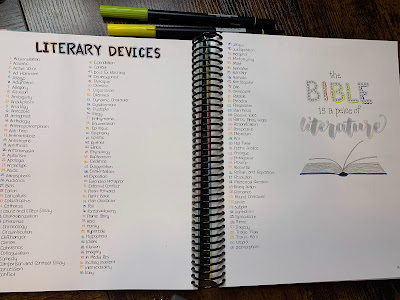
Sometimes a rose isn't just a rose, a woman isn't just a woman and a passage in the Bible is actually illustrating a larger theme or event in the text.
I used to hate when my teacher told me a rose wasn't just a rose. I didn't trust that she knew what the author was thinking and didn't understand the point of guessing outside of what was explicitly written. As I've grown over the years, I've learn to appreciate hidden meanings in texts a lot more. In the Bible, a lot of the individual stories are allegories for larger themes. One of the biggest clues to helping me find these allegories can be found in Jeremiah 6:2. In this verse, we are explicitly told a woman symbolizes God's holy city was really is His holy people. In the New Testament, you see confirmation of this when the Church constantly being refered to as "the Bride of Christ." When I started plugging "the Church" in for women in Biblical narratives, a whole new layer started to unravel for me. Below are just a few examples of allegory in the Bible. Can you come up with more?
Passage Allegory
The Book of Esther Represents the transition of the Old Covenant into the New Covenant and redemption of God's people
  • King Ahauserus --> God
  • Queen Vashti --> Israel in rebellion
  • Esther --> The New Testament Church
  • Haman --> Satan
  • Purim --> The Marriage Supper of the Lamb to the Church
The Fall of Man Represents Christ coming to earth as a man to suffer to save the Church
  • Adam --> Christ (notably Christ doesn't sin as Adam did)
  • Eve --> the Church
  • Eden --> Heaven/Paradise
The Feast Days Represents the mission of Christ
  • Passover (Salvation from Egypt) --> Crucifixion (Salvation from sin)
  • Feast of Unleavened Bread (Firstfruits) --> The resurrected dead + Christ (Matthew 27:50-53)
  • Pentacost (Giving of the law) --> Receiving the Holy Spirit
  • Feast of Trumpets --> Warnings of Christ's second return (Matthew 24; Revelation 8-11)
  • Day of Atonement (High Priest redeems Israel for their sacrifice) --> The sealing of the saints in Revelation
  • Feast of Tabernacles (commemorates when God dwelt with Israel during their 40 years) --> Living in paradise in union with the Most High/The Millenium

References

  1. "Allegory". Merriam Webster Dictionary; visited March 2022

Are You A Christian?

Do you identify yourself as Christian? What does it mean to you? Better yet, what does it mean to others?
15“Beware of the false prophets! They come to you wearing sheep’s clothing, but underneath they are hungry wolves! 16You will recognize them by their fruit. Can people pick grapes from thorn bushes, or figs from thistles? 17Likewise, every healthy tree produces good fruit, but a poor tree produces bad fruit. 18A healthy tree cannot bear bad fruit, or a poor tree good fruit. 19 Any tree that does not produce good fruit is cut down and thrown in the fire! 20So you will recognize them by their fruit. Matthew 7:15-20 CJB

What does it tell you if I call myself a Christian? How much of what you think is tells you is assumption versus Biblical fact and further, how much of that Biblical fact am I actually following?

Identifying As A Christian

I find it difficult to identify as a Christian because it doesn't mean the same thing to everybody. Technically, it means "follower of Christ," which means it should be applied to someone who follows the teachings of the Messiah. However, many people claim the title without following the teachings of Christ—a large number of Christian get their sole teachings from a pastor not the scriptures and therefore don't actually know the teachings of Christ. Yet still, even for those of following the teachings, there are many things people disagree on which means following the teachings of Christ can look different. The person hearing me identify as a Christian defines what he/she believes that means and that may or may not be what I mean.

By The Fruit

Matthew 7 tells us a true prophet is known by the fruit; this applies to disciples too. Anyone can call themselves a Christian but it is the fruit of the Spirit that proves us to be His. My grandfather used to say "let the deeds I've done speak for me." That's how I identify: "let the fruit I bear, speak for me."

DON'T MISS

Book Review,Food,Testimony
© 2022 all rights reserved
made with by templateszoo